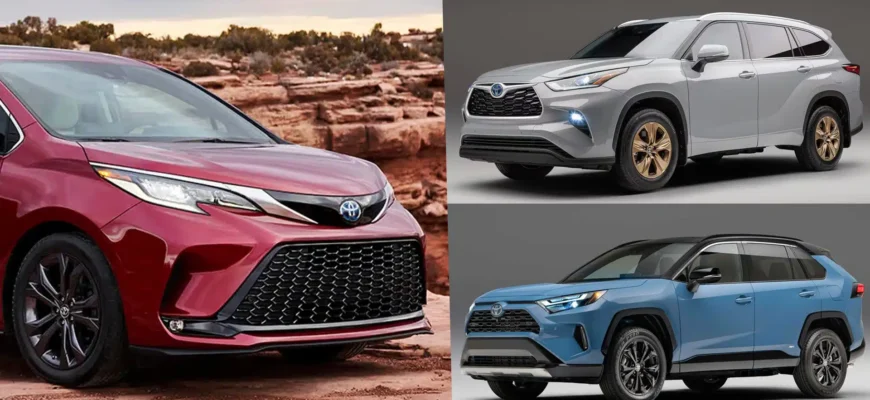
Toyota from China: A Complete Guide to Buying, Russification and Operation
Why Toyota from China?
The growing popularity of Chinese Toyota in the Russian market
After the departure of official representative offices from Russia in 2022, Russian motorists faced a shortage of high-quality Japanese cars. The Chinese market has been a lifesaver for Toyota fans, offering a wide variety of models at affordable prices. In 2024-2025, there has been a steady increase in parallel imports, with Toyota from China occupying a significant share among imported cars.
China is the largest car market for Toyota, where the company operates nine factories in Tianjin, Guangzhou and Chengdu. The joint ventures between GAC Toyota and FAW Toyota produce a full lineup, from compact sedans to premium SUVs.
Main advantages: accessibility, modern equipment, favorable price
The appeal of Chinese Toyotas lies in three key factors. The first is significant savings, reaching 25-30% compared to official dealers or stock balances. The second is rich equipment even in basic configurations, including adaptive cruise control, surround view cameras, and modern multimedia systems. The third is the availability of new cars with minimal mileage, which is important in the face of a shortage of official supplies.
Debunking myths about build quality - personal experience of owners
A common misconception about the low quality of Chinese assembly is refuted by real operating experience. The owners note that the quality is not inferior to the Russian and Japanese assembly. One of the owners of a 2025 RAV4 assembled in China shares his impressions: "the build quality is not inferior to Russian and Japanese, there are no squeaks, the plastic is of high quality." Another car owner confirms: "the suspension is softer and works better than that of the Russian assembly."
Japanese manufacturers strictly control the processes in Chinese factories. Toyota's Guangzhou plant operates on the Toyota Way system, where each part undergoes a multi-stage inspection. In 2022, the Corolla assembled in China received 4.8 out of 5 points in the J.D. Power Asia reliability rating.
1. Model range and configurations
1.1. Popular Toyota Models in the Chinese Market
Toyota RAV4 — prices starting at $29,690
The Chinese-built RAV4 comes in several trim levels, from the Urban Edition to the flagship Adventure Ultimate Edition. The standard equipment is equipped with a two-liter gasoline engine with a capacity of 171 hp, paired with a CVT variator. The all-wheel drive versions are additionally available with a hybrid powertrain with 220 hp.
The Adventure Plus package includes a 360-degree camera, adaptive cruise control, lane keeping and all-wheel drive. The turnkey price in Russia is from 3.44 million rubles, which is noticeably more profitable than analogues.
Toyota Corolla Cross is a compact crossover with a hybrid installation
The Corolla Cross is offered in seven trim levels, starting with the Pioneer Edition for $28,700. The basic version is equipped with a two-liter naturally aspirated engine with 171 hp. with a CVT. The dimensions of the compact crossover are 4460 mm long, 1825 mm wide and 1620 mm high with a wheelbase of 2640 mm.
Fuel consumption in the combined cycle is only 5.9 l/100 km, which makes the model economical to operate. Top-of-the-line trim levels offer a panoramic camera, LED optics, an electric trunk and decorative interior lighting.
Toyota Highlander is a seven-seater premium SUV
The Chinese-built Highlander (also known as the Crown Lufang) is a full-size, seven-seater SUV with a hybrid powertrain. The base price starts at $27,979, and the top trim will cost $39,323. The 2.5-liter engine in combination with an electric motor develops a total power of 189-220 hp.
Owners note the spacious interior, soft suspension and low fuel consumption - about 5.23-7.4 l/100 km.
Toyota Levin is a budget sedan with excellent economy
Levin is a localized version of the Corolla for the Chinese market with its own design. The sedan is offered with a 1.2-liter turbo engine (116 hp) and a 2.0-liter hybrid installation (169 hp). Prices start at 149,800 yuan (about 1.89 million rubles).
The hybrid version demonstrates an impressive fuel consumption of only 4.07 l/100 km on the WLTC cycle. The dimensions are 4695x1780x1435 mm with a wheelbase of 2750 mm.
Toyota Crown is a flagship model with premium equipment
The Crown assembled in China is positioned as an executive sedan of class D. The car is equipped with a two-liter turbo engine with a capacity of 235 hp. with an eight-speed automatic and rear-wheel drive. The length of the sedan reaches 5020 mm with a wheelbase of 2925 mm.
The model features a luxurious interior, independent multi-link rear suspension and rich equipment. The top speed is 230 km/h and fuel consumption of 7.4 l/100 km.
Toyota Alphard is a luxury minivan
The Alphard is Toyota's flagship minivan that offers the ultimate level of comfort. The seven- or eight-seater cabin is equipped with leather trim, captain's chairs with massage, panoramic roof and entertainment system. A 3.5-liter engine with 275 hp or a hybrid installation ensures dynamic driving.
The owners call Alphard a "mobile office" and "apartment on wheels" for its unrivaled level of comfort. The main disadvantage is the high price, starting from 3.5-4.3 million rubles.
Toyota Harrier is a stylish SUV of the crossover type
The Harrier is a mid-size premium crossover with a sleek, coupe-like design. The base version is equipped with a two-liter engine with a capacity of 171 hp, the top version is equipped with a 2.5-liter hybrid installation with a capacity of 178 hp. Dimensions: 4755x1855x1660 mm with a wheelbase of 2690 mm.
Prices in China start at 211,800 yuan (about 2.57 million rubles). Fuel consumption is 6.57 l/100 km for the petrol version.
1.2. Comparison Table of the Main Models
| Model | Price (USD) | Engine Type | Fuel consumption | Features |
|---|---|---|---|---|
| RAV4 | $29,690 | Gasoline/hybrid | 5.2-8.0 l/100km | All-wheel drive, 360° camera |
| Corolla Cross | $28,700 | Petrol | 5.9 l/100km | Compact size |
| Highlander | $27,979 | Gasoline/hybrid | 5.23-7.4 l/100km | 7 seats, premium cabin |
| Levin | $18,900 | Gasoline/hybrid | 4.07-5.6 l/100km | Economy |
| Crown | $15,992 | Gasoline turbo | 7.4 l/100km | Rear-wheel drive, 235 hp |
| Alphard | from $35,000 | Gasoline/hybrid | 9.3 l/100km | Luxury Minivan |
| Harrier | $25,570 | Gasoline/hybrid | 6,57 l/100km | Stylish design |
2. Purchase and Shipping Process
2.1. Search and selection of a car
Work with trusted intermediaries and exporters
Buying a car from China requires interaction with reliable intermediaries. Specialized companies such as Eauto Export, CarHao, Myron Cars, VitMotor offer full transaction support from selection to delivery. It is important to choose companies with an exporter license and direct contracts with factories.
When choosing an intermediary, pay attention to the presence of an official contract with a fixed price, a money-back guarantee and a transparent scheme of work. Professional companies provide a personal manager and legal support at all stages.
Checking VIN and Vehicle History
Before buying, a thorough check of the technical condition is necessary. Experienced intermediaries organize an on-site inspection of the car, checking the mileage, the condition of the engine, body and other elements. For used cars, a full diagnosis is carried out on 258 points and a forensic check.
Checking the VIN number allows you to get the history of operation, participation in an accident, and the number of owners. Chinese services like Tianyancha help verify the trustworthiness of the seller.
Coordination of equipment and additional options
It is important to clearly define the desired configuration, taking into account the characteristics of the Chinese market. Chinese versions of Toyota often have elongated bodies, additional electronic options, and improved noise insulation compared to global versions. At the same time, some winter options such as heated steering wheel or seats may be missing.
The intermediary helps to choose the optimal configuration, taking into account the budget and wishes of the client, agrees on the color of the body and additional equipment.
2.2. Organization of purchase and delivery
Conclusion of the contract and payment of the invoice
After choosing a car, an agency agreement is concluded, which prescribes the stages of payment, delivery times and mutual obligations. The standard scheme involves making a 10% prepayment for booking, after which a VIN number is provided. Then the full cost of the car is paid with delivery by invoice.
Payment is made through payment agents who convert rubles into yuan and document the payment for currency control and customs. The term for crediting non-cash funds is 7-8 business days.
Estimated timeframe: 28-42 days from payment to receipt
The full cycle from payment to receipt of the car takes from 28 to 60 days, depending on the delivery method. The stages include: delivery by the dealer to the consolidation point (3-7 days), registration of an export permit (12-14 days), transportation to the border (10-40 days), customs clearance (2-3 days), delivery to the recipient's city (7-8 days).
Sea transportation takes 25-40 days and costs from $2500, rail — 15-30 days from $3800, car transporter — 10-20 days from $4500. If the car is not available at the dealer, the order at the factory adds 3 weeks to the timing.
Shipping and customs clearance costs
The total cost consists of the price of the car, logistics, customs payments and intermediary services. Logistics in China to the border costs 15,000 yuan (about 170,000 rubles), export costs are 8400 yuan (95,000 rubles).
The customs duty is 48% of the invoice value for individuals, the recycling fee is 3400 rubles for cars up to 3 years old. The intermediary's commission is from 50,000 to 215,000 rubles, depending on the cost of the car.
Real example: RAV4 Adventure+ 2025 — 3,440,000 rubles on a turnkey basis
The specific calculation for the 2025 Toyota RAV4 Adventure Plus shows the transparency of pricing. The cost of a car in China is about 204,800 yuan (2.42 million rubles), logistics is 170,000 rubles, customs duty is 1.11 million rubles, brokerage services and clearance are 120,000 rubles, commission is 215,000 rubles, delivery to Moscow is 190,000 rubles. Total: 4.34 million rubles at the exchange rate, but taking into account discounts, the real price was 3.44 million rubles on a turnkey basis.
2.3. Customs Clearance and Registration
Required Documents and Procedures
A full package of documents is required for customs clearance. A purchase and sale agreement or invoice, technical passport of the car, buyer's passport, SNILS, TIN on the form, payment of the deposit at customs if necessary, are required. In addition, you need a design safety certificate (SBKTS), documents for ERA-GLONASS for legal entities, receipts for payment of duties and fees.
The customs clearance procedure takes from one to three days if all the documents are in order. The inspector checks the accuracy of the declaration data, the car is inspected at a special site, after which an electronic PTS is issued.
Calculation of customs payments and utilization fee
Customs payments for individuals are calculated according to the formula: 48% of the invoice value plus the utilization fee. For cars under 3 years old, the recycling fee is 3400 rubles, over 3 years old - 5200 rubles. The customs fee for clearance is from 775 to 100,000 rubles, depending on the value of the car.
For electric vehicles, there is a preferential duty rate of 10-15% instead of 48%, which makes their import much more profitable. VAT 20% is paid only by legal entities.
Features of registration with the traffic police
After receiving an electronic title certificate, the car is ready for registration with the traffic police. The state fee for registration is from 850 rubles. For legal entities, it is mandatory to install the ERA-GLONASS system at a cost of 25,000-45,000 rubles and issue the appropriate certificate. Individuals do not need to install ERA-GLONASS until 2027 according to the current moratorium.
3. Russification and adaptation
3.1. What is subject to Russification?
OEM multimedia system
Chinese versions of Toyota come with Chinese-language multimedia systems, which creates serious inconvenience for Russian owners. The interface, the settings menu, the voice assistant — everything is displayed in hieroglyphs, making it almost impossible to control the system without knowing Chinese.
Instrument panel and on-board computer
The dashboard also requires translation into Russian. This includes an information display between instruments, warning messages, climate control settings and other functions of the on-board computer.
Navigation system
Standard navigation in Chinese cars works only with Chinese maps and does not support Russian navigation services. After Russification, it becomes possible to install Yandex.Navigator, 2GIS, Google Maps and other familiar applications.
Voice assistant
Voice control in the Chinese version is set to Chinese only. Russification allows you to use voice commands in Russian for calls, navigation, and music control.
3.2. Professional Russification
Contacting specialized services (for example, Tao-Bao.KZ)
Professional Russification is carried out by specialized service centers that have experience working with Chinese Toyota. In Moscow and St. Petersburg, there are companies like Connect Service Car, Alarm Store, JDM Motors, offering a full range of services.
Specialists use specialized equipment and original software for safe reflashing of systems. The work is carried out with the preservation of all functions of the car and does not affect the warranty obligations.
Work execution time: from 3 hours to 1 working day
The Russification process takes from several hours to one working day. It depends on the model of the car and the amount of work. Basic Russification of multimedia is completed in 3-4 hours, full adaptation with the installation of additional applications may take a whole day.
Preservation of all functions and guarantees
Professional Russification retains all the factory functions of the car. All driver assistance systems, cameras, parking sensors, climate control are working. It is important that Russification does not block over-the-air (OTA) updates that continue to come from the manufacturer.
Cost of the service: from 10,000 to 30,000 rubles
Prices for Russification vary depending on the model and the amount of work. Basic Russification of a multimedia system costs from 10,000 to 20,000 rubles. Full adaptation with the installation of Yandex.Navigator, eSIM, Google Play and other services costs from 20,000 to 40,000 rubles.
3.3. Alternative solutions
Using Apple CarPlay/Android Auto
The easiest solution to the Chinese interface problem is to install an adapter to activate Apple CarPlay or Android Auto. Special modules like NaviPilot CarLife CP BOX allow you to connect your smartphone to OEM multimedia via USB or wirelessly.
After installing the adapter, the smartphone interface is displayed on the car screen with access to all the usual applications: Yandex.Navigator, WhatsApp, Telegram, music services. The cost of such adapters ranges from 15,000 to 35,000 rubles.
Installation of additional multimedia systems
An alternative option is to replace the standard head system with an after-sales radio with support for the Russian language. Modern Android head units offer large screens, powerful processors and full integration with the car's OEM systems.
However, this method is more expensive and invasive, requiring intervention in the electrical wiring. The cost with installation can reach 50,000-80,000 rubles.
Partial adaptation through language settings
Some models allow you to change the interface language in the settings, but often this gives only partial Russification. The main menus are translated, but many functions remain in Chinese or English. This free solution is suitable as a temporary measure until full professional Russification.
4. Owner reviews and operation
4.1. Real Experiences of Owners
RAV4 2025: "The build quality is not inferior to Russian and Japanese, there are no squeaks, the plastic is of high quality"
The owner of a 2025 RAV4 assembled in China shares his operating experience. After two months of use, no squeaks or extraneous sounds appeared, everything was assembled with high quality. Finishing materials are not inferior to Japanese counterparts, good sound insulation, there is no characteristic smell of cheap plastic.
Another owner with a mileage of 50,000 km notes: "in principle tolerable", which indicates acceptable quality even with intensive use. The owner from Siberia confirms: "I operate the car in harsh conditions, we survived frosts down to -55 perfectly."
Dynamics: "It doesn't go well, a standard vegetable among other SUV vegetables" – an honest assessment
In terms of dynamic characteristics, the owners note that the two-liter version of the RAV4 "does not go", this is a typical family crossover without sports ambitions. One of the owners honestly admits: "it doesn't go so well, a standard vegetable among other SUV vegetables." The 2.5-liter hybrid version shows better dynamics and is more responsive to pressing the gas pedal.
Quality of materials: good sound insulation, no "smelly plastic"
The materials of the salon receive positive ratings from the owners. Chinese assembly does not have the characteristic smell of cheap plastic, which was found in early models. Noise insulation is at a good level, although some owners note that it is slightly weaker than the Japanese one.
Door seals can squeak in frost, but the problem is solved by treating with silicone grease. In general, the quality of materials meets the expectations of a modern Toyota.
Economical: low fuel consumption compared to analogues
One of the main advantages of Chinese Toyota is efficiency. Hybrid versions show impressive performance: RAV4 Hybrid - 4.0-6.0 l/100 km, Corolla Cross - 4.56 l/100 km, Levin - 4.07 l/100 km, Highlander - 5.23 l/100 km.
The owner of the RAV4 Hybrid reports a consumption of 4 liters in the city and 6 liters on the highway. The owner of the Camry Hybrid indicates consumption of 5.3 l/100 km after 3023 km of mileage. This is significantly lower than similar non-hybrid versions and competitors.
4.2. Advantages and disadvantages
✅ Advantages:
Affordable prices compared to official dealers – savings reach 25-30% relative to the balance of warehouse stocks of official dealers.
Modern equipment even in basic configurations – adaptive cruise control, surround view cameras, LED optics, multimedia with large screens are included in the standard equipment.
High build quality made in China Toyota factories in China operate to the same standards as Japanese factories, with strict quality control.
Reliability and availability of spare parts - Toyota spare parts remain available and inexpensive thanks to a developed service network.
❌ Disadvantages:
Difficulties with Russification and warranty service — All systems in Chinese require additional costs for Russification, there is no official guarantee.
Lengthy delivery and clearance process – It takes 1.5-2 months from order to receipt of the car.
Possible problems with connecting to official services - Some of the manufacturer's online services may not be available for Chinese versions.
Language barrier in the initial setup — Without Russification, it is extremely difficult to understand the settings of the car.
4.3. Comparison with other markets
Differences between Chinese assembly and Russian, Japanese and European
Chinese versions of Toyota have a number of features compared to other markets. Structurally, the cars are identical, the same platforms and units are used. The differences relate mainly to configurations and localization of components.
The build quality of Chinese Toyota is comparable to Japanese and Russian versions. Crash tests of Chinese models show high results, sometimes exceeding those of European versions. However, the sound insulation may be slightly below the Japanese level, although the difference is minimal.
Features of configurations for the Chinese market
Chinese versions often get elongated bodies to increase rear passenger space. The basic trim levels are richly equipped with electronics: more screens, cameras, parking sensors. Improved sound insulation and a softer suspension for comfort.
At the same time, there may be no options typical for Russia: heated steering wheel and washer nozzles, autonomous heaters. Anti-corrosion protection may be weaker due to China's milder climate.
Adaptation to the climatic conditions of Russia
Chinese Toyota are performing well in Russian conditions. Owners from Siberia confirm their performance in frosts down to -55 degrees. However, additional anti-corrosion treatment of the body is recommended to protect against reagents.
The lack of heating can be compensated for by installing it in the service. The ERA-GLONASS system for individuals is not mandatory until 2027.
5. Practical recommendations
5.1. What to look for when buying
Checking the compatibility of systems with Russian standards
Before buying, check the possibility of Russification of a specific model and year of manufacture. Not all versions of multimedia systems are equally adaptable. Make sure that the car meets the environmental class of at least Euro-4 for individuals.
Check for a Structural Safety Conformity Certificate (SBKTS). For cars under 3 years old, this is a simplified procedure, for older cars the requirements are stricter.
Clarification of the possibility of Russification of a specific model
Contact the service centers engaged in Russification before buying. They will tell you which versions of multimedia are easier to adapt and what the cost of work will be. Some models have hardware limitations that complicate full Russification.
An alternative option is to choose a model with Baidu CarLife support, for which there are ready-made CarPlay/Android Auto adapters.
Calculation of the full cost taking into account all expenses
Make a detailed calculation of all costs. Include the price of the car in China, logistics (170,000 rubles), customs duty (48% of the cost), recycling fee (3400 rubles), brokerage services (120,000 rubles), intermediary commission (50,000-215,000 rubles), delivery to the city (190,000 rubles).
Add the cost of Russification (10,000-40,000 rubles) and the installation of ERA-GLONASS for legal entities (25,000-45,000 rubles). Set aside a 10% reserve for unforeseen expenses.
Checking the reputation of the intermediary
Choose your intermediary company carefully. Study the reviews of real customers, check the availability of an official exporter license. Make sure that the contract is transparent with a clear indication of the terms, cost and responsibilities of the parties.
Reliable companies provide a money-back guarantee if the car does not meet the declared characteristics. Avoid 100% prepayment - bona fide intermediaries work in stages.
5.2. First steps after purchase
Organization of delivery and insurance
Discuss with the intermediary the best delivery method. Sea freight is cheaper but takes longer. Railway is the optimal balance of price and speed. A car transporter is the fastest, but most expensive option.
Be sure to insure the car for the entire route. Reliable intermediaries include insurance in the cost of services and confirm the costs with documents.
Pre-operation Russification planning
Plan your Russification as soon as you pick up the car. Operation with a Chinese interface creates serious inconvenience and is unsafe. Book an appointment with a dedicated service in advance, especially during the high season.
Prepare a list of your desired apps and features to install. Modern services offer package solutions with the installation of Yandex.Navigator, eSIM, instant messengers and music services.
Study the Instruction Manual
Get an instruction manual in Russian. Many intermediaries provide translated manuals for popular models. Study the features of a hybrid power plant, if the car is equipped with one.
Read the maintenance regulations and recommended replacement intervals for consumables. This will help you plan your operating budget correctly.
Selection of service stations for further maintenance
Select a service center for pre-use service. Official Toyota dealers continue to service the brand's cars regardless of origin. Independent service stations offer more affordable prices with comparable quality.
The cost of basic maintenance for Toyota ranges from 4000 to 16,000 rubles per procedure. Spare parts are available and relatively inexpensive. The waiting time for parts from warehouses is 1-2 days, from China - 2-3 weeks.
Is it worth buying a Toyota from China?
Analysis of the feasibility of the purchase depending on the model and needs
Buying a Toyota from China is a reasonable decision for those who appreciate Japanese quality and reliability, but are not ready to overpay for official channels. Savings reach 25-30%, while the build quality is not inferior to Japanese and Russian counterparts.
The best choice is popular models like RAV4, Camry, Highlander, for which logistics, Russification and service are well developed. Less common models can create difficulties with spare parts and Russification.
Prospects for market development and changes in legislation
The market for parallel imports from China continues to develop. Customs rules have stabilized, procedures have been worked out. Service centers are accumulating experience in Russification, offering better and better solutions.
The moratorium on the installation of ERA-GLONASS has been extended until 2027. A network of independent service stations specializing in servicing Chinese versions of Japanese brands is developing.
Alternatives to buy Toyota
In addition to buying from China, there are alternatives. You can consider cars from auctions in Japan, but their choice is limited and prices are higher. Leftovers from official dealers are sold with a significant markup.
Used cars assembled in Russia are available on the secondary market, but without a guarantee of the history of operation. New Chinese brands offer modern technology at affordable prices, but without Toyota's reputation for reliability.
Weighing all the factors, buying a new Toyota from China seems to be the best choice for those who are ready to spend time organizing delivery and Russification for the sake of significant savings and obtaining a high-quality car of a proven brand.