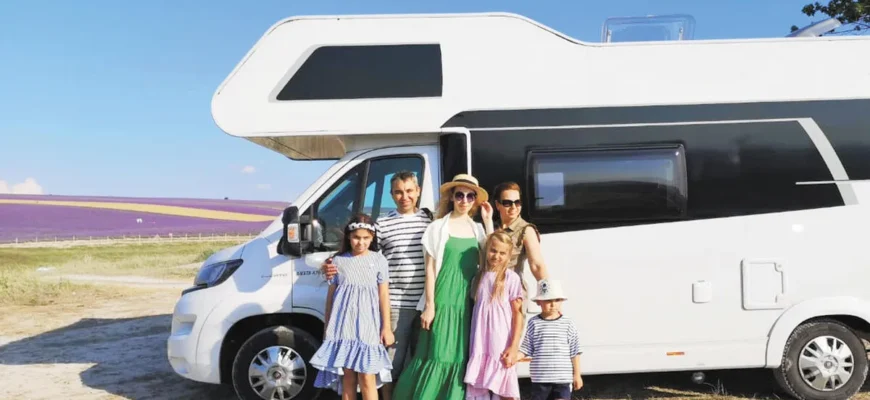
Traveling in a motorhome with your family is an opportunity to create unforgettable memories without being limited to hotels and tourist routes. However, choosing the right motorhome for traveling with children requires careful analysis of many parameters to ensure comfort, safety and practicality.
1. Determine a budget with a margin for the unforeseen
Buying a motorhome is an investment that requires not only upfront costs, but also systematic financial planning. New factory-made motorhomes start from 1.5 million rubles on the chassis of domestic manufacturers, but the middle class will require from 4 to 8 million rubles. Premium models can cost 15-25 million rubles, depending on the class, equipment and manufacturer.
When setting a budget, it is important to consider not only the cost of purchase, but also the full range of annual maintenance costs. Motorhome insurance will cost 5-10 thousand rubles per year, depending on the type of coverage and the class of the car. Scheduled maintenance requires 3-5 thousand rubles annually, especially if you plan to actively use it in different climatic zones.
Gasoline or diesel costs vary depending on the engine power and the intensity of travel. For a medium-sized camper based on Fiat Ducato or Ford Transit, fuel consumption is 6-10 liters per 100 km. Renting parking spaces at campsites can vary from 500 to 5000 rubles per day, depending on the category and season.
Be sure to set aside a reserve of 10-15% of the annual costs for unscheduled repairs. This can be changing oil and filters, repairing gaskets, replacing brake pads or working with the gas supply and water supply system. In addition to mechanical breakdowns, consider a budget for additional travel equipment: a tent to lengthen the living space, awnings to protect from the sun and rain, kitchen utensils, bed linen and textiles.
2. Choose a layout with a separate overnight space for parents
The psychological comfort of the whole family during the trip directly depends on the availability of personal space for each family member. The separation of activity and relaxation zones prevents conflicts and allows everyone to get the necessary rest after a day's adventures.
The ideal layout should provide for a separate bedroom for adults, which is separated from the children's area either visually or physically through a door or a sliding partition. This is especially important if there are young children in the family who can wake up during the night or teenagers who need a certain degree of independence.
The bed for parents is best placed in the back of the motorhome, where it is much quieter while driving and parking on the highway, since vibration from passing cars is minimal. It is even better if this bedroom is slightly raised or insulated with soundproofing.
Of the successful examples of planning, it is worth noting the following options: Island Bed In the back part, this is a classic solution in which the mattress is placed not against the wall, but in the center of the room, allowing you to approach from both sides. This arrangement is ideal for families where both parents want easy access and ease of making beds.
Pop-top roof with sleeping place at the top is an innovative solution that is especially popular in medium-sized campers. When the roof is raised, it increases the internal height to 1.9-2.1 meters, allowing an adult to stand comfortably. At the same time, an additional bed with a mattress thickness of 8-10 cm can be placed in the raised roof, which is ideal for one child or teenager. Pros of pop-top: better ventilation, natural light through panoramic windows in the roof, the ability to observe the starry sky when the roof is open.
3. Assess the number and type of beds for growing children
Families with children of different ages face a particular challenge: what is appropriate for a four-year-old may be uncomfortable for a ten-year-old, and vice versa. The right number and configuration of beds is the key to a good night's sleep and good mood for all family members during the trip.
Modern manufacturers offer several effective solutions for sleeping places in motorhomes. Convertible sofas is a versatile solution that serves as a place to sit and entertain during the day and turns into a full-fledged sleeping place at night. Usually, such a sofa is designed for the sleep of one or two people and can be unfolded in just a few seconds.
The advantages of sofas are: space saving, ease of use, the ability to store linen and pillows in drawers under the seat. Disadvantages: the mattress is often firmer than on the bed, and over time it can wear out from frequent folding.
Pull-out beds (roll-out beds) are pull-out half-sections that are built under the main bed. If necessary, such a bed can be easily pulled out and placed parallel or perpendicular to the main bedroom. This is a great solution for accommodating one or two younger children.
Advantages: a separate bed for each child, maximum use of vertical space, quick deployment. Disadvantages: they require a certain height of the room, and not all roll-out beds have a hard bottom.
Upper berths (alcove berths) is a traditional solution in which a sleeping shelf with a height of 60-80 cm is mounted above the kitchen or dining area.
Advantages of alcove places: compactness, do not take up additional space in the daytime, are interesting for children as their own cozy "refuge". Disadvantages: difficulty in entering and exiting, height restriction, possible feeling of claustrophobia.
The most important aspect of safety is securing all sleeping places and protecting children from falls. On the upper shelves there should be strong edges with a height of at least 25-30 cm , which are securely attached to the structure of the motorhome. The sides should be hard enough to support the weight of a child trying to climb out. Use padded pads to prevent injury if you accidentally touch the rim.
Stairs and steps must be stable and have handrails for safe ascent and descent. If the staircase is wooden, make sure that it does not rot or have cracks. Plastic ladders are lighter, but less durable. The distance between the steps should be 25-30 cm, and the angle of inclination should be no more than 45 degrees.
4. Check the availability of a bathroom and shower - this is a matter of hygiene and comfort
Personal hygiene is becoming critical for a family living in a confined space of mobile housing. Even if you do not plan to use the built-in toilet and shower all the time, their presence significantly increases the comfort of long trips and gives confidence in unforeseen circumstances.
In practice, many travelers use the built-in toilet and shower during overnight stays in remote parking lots where there are no campsites with amenities nearby, or when family members suddenly fall ill. It is also useful when traveling with young children, who often need quick access to the toilet, especially while driving.
A traditional wet bathroom (toilet-shower) occupies an area of 1-1.5 square meters and integrates a toilet and shower into a single space. Cassette toilets (porta-potty) is the most common solution, they are easy to clean and lightweight. Peat toilets is an environmentally friendly option, but requires more frequent cleaning. Dry toilets – are compact and do not require water.
For the water supply system, plastic tanks with a volume of 50-120 liters are used as standard, located in the floor or under the floor of the motorhome. Fresh water flows into the sink, kitchen faucet and shower head. For a family with children, a tank with a capacity of at least 80 liters is recommended, as children often require extra water for washing their hands and taking baths.
Important point: Sliding partition wall , which enlarges the bathroom space when needed. Some premium models are equipped with a telescopic partition, which allows you to "attach" part of the living space to the bathroom when additional space is required. This is especially useful for bathing young children or changing clothes during cold weather.
Ventilation in the bathroom is a critical element. Install a 100-150 mph exhaust fan that will run 24/7 or automatically turn on when humidity is detected. Good ventilation prevents the formation of mold, which is dangerous to the health of children.
5. Make sure of the simplicity of organizing life on wheels
The organization of life in the compact space of a motorhome requires maximum functionality and logical placement of each item. Lack of space becomes an advantage if everything is planned correctly: every cubic centimeter works for the comfort of the family.
Kitchen in a motorhome is the heart of the mobile home. The minimum configuration includes a refrigerator with a volume of 40-60 liters (compressor or absorption), one or two cooking burners, and a sink. Compressor refrigerators cool faster (up to 5-10 minutes to the desired temperature) and work more efficiently in the heat, but consume more electricity (4-6 amperes at 12 volts). Absorption refrigerators are quieter and can use gas or electricity, but require constant 12-volt power.
The recommended volume of the refrigerator for a family of four is 50-80 liters, which will allow you to store food for 5-7 days. It is better to choose a gas stove with one or two burners, since gas is cheaper than electricity, and such stoves take up a minimum of space.
The kitchen in a motorhome should be located next to the door so that it is convenient to take out the garbage and bring in food. The countertop should be removable or folding to increase space during the daytime.
Storage system is the key to comfort on long journeys. A sufficient number of lockers are needed to store clothes, food, kitchen utensils, bed linen and toys. The standard norm is 4-6 cubic meters of storage for a family of four.
Many families use roll-out drawers under the sofa to store bed linen, pillows and blankets, which saves space in closets. Open shelves and fabric organizers for small items can be mounted on the walls: toothbrushes, medicines, books, gadgets. On the ceiling, you can hang nets for light objects.
Particular attention should be paid to storage space for traveling with children: strollers, bicycles, scooters. A standard children's bike takes up about 0.5 cubic meters of space, so you need to provide either a place under the floor of the motorhome (through the hatch) or a roof with a trunk.
6. Prioritize compactness and comfort
Choosing between compactness and comfort is a strategic decision that will determine the convenience of the entire trip. Compact autodomes are easier to park on narrow city streets, more maneuverable in dense traffic, more economical in fuel consumption, and cheaper to maintain. At the same time, the more spacious models provide better comfort, especially during long journeys and bad weather.
Compact motorhome (class B or campervan) is a converted minibus with a length of 5.5-6 meters. Such campers are based on the Fiat Ducato, Renault Master, Ford Transit or Mercedes Sprinter platform. They park better in the city, pass through narrow village streets more easily, and require less fuel.
Disadvantages: limited living space, it is impossible to stand upright in most trim levels (unless there is a pop-top roof), it is difficult to accommodate a family with two or three children.
Medium-sized motorhome (class C or semi-integrated) - length 6.5-7.5 meters, based on similar chassis, but with a superstructure above the cockpit. The superstructure allows you to place a bed for one or two people, increases living space and allows you to stand upright in the cabin.
This is the perfect compromise for families: sufficient space, relative maneuverability, reasonable fuel price.
Large integrated motorhome (class A) – length 7.5-11 meters, the cabin is integrated into a single living space. Such motorhomes provide maximum comfort: you can safely stand upright, there is a separate bedroom, a large kitchen, a full bathroom.
Disadvantages: very difficult to park, require maneuvering skills, significant fuel costs, often require a C1 category driver's salary (if the weight is above 3500 kg).
For a family with two to four children, the best choice is often Semi-integrated motorhome based on Fiat Ducato 6.5-7 meters long. This strikes a good balance between comfort, handling and practicality.
7. Don't forget about safety and reliability
Safety is not just a legal requirement, it is the foundation of the peace of mind of parents and the protection of children's lives. When choosing a motorhome for a family with children, it is necessary to carefully check all aspects of safety and reliability.
Child car seats in a motorhome is a mandatory security element regulated by the legislation of the Russian Federation and other CIS countries. On July 26, 2025, updated requirements came into force in Russia: the use of certified child restraint systems (CRS) has become mandatory, and non-certified adapters, straps and pads are no longer allowed.
Children under 7 years old must be transported in special car seats, selected according to weight and height. Children from 7 to 11 years old can ride both in a restraint device and with a regular seat belt, but only in the back seats. Violation of these rules entails a fine of 3000 rubles.
In a motorhome, seats must be securely fastened using standard seat belts (if they have an ISOFIX fastener) or special fastening straps. Do not rely on simply placing the chair on the sofa - with sudden braking, it can move and create danger.
Chassis and engine condition is the basis of reliability and your peace of mind. When buying a used motorhome, be sure to carry out a full technical diagnosis:
- Check the maintenance history (MOT) - the presence of regular maintenance indicates the responsibility of the previous owner.
- Inspect the bottom and spars for corrosion.
- Check the oil level, coolant quality, filter condition.
- Test all systems: brakes, steering wheel, electrical equipment, lighting.
- Make sure that the engine starts without problems, there are no extraneous sounds and knocking.
- Check the transmission for smooth gear shifting.
- Inspect the tires for wear (tread depth of at least 1.6 mm), uniformity of abrasion.
- Check the condition of the shock absorbers and suspension - they should provide a comfortable ride with a loaded motorhome.
Gas supply system (if the motorhome is equipped with gas appliances) must be especially reliable. The gas cylinder must be placed in a safe place, outside the motorhome, in a special metal box with ventilation. All gas lines must be braided and protected from damage. Be sure to install a gas leak detector that will beep when gas is detected.
Electrical system Motorhomes must provide reliable power to all devices. Two batteries are installed as standard: one for the engine starter, the second (auxiliary) to power residential systems. The auxiliary battery is usually with a capacity of 100-200 ampere-hours and can work independently of the main battery through a release diode.
Additionally, it is recommended to install solar panels with a capacity of 100-200 watts to recharge the auxiliary battery and a generator with a capacity of 2000-3000 watts for use in emergency situations.
Motorhome insurance — This is not just a document, it is your financial protection. Be sure to take out an OSAGO policy (compulsory civil liability insurance), which covers damage caused to third parties. Additionally, it is recommended to take out CASCO (comprehensive insurance) to protect the motorhome itself from damage, theft, natural disasters.
The cost of insurance varies depending on: the cost of the motorhome, age and technical condition, type of coverage, region of residence. On average, annual insurance costs 5-10 thousand rubles for OSAGO and 15-30 thousand rubles for CASCO (or 10-20% of the cost of the motorhome per year).
Additional protection against risks : Check if your policy includes insurance against natural disasters, fire, theft of parts, roadside assistance. For international trips, you will need separate insurance (for example, Turkish visa insurance will cost about 2500 rubles).
Final recommendations when choosing a motorhome for a family
Choosing the perfect motorhome for a family with children is a multi-factor task that requires a balance between the desired comfort and practical limitations. Using the recommendations above, you will be able to make an informed decision that will ensure safety, comfort, and enjoyment of travel.
Remember that the best motorhome is not necessarily the most expensive or the largest. It's one that fits your specific needs, allows you to travel with peace of mind, and sets the stage for family unity along the way.