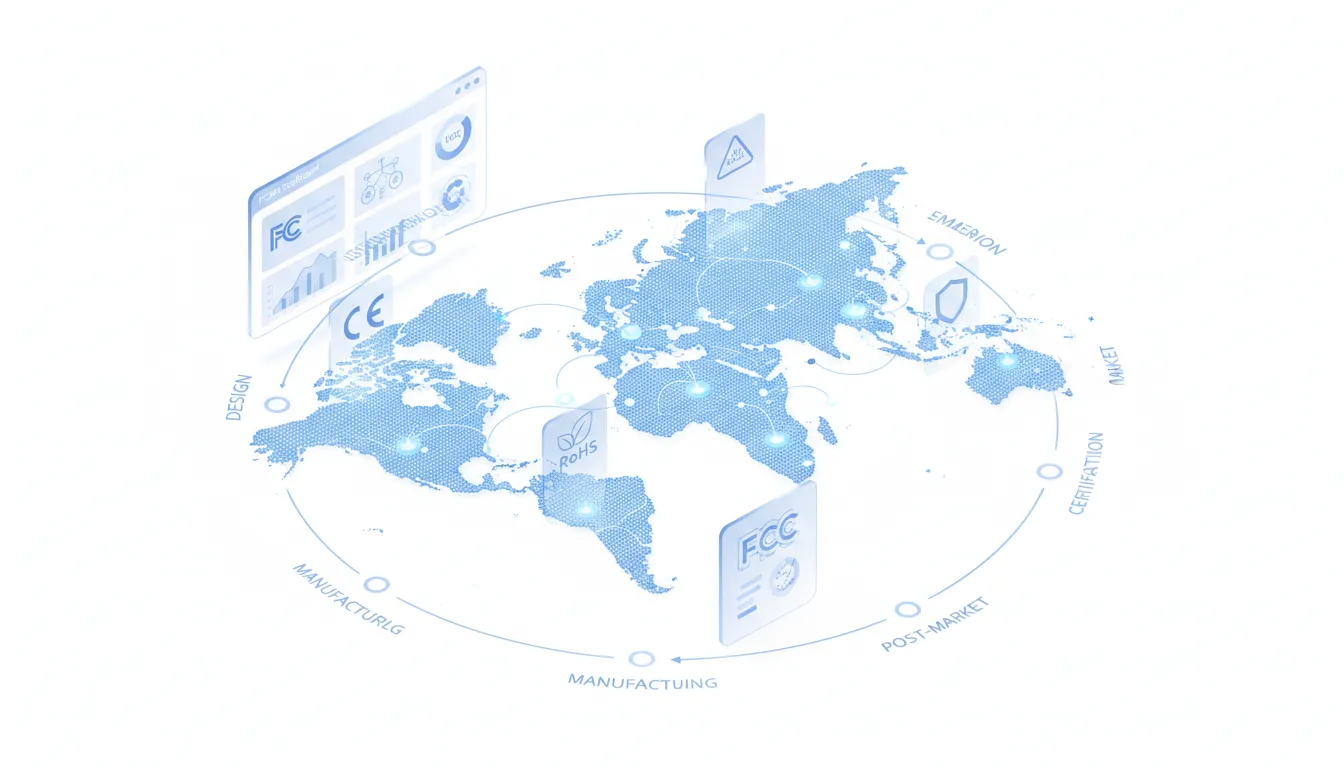
Product compliance represents the cornerstone of global market access, determining whether companies can legally manufacture, distribute, and sell their products across international borders. In 2026, businesses face an unprecedented regulatory landscape where non-compliance doesn’t just mean fines-it means complete market exclusion, product recalls costing millions, and supply chain disruptions that can erase 25% of company earnings over a decade. With the European Union advancing Digital Product Passport requirements, the United States strengthening chemical restrictions, and Asia harmonizing safety standards, managing product compliance has evolved from a checkbox exercise into a strategic business imperative that directly impacts revenue, reputation, and competitive positioning.
What Is Product Compliance? (Clear Definition)
Product compliance is the systematic process of ensuring that products, materials, and components meet all applicable legal requirements, safety standards, technical specifications, and regulatory obligations throughout their entire lifecycle-from design and sourcing through manufacturing, distribution, market entry, and post-market surveillance. Unlike general regulatory compliance, which encompasses broader organizational obligations, product compliance specifically focuses on the physical characteristics, chemical composition, safety performance, environmental impact, labeling accuracy, and documentation requirements of tangible goods.
Product Compliance vs. Regulatory Compliance
Product compliance operates as a specialized subset of regulatory compliance, concentrating exclusively on product-specific requirements rather than corporate governance, financial reporting, or operational procedures. While regulatory compliance addresses how organizations operate, product compliance addresses what organizations produce and whether those products can legally enter specific markets.
Product Safety vs. Environmental vs. Market Access Compliance
The compliance landscape divides into three interconnected domains. Product safety compliance ensures products don’t pose physical, chemical, or electrical hazards to users, covering electrical safety standards, mechanical integrity, and consumer protection regulations. Environmental compliance addresses the ecological impact of products throughout their lifecycle, including restricted substance regulations like RoHS and REACH, packaging waste requirements, and carbon footprint disclosure obligations. Market access compliance encompasses the certifications, markings, and documentation required to legally sell products in specific jurisdictions, such as CE marking in the EU or FCC certification in the United States.
Lifecycle Perspective: Design → Sourcing → Manufacturing → Market → Post-Market
Effective compliance management recognizes that regulatory obligations extend across the entire product journey. During the design phase, compliance begins with material selection and engineering decisions that determine whether products can meet regulatory thresholds. The sourcing stage requires supplier declarations, material data collection, and supply chain due diligence to verify component compliance. Manufacturing introduces process controls, quality management systems, and testing protocols that validate compliance at scale. Market entry demands certification, documentation, labeling, and regulatory submissions specific to each target jurisdiction. Post-market surveillance maintains ongoing compliance through adverse event monitoring, regulatory reporting, field actions, and response to evolving regulatory requirements.
Why Product Compliance Is Critical for Modern Businesses
Legal Risk
Non-compliance exposes organizations to severe legal consequences that extend far beyond monetary penalties. Regulatory violations in the pharmaceutical sector have resulted in $18 billion in penalties over five years, with individual DSCSA violations starting at $1,000 per incident and EU GDPR breaches reaching €20 million or 4% of global revenue. Beyond fines, companies face product seizures, manufacturing shutdowns, import blocks, and mandated operational restrictions that can permanently damage business viability.
Market Access
The most consequential risk of non-compliance isn’t financial penalties-it’s complete exclusion from major economic markets. The European Union operates as a strict gatekeeper where products lacking proper CE certification cannot enter under any circumstances, effectively eliminating access to the world’s second-largest economy. For a medical device company with $150 million in annual EU revenue, an 18-month market access delay due to non-compliance represents a $225 million opportunity cost that dwarfs any regulatory fine. Unlike penalties that can be paid and forgotten, market exclusion eliminates entire revenue streams indefinitely.
Product Safety
Compliance regulations exist fundamentally to protect human health and safety. Products that fail safety standards pose direct physical, chemical, or electrical hazards to end users, creating liability exposure and ethical obligations that transcend regulatory requirements. The 2026 regulatory environment increasingly emphasizes traceability, requiring manufacturers to demonstrate safety throughout the entire supply chain from raw materials to finished goods.
Brand & ESG
Modern consumers and institutional buyers increasingly evaluate suppliers based on environmental, social, and governance (ESG) performance, with product compliance serving as tangible evidence of corporate responsibility. Companies that experience recalls or compliance failures suffer immediate brand damage and erosion of trust with distributors, hospitals, and end consumers. Conversely, organizations that demonstrate proactive compliance management differentiate themselves in competitive markets and build customer confidence.
Supply Chain Transparency
Regulations enacted in 2025-2026 mandate unprecedented levels of supply chain visibility, requiring companies to trace material origins, document processing steps, and verify supplier compliance at every tier. The EU’s Carbon Border Adjustment Mechanism (CBAM), which entered its definitive phase in January 2026, and the Deforestation Regulation (EUDR) both require comprehensive supply chain documentation as a prerequisite for market entry.
Sustainability Regulations
The regulatory shift toward circular economy principles and sustainability obligations represents one of the most significant compliance developments of 2026. The EU’s Ecodesign for Sustainable Products Regulation (ESPR) and associated Digital Product Passport requirements mandate granular material-level insights, circular design principles, and verifiable product composition data. Unlike traditional safety regulations focused on harm prevention, sustainability regulations require positive environmental performance and transparent lifecycle documentation.
Digital Traceability
Digital Product Passports, rolling out across EU markets beginning in 2026, transform compliance from static documentation into dynamic digital systems. Products from electronics and textiles categories require basic DPP implementation as early as 2026, with comprehensive coverage expected by 2027. These systems link product identifiers with inventory actions, disposal outcomes, material compositions, and compliance status, enabling real-time regulatory verification and automated reporting.
Global Product Compliance Regulations Landscape
European Union
The European Union maintains the world’s most comprehensive and stringent product compliance framework, serving as the de facto global standard that influences regulations worldwide.
CE Marking represents the mandatory conformity mark for products sold in the European Economic Area, indicating compliance with applicable EU directives and regulations. Products requiring CE marking include machinery, electrical equipment, medical devices, toys, personal protective equipment, and construction products. Manufacturers must conduct conformity assessments, compile technical documentation, issue Declarations of Conformity, and affix CE marking before market placement.
REACH (Registration, Evaluation, Authorization and Restriction of Chemicals) regulates chemical substances manufactured or imported into the EU in quantities exceeding one metric ton annually. The regulation places responsibility on companies to prove chemical safety, mandates hazard testing based on production volumes, and requires public sharing of key safety data. REACH operates through tiered categorization including the Candidate List of Substances of Very High Concern (SVHCs), the Authorization List (Annex XIV), and the Restrictions List (Annex XVII).
RoHS (Restriction of Hazardous Substances) limits specific hazardous materials in electrical and electronic equipment, evaluated at the homogeneous material level. The directive restricts lead, mercury, cadmium, hexavalent chromium, polybrominated biphenyls, polybrominated diphenyl ethers, and four phthalates.
WEEE (Waste Electrical and Electronic Equipment) establishes collection, recycling, and recovery targets for electronic products, requiring manufacturers to finance end-of-life management.
GPSR (General Product Safety Regulation), which became applicable December 13, 2024, modernizes consumer product safety requirements for both online and offline sales. Article 14 requires manufacturers to implement “internal procedures to ensure product safety” throughout the entire product lifecycle, making Product Compliance Management Systems (PCMS) a legal obligation. Full traceability and documentation systems are expected to be operational by 2026.
Ecodesign for Sustainable Products Regulation (ESPR) and Digital Product Passports represent the most significant regulatory development of 2026. The ESPR establishes mandatory sustainability obligations for in-scope products starting with iron and steel in 2026, requiring granular material-level data, circular design principles, and verifiable sustainability performance. Digital Product Passports provide interoperable data on product identification, manufacturer details, material composition, supply chain origin, performance characteristics, repair information, and end-of-life instructions.
Batteries Regulation introduces the world’s first mandatory battery passport with a confirmed compliance date, requiring digital documentation of battery composition, performance, and sustainability metrics.
SCIP Database requires companies to submit information on articles containing Substances of Very High Concern to enable proper waste management.
ESPR (Ecodesign for Sustainable Products Regulation) phases in sector-specific requirements through delegated acts with transition periods before compliance becomes mandatory.
United States
The United States employs a fragmented regulatory approach with multiple agencies governing different product categories, creating complexity for manufacturers serving the American market.
CPSIA (Consumer Product Safety Improvement Act) governs consumer products, particularly children’s products, establishing lead content limits, phthalate restrictions, testing requirements, and certification obligations enforced by the Consumer Product Safety Commission.
TSCA (Toxic Substances Control Act) regulates chemical substances and mixtures, requiring EPA notification and approval before introducing new chemicals or Significant New Uses. Unlike REACH’s tiered categorization, TSCA maintains a binary framework where chemicals are either approved or restricted with no intermediate classifications. The EPA prioritizes chemicals for evaluation on a rolling basis, but TSCA generally provides less advanced warning of pending restrictions compared to REACH.
FCC (Federal Communications Commission) Certification mandates compliance for electronic devices emitting radio frequency energy, including smartphones, computers, and wireless communication devices. FCC rules under Part 15 govern both unintentional and intentional radiators, requiring testing in authorized laboratories and submission of compliance documentation. Non-compliance results in fines, product recalls, or market bans.
FDA (Food and Drug Administration) regulates medical devices, pharmaceuticals, food products, and cosmetics through product-specific frameworks that vary by risk classification.
California Proposition 65 requires warnings for products containing chemicals known to cause cancer or reproductive harm, with enforcement through private civil actions.
OSHA (Occupational Safety and Health Administration) establishes workplace safety requirements that affect product design, particularly for industrial equipment and chemicals.
United Kingdom
Following Brexit, the United Kingdom established independent regulatory frameworks that parallel but differ from EU requirements.
UKCA (UK Conformity Assessed) marking replaced CE marking for the GB market (England, Wales, Scotland), though CE marks remain accepted during transition periods. Products sold in Northern Ireland continue following EU rules under the Northern Ireland Protocol.
UK REACH operates as a standalone chemical regulation system requiring separate registration from EU REACH, creating duplication for companies serving both markets.
Asia & Global Markets
Asian markets maintain diverse regulatory frameworks that reflect regional priorities and development stages.
China RoHS restricts hazardous substances in electronic products, requiring compliance marking and material content declarations.
CCC (China Compulsory Certification) mandates certification for products in 17 categories before market entry, covering electrical equipment, vehicles, and safety equipment.
Japan PSE (Product Safety of Electrical Appliances and Materials) requires certification for electrical products through specified notified bodies.
Korea KC (Korea Certification) consolidates multiple certification marks into a unified framework covering electrical safety, EMC, and telecommunications.
Regional Differences & Challenges
Manufacturers serving global markets face fundamental differences in regulatory philosophy, enforcement mechanisms, and technical requirements across jurisdictions. The EU’s precautionary approach mandates proving safety before market entry, while the US system historically allowed market access pending risk assessment. Substance restrictions vary significantly-a material approved under TSCA may appear on REACH’s SVHC Candidate List, requiring different formulations for different markets. Documentation requirements, testing protocols, certification bodies, labeling formats, and language obligations create operational complexity that demands sophisticated compliance management systems.
Core Categories of Product Compliance
Safety Compliance
Safety compliance addresses physical, electrical, mechanical, and chemical hazards that products may pose to users, bystanders, or the environment. This category encompasses electrical safety testing, mechanical integrity verification, flammability assessment, toxicity evaluation, and user protection measures. Products must meet jurisdiction-specific safety standards established by organizations like Underwriters Laboratories (UL) in the United States, the International Electrotechnical Commission (IEC) globally, and European Norms (EN) in the EU.
Chemical & Environmental Compliance
Chemical compliance regulations restrict or require disclosure of hazardous substances in products and packaging. REACH in the EU, TSCA in the United States, and parallel frameworks in other jurisdictions govern chemical content, requiring manufacturers to identify, assess, and manage chemical risks throughout supply chains. Environmental compliance extends beyond chemical restrictions to encompass packaging waste obligations, recycling targets, carbon footprint disclosure, and circular economy requirements.
Labeling & Documentation
Accurate product labeling and comprehensive technical documentation form essential compliance components. Labels must display mandatory safety warnings, substance declarations, energy efficiency ratings, disposal instructions, importer identification, and conformity marks in prescribed formats and languages. Technical documentation includes test reports, safety data sheets (SDS), Declarations of Conformity, risk assessments, user manuals, and material composition data.
Certification & Market Approval
Market-specific certifications serve as prerequisites for legal product sales. CE marking in the EU, FCC certification in the United States, PSE in Japan, and CCC in China each require distinct testing protocols, documentation packages, and approval processes. Certification timelines range from weeks to months depending on product complexity and regulatory pathway.
Sustainability & ESG
The 2026 regulatory landscape elevates sustainability from voluntary corporate social responsibility to mandatory legal obligation. Companies must now demonstrate circular design principles, material recyclability, carbon footprint transparency, supply chain due diligence, and environmental performance throughout product lifecycles. Digital Product Passports make this information publicly accessible and machine-readable for regulatory verification.
Supply Chain Due Diligence
Recent regulations including the EU Deforestation Regulation and various supply chain transparency laws mandate verification of material origins, ethical sourcing practices, and supplier compliance status. Companies must implement due diligence systems that identify, assess, and mitigate supply chain risks, particularly for conflict minerals, forced labor, and environmental destruction.
What Are Product Compliance Services?
Product compliance services encompass specialized professional assistance that helps organizations navigate regulatory requirements, achieve certifications, manage compliance data, and maintain ongoing adherence to evolving standards. These services bridge the gap between complex regulatory frameworks and practical business operations, providing expertise that most companies cannot economically develop in-house.
Regulatory Monitoring
Compliance service providers track regulatory changes across multiple jurisdictions, translating legal text into actionable requirements and alerting clients to upcoming obligations. This continuous monitoring function prevents companies from being blindsided by new regulations that could affect product design, material selection, or market access.
Certification & Testing
Service providers coordinate product testing through accredited laboratories, manage certification applications with regulatory bodies, and guide companies through approval processes. This includes identifying required tests, preparing samples, interpreting results, addressing deficiencies, and securing necessary approvals.
Documentation & SDS
Compliance consultants prepare technical files, Declarations of Conformity, Safety Data Sheets, test reports, and regulatory submissions in formats meeting jurisdiction-specific requirements. Documentation services ensure that products have the audit-ready evidence needed for customs clearance, market surveillance responses, and regulatory inquiries.
Compliance Assessments
Comprehensive compliance assessments evaluate whether products adhere to applicable regulations by reviewing design, materials, intended use, and target markets. Assessments identify gaps between current product specifications and regulatory requirements, enabling proactive remediation before market entry.
Supplier Data Collection
Service providers implement systems for collecting material declarations, compliance certificates, test reports, and substance data from suppliers throughout multi-tier supply chains. This function addresses the fundamental challenge that manufacturers rarely produce all components in-house, requiring reliance on supplier-provided information.
Compliance Program Design
Consultants design organizational compliance programs that define roles, responsibilities, workflows, escalation procedures, and governance structures. Effective program design integrates compliance into existing quality management, product development, and procurement processes rather than treating it as a separate function.
Audits & Risk Analysis
Compliance audits verify that organizations follow established procedures, maintain required documentation, and meet regulatory obligations. Risk analysis identifies products, materials, or markets with elevated compliance exposure, enabling prioritized resource allocation.
Compliance Management Systems
Service providers implement Product Compliance Management Systems (PCMS) that centralize compliance data, automate rule checks, track regulatory changes, and generate required reports. These systems integrate with Product Lifecycle Management (PLM) and Enterprise Resource Planning (ERP) platforms to embed compliance into operational workflows.
Training & Advisory
Compliance service providers deliver training programs that educate internal teams on regulatory requirements, best practices, and organizational procedures. Advisory services provide strategic guidance on regulatory strategy, market entry planning, and compliance optimization.
Compliance Services vs. Compliance Software vs. In-House Programs
Organizations face strategic decisions about whether to engage external compliance consultants, implement compliance software platforms, build internal capabilities, or adopt hybrid approaches. Each model offers distinct advantages and limitations that vary based on organizational size, product complexity, regulatory scope, and resource availability.
Decision Framework Considerations:
Companies should evaluate their compliance approach based on several critical factors. Regulatory scope determines whether the organization faces single-jurisdiction requirements amenable to internal management or multi-regional obligations requiring sophisticated external support. Product complexity influences whether standard software tools suffice or whether specialized consulting expertise becomes necessary. Change frequency affects the value of continuous monitoring software versus periodic consulting assessments. Budget constraints must balance upfront software investments against ongoing consulting fees. Internal resources determine whether the organization has staff capable of operating software tools or requires extensive external support. Growth trajectory influences scalability needs-software scales more cost-effectively than proportionally increasing consulting hours. Risk tolerance shapes whether continuous automated monitoring or periodic manual assessments provide adequate protection.
How Companies Manage Compliance Across Global Markets
Effective global compliance management requires integrated systems that connect disparate data sources, apply jurisdiction-specific rules, generate required documentation, and maintain audit readiness across product portfolios.
Regulatory Intelligence
Organizations must systematically monitor regulatory developments across all markets where they operate or plan to sell products. This function tracks proposed regulations, final rules, effective dates, transition periods, and technical amendments that affect product requirements. Leading companies implement formal regulatory intelligence processes rather than relying on ad-hoc awareness.
Product Data
Comprehensive product data management captures design specifications, bill of materials (BOM), component suppliers, material compositions, and performance characteristics in centralized systems. Product Lifecycle Management (PLM) platforms serve as the foundation for compliance management by maintaining authoritative product definitions.
Material Data
Material-level compliance requires detailed chemical composition data for every substance in products and packaging. Companies must collect full material declarations (FMDs), substance concentration ranges, CAS registry numbers, and compliance status for restricted substance lists. The 2026 regulatory environment demands unprecedented material data granularity to support Digital Product Passport requirements.
Supplier Data
Multi-tier supply chain compliance depends on accurate, current data from component suppliers, material producers, and sub-tier vendors. Organizations implement supplier declaration processes that collect material compliance certificates, test reports, conflict minerals declarations, and other required documentation. Supplier risk assessment identifies vendors requiring enhanced due diligence.
Rule Engines
Automated rule engines apply jurisdiction-specific regulatory requirements to product data, identifying compliance gaps and triggering alerts. These systems encode complex regulations into machine-readable logic that evaluates product compositions against restricted substance thresholds, labeling requirements, and certification obligations.
Documentation
Compliance management systems generate jurisdiction-specific documentation including Declarations of Conformity, technical files, Safety Data Sheets, and certification applications. Automated documentation reduces manual effort, improves consistency, and accelerates regulatory submissions.
Reporting
Organizations must report compliance status to internal stakeholders, customers, regulatory authorities, and market surveillance agencies. Modern systems generate standard reports (REACH SVHC declarations, conflict minerals reports, RoHS compliance statements) and custom analytics for management decision-making.
Product Compliance Management Systems (PCMS)
What PCMS Is
A Product Compliance Management System (PCMS) is a centralized software platform that helps companies collect, manage, and validate product and material compliance data across their supply chains. PCMS platforms connect supplier declarations, regulatory rules, and product structures to automatically check compliance with regulations such as REACH, RoHS, TSCA, and California Proposition 65. These systems enable audit-ready documentation, risk identification, and efficient compliance management across global product portfolios.
How It Works
PCMS platforms integrate compliance data from multiple sources including supplier portals, PLM systems, ERP databases, and laboratory information management systems. The core architecture includes a regulatory content database that maintains current substance restrictions and requirements across jurisdictions. Product data integration connects PCMS to authoritative product definitions in PLM systems, creating compliance visibility at the product, assembly, and component levels. Supplier data collection workflows request material declarations, automatically process incoming data, and flag incomplete or inconsistent submissions. Compliance rule engines evaluate product compositions against applicable regulations, identifying violations of substance thresholds, missing certifications, or documentation gaps. Reporting modules generate standard compliance declarations and custom reports for internal stakeholders and external parties.
Integration with PLM / ERP / ESG
Modern PCMS implementations integrate deeply with enterprise systems rather than operating as standalone tools. PLM integration ensures compliance assessments use authoritative product data and BOMs, while enabling compliance status to influence design decisions. ERP integration connects compliance data with procurement, quality, and supply chain management processes, embedding compliance into operational workflows. ESG platform integration links product-level compliance data to corporate sustainability reporting, carbon accounting, and circular economy metrics.
Automation & Rule Checks
Automated compliance checking represents the transformative capability that distinguishes PCMS from manual spreadsheet processes. Rule engines continuously evaluate product data against thousands of regulatory requirements, instantly identifying compliance issues when materials change, regulations update, or new products enter development. This automation prevents human error, ensures consistency across product lines, and scales to manage thousands of SKUs across dozens of markets.
Regulatory Updates
PCMS platforms include regulatory content services that monitor global regulations and update rule databases when requirements change. This ensures compliance assessments always reflect current regulations rather than outdated requirements. Leading platforms provide advance notification of pending regulatory changes, enabling proactive product reformulation before restrictions become effective.
Audit Readiness
PCMS platforms maintain comprehensive audit trails documenting compliance assessments, data sources, decision rationale, and version history. This audit readiness proves critical during regulatory inspections, customer audits, and market surveillance inquiries that demand immediate evidence of compliance. Organizations with mature PCMS implementations can respond to compliance inquiries within hours rather than weeks.
Key Challenges in Product Compliance
Supply Chain Transparency
Modern regulations demand visibility into multi-tier supply chains where manufacturers often lack direct relationships with raw material producers. Collecting accurate compliance data from hundreds or thousands of suppliers across linguistic, cultural, and technological barriers represents a persistent operational challenge. Suppliers may lack sophistication to provide required data, resist disclosure of proprietary material compositions, or provide incomplete declarations that fail regulatory standards.
Data Quality
Compliance decisions are only as reliable as the underlying data quality. Organizations struggle with incomplete material declarations, conflicting information from different sources, outdated certificates that don’t reflect current formulations, and missing CAS numbers that prevent substance identification. Poor data quality leads to false compliance confidence or unnecessary product restrictions based on incomplete information.
Multi-Region Requirements
Companies serving global markets must simultaneously comply with EU REACH, US TSCA, China RoHS, California Proposition 65, and dozens of other overlapping but non-identical regulations. A single product may require different formulations for different markets, with material approved in one jurisdiction restricted in another. Managing this complexity without sophisticated systems leads to errors, delays, and compliance failures.
Manual Workflows
Organizations relying on spreadsheets, email chains, and manual documentation processes cannot scale compliance management effectively. Manual workflows suffer from version control problems, limited data validation, lack of audit trails, and dependence on individual employees’ knowledge. As product portfolios grow and regulations multiply, manual approaches collapse under information overload.
Regulatory Change Speed
Global regulations evolve continuously, with new substance restrictions, updated technical requirements, and emerging compliance obligations announced regularly. The EU REACH Candidate List of SVHCs updates multiple times annually, TSCA prioritizes new chemicals for review continuously, and individual US states enact product-specific restrictions independently. Organizations without systematic regulatory monitoring miss emerging requirements until market access problems occur.
Resource Constraints
Compliance management competes for limited organizational resources against product development, sales, and operations. Companies struggle to justify compliance investments until experiencing costly market access delays, recalls, or regulatory enforcement actions. Small and mid-sized enterprises particularly face resource constraints that prevent building sophisticated internal compliance capabilities.
Industry-Specific Compliance Needs
Electronics
Electronics manufacturers face the most complex compliance landscape, navigating electrical safety, electromagnetic compatibility (EMC), restricted substances, energy efficiency, wireless communications, and battery regulations simultaneously. Key requirements include CE marking and Low Voltage Directive compliance in the EU, FCC certification for RF emissions in the United States, UL safety certification, RoHS substance restrictions, REACH chemical disclosure, WEEE recycling obligations, energy efficiency labels, battery regulations, and PFAS restrictions affecting coatings and cables. By 2026, IT and audio/video equipment transitioned to the unified IEC 62368-1 standard, increasing consistency but requiring recertification. Supply chain traceability demands for electronics intensify as component-level compliance verification becomes regulatory expectation.
Automotive
Automotive compliance encompasses vehicle safety standards, emissions regulations, chemical restrictions for interior materials, end-of-life vehicle recycling, and increasingly, battery regulations for electric vehicles. REACH substance restrictions apply to interior plastics, coatings, and fluids, while global automotive manufacturers must navigate region-specific type approval processes. Leading automotive companies like Audi implement comprehensive Product Compliance Management Systems integrated with quality management frameworks to manage regulatory complexity.
Consumer Goods
Consumer products face intense regulatory scrutiny focused on user safety, chemical content, and packaging compliance. General Product Safety Regulation in the EU, CPSC enforcement in the United States, and product-specific requirements for toys, textiles, furniture, and household goods create market-specific compliance obligations. Packaging regulations including the EU Packaging and Packaging Waste Regulation and US state Extended Producer Responsibility programs add compliance layers affecting product design and business models.
Chemicals
Chemical manufacturers face the most direct regulatory burden under REACH, TSCA, GHS labeling, transport regulations, and workplace safety requirements. REACH registration obligations require extensive toxicological testing, exposure assessments, and downstream user communication. Chemical companies must navigate the distinction between substances, mixtures, and articles across different regulatory frameworks.
Medical Devices
Medical device compliance combines product safety with clinical effectiveness requirements, creating rigorous pre-market approval processes and post-market surveillance obligations. EU Medical Device Regulation (MDR) and FDA requirements demand clinical evidence, quality management system certification, adverse event reporting, and periodic safety updates. Non-compliance results not in fines but market access denial, making regulatory strategy critical for medical device companies.
Textiles
Textile and apparel products face chemical restrictions (particularly for dyes, finishes, and treatments), flammability requirements, fiber content labeling, and emerging digital product passport requirements. The EU anticipates textiles among the first product categories requiring Digital Product Passports in 2026. PFAS restrictions increasingly affect textile coatings, water-repellent treatments, and stain-resistant finishes.
Toys & Children’s Products
Children’s products face the strictest safety and chemical restrictions given vulnerable user populations. US CPSIA requirements include lead content limits below 100 ppm, phthalate restrictions, mandatory third-party testing, and tracking labels. EU toy safety directives impose similar substance restrictions, mechanical safety requirements, and age-appropriate labeling obligations.
Step-by-Step Product Compliance Lifecycle
Design Stage
Compliance begins during conceptual design when material selections, component choices, and architectural decisions determine future regulatory feasibility. Design for Compliance principles integrate regulatory requirements into engineering specifications, avoiding costly redesigns later in development. This stage includes regulatory requirement identification for target markets, restricted substance avoidance in material selection, Design for Environment principles supporting sustainability objectives, and certification pathway planning.
Material Selection
Material decisions directly determine compliance outcomes, requiring systematic evaluation of substance content against applicable restrictions. Designers must consult restricted substance databases (REACH SVHCs, RoHS exceptions, TSCA restrictions, Proposition 65 chemicals), evaluate alternative materials meeting performance and regulatory requirements, document material selection rationale for regulatory submissions, and engage suppliers early to verify material compliance.
Supplier Compliance
Manufacturers depend on supplier-provided compliance data for components and materials not produced in-house. Effective supplier compliance management includes pre-qualification screening to verify supplier compliance capabilities, contractual compliance obligations in purchase agreements, standardized declaration requests using industry templates, validation processes to verify declaration accuracy, and ongoing monitoring for changes in material formulations or supplier compliance status.
Testing & Certification
Products undergo testing to demonstrate compliance with applicable standards before market entry. The testing and certification phase includes identifying required tests based on product category and target markets, engaging accredited test laboratories, submitting representative samples that reflect production specifications, interpreting test results and addressing any failures, and securing final certifications or approvals from regulatory authorities.
Documentation
Comprehensive documentation provides evidence of compliance throughout the regulatory lifecycle. Required documentation includes technical files containing product specifications and compliance evidence, Declarations of Conformity stating regulatory conformance, test reports from accredited laboratories, Safety Data Sheets for chemical products, user manuals with safety information, and certificates from notified bodies or certification agencies.
Market Approval
Formal market approval processes vary by jurisdiction and product category. Market approval may require submitting documentation packages to regulatory authorities, obtaining pre-market clearance or approval for regulated products, registering products in national databases, and affixing compliance marks (CE, UKCA, FCC) to products and packaging.
Post-Market Monitoring
Compliance obligations extend throughout product commercial life through post-market surveillance programs. Post-market activities include monitoring adverse events or safety incidents, reporting serious incidents to regulatory authorities within prescribed timeframes, conducting periodic safety reviews, implementing field actions or recalls when necessary, and updating documentation as regulations evolve.
Risks of Non-Compliance
Fines
Regulatory violations result in substantial financial penalties that vary by jurisdiction and violation severity. DSCSA violations in the US pharmaceutical sector start at $1,000 per incident, while EU GDPR and FMD breaches can reach €20 million or 4% of global revenue. Major pharmaceutical companies have absorbed $18 billion in compliance penalties over five years. FDA violations lead to warning letters, product seizures, import blocks, and manufacturing shutdowns.
Recalls
Product recalls represent one of the most financially devastating non-compliance consequences. Beyond customer refunds, recalls generate massive costs including reverse logistics to recover distributed products, re-manufacturing or disposal expenses, legal fees and liability exposure, third-party audit costs, and enhanced monitoring systems. Recalls typically erase 25% of company earnings (EBITA) over 10 years when manufacturing disruptions and supply chain impacts are included.
Bans
Products failing compliance requirements face outright market bans that eliminate entire revenue streams. EU market surveillance authorities can prohibit non-compliant products from sale, requiring complete withdrawal from commerce. Unlike fines that can be paid, market bans cannot be resolved through financial settlement.
Lawsuits
Non-compliant products exposing users to safety hazards create product liability exposure through civil litigation. Companies face class action lawsuits, individual injury claims, and regulatory enforcement actions that compound financial consequences.
Market Exclusion
The most strategically damaging non-compliance consequence is complete exclusion from major economic markets. The European Union requires CE certification as an absolute prerequisite for market access-products lacking proper certification cannot enter under any circumstances. For a manufacturer with $150 million in annual EU revenue, an 18-month compliance delay represents a $225 million opportunity cost that dwarfs any conceivable regulatory fine. Unlike penalties that represent one-time expenses, market exclusion eliminates revenue indefinitely until compliance is achieved.
Reputational Damage
Compliance failures erode trust with distributors, customers, and regulatory authorities. Companies experiencing recalls or market withdrawals suffer immediate brand damage that affects future market acceptance even after compliance is restored. For manufacturers selling through distribution networks, compliance problems can lead to distributor abandonment and retail delisting.
How to Choose Product Compliance Services
Geographic Scope
Service providers must demonstrate expertise in all jurisdictions where the organization operates or plans to sell products. Global manufacturers require partners with multi-regional regulatory knowledge, whereas companies serving single markets may prioritize deep local expertise.
Regulatory Depth
Evaluate whether service providers understand both horizontal regulations affecting all products (REACH, RoHS, GPSR) and vertical product-specific requirements (medical devices, automotive, electronics, toys). Regulatory depth encompasses knowledge of current requirements, awareness of pending changes, and understanding of enforcement patterns.
Industry Expertise
Compliance requirements vary dramatically across industries, making industry-specific experience valuable. Electronics manufacturers benefit from partners understanding EMC testing, wireless certification, and component-level substance compliance, while medical device companies require expertise in clinical evaluation, quality system compliance, and post-market surveillance.
Software Capability
Modern compliance management demands technological solutions that enable scale, automation, and continuous monitoring. Evaluate whether service providers offer integrated PCMS platforms, can implement and customize compliance software, or rely primarily on manual processes.
Supplier Network
Effective compliance management requires collecting data from extended supply chains. Service providers with established supplier portal networks, standard declaration templates, and supplier engagement experience deliver faster time-to-compliance than those requiring companies to build supplier processes from scratch.
Scalability
Consider whether service providers can support organizational growth, product portfolio expansion, and entry into new markets without requiring complete provider changes. Software-based approaches generally scale more cost-effectively than consulting models where costs increase proportionally with complexity.
Future of Product Compliance
ESG Regulations
Environmental, social, and governance regulations increasingly mandate product-level compliance beyond traditional safety and chemical requirements. The 2026 regulatory environment transforms ESG from voluntary corporate reporting into legally binding product obligations, with the EU’s Corporate Sustainability Reporting Directive (CSRD) requiring supply chain transparency and the ESPR mandating sustainability performance documentation.
Digital Product Passport
Digital Product Passports represent the most significant compliance innovation of the decade, transforming static documentation into dynamic digital systems. Beginning with batteries (mandatory) and expanding to electronics and textiles in 2026, DPPs create machine-readable compliance records linked to physical products through QR codes or NFC tags. These systems enable real-time regulatory verification, automated customs clearance, consumer transparency, circular economy tracking, and post-market surveillance.
Circular Economy
Circular economy regulations mandate that products are designed for durability, repair, reuse, and recycling rather than disposal. The ESPR establishes ecodesign requirements targeting material efficiency, product longevity, and end-of-life recyclability. Manufacturers must demonstrate circular design principles through documented material choices, spare part availability commitments, and repair information accessibility.
Supply Chain Due Diligence Laws
New regulations including the EU Deforestation Regulation, Corporate Sustainability Due Diligence Directive, and various supply chain transparency laws mandate verification of ethical and sustainable sourcing. Companies must implement due diligence systems that map supply chains, assess risks, implement mitigation measures, and report publicly on supply chain practices.
Automated Compliance
Artificial intelligence and machine learning increasingly automate compliance tasks including regulatory monitoring, product classification, substance identification, and documentation generation. Future compliance systems will predict regulatory changes, automatically update product formulations, and proactively identify compliance risks before they materialize.
AI Regulatory Intelligence
Regulatory intelligence platforms employing natural language processing analyze proposed regulations, extract technical requirements, and translate legal text into actionable product specifications. These systems monitor thousands of regulatory sources globally, identifying relevant changes and alerting appropriate stakeholders faster than manual monitoring processes.
Frequently Asked Questions
What is product regulatory compliance?
Product regulatory compliance is the process of ensuring products meet all legal requirements, safety standards, and technical specifications mandated by governments and regulatory authorities in markets where products are sold. This encompasses chemical restrictions, safety certifications, environmental obligations, labeling requirements, and documentation standards that vary by jurisdiction and product category.
What are product compliance services?
Product compliance services are specialized professional services that help organizations navigate regulatory requirements, achieve necessary certifications, manage compliance data, and maintain ongoing adherence to evolving standards. Services include regulatory monitoring, testing coordination, documentation preparation, supplier data collection, compliance assessments, and implementation of compliance management systems.
How do companies manage compliance regulations?
Companies manage compliance regulations through integrated systems combining regulatory intelligence, product data management, material composition tracking, supplier declarations, automated rule engines, and documentation generation. Leading organizations implement Product Compliance Management Systems (PCMS) that centralize compliance data, automate checks against regulatory requirements, and integrate with PLM and ERP platforms.
What is a compliance management system?
A compliance management system is a software platform that centralizes collection, validation, and management of product and material compliance data across supply chains. These systems connect supplier declarations, regulatory rules, and product structures to automatically check compliance with regulations, enable audit-ready documentation, identify risks, and generate required reports.
How much do compliance consultants cost?
Compliance consultants typically charge $150-$500 per hour depending on expertise level and project complexity, with specialized regulatory experts commanding premium rates. Project-based engagements for specific certifications range from thousands to tens of thousands of dollars, while annual retainers for ongoing compliance support can exceed $100,000 for comprehensive services. Software-based compliance solutions require substantial initial investments but prove more cost-effective long-term than ongoing consulting fees.
Who needs product compliance?
Any organization manufacturing, importing, distributing, or selling physical products must address product compliance. This includes manufacturers of electronics, consumer goods, automotive components, medical devices, chemicals, textiles, toys, and industrial equipment selling in regulated markets. Online sellers, retailers, and distributors share compliance responsibility under modern regulations like the EU General Product Safety Regulation.
What happens if a product is non-compliant?
Non-compliant products face severe consequences including regulatory fines ranging from thousands to millions of dollars, mandatory product recalls with associated reverse logistics and remediation costs, complete market bans eliminating revenue streams, civil litigation and liability exposure, and reputational damage eroding customer trust. The most strategically damaging consequence is market exclusion-the EU denies market access entirely to non-compliant products regardless of willingness to pay penalties.
Conclusion
Product compliance has evolved from a technical checkbox into a strategic business function that directly determines market access, competitive positioning, and financial performance. Organizations that treat compliance as a proactive competitive advantage-investing in sophisticated management systems, embedding regulatory requirements into design processes, and maintaining supply chain transparency-gain faster time-to-market, avoid costly recalls, and differentiate themselves in sustainability-conscious markets. As regulations continue expanding in scope and complexity through 2026 and beyond, the gap widens between organizations with mature compliance capabilities and those relying on reactive manual processes. The future belongs to companies that integrate compliance intelligence into product strategy, leveraging digital tools, automation, and supply chain collaboration to transform regulatory obligations into competitive differentiation.