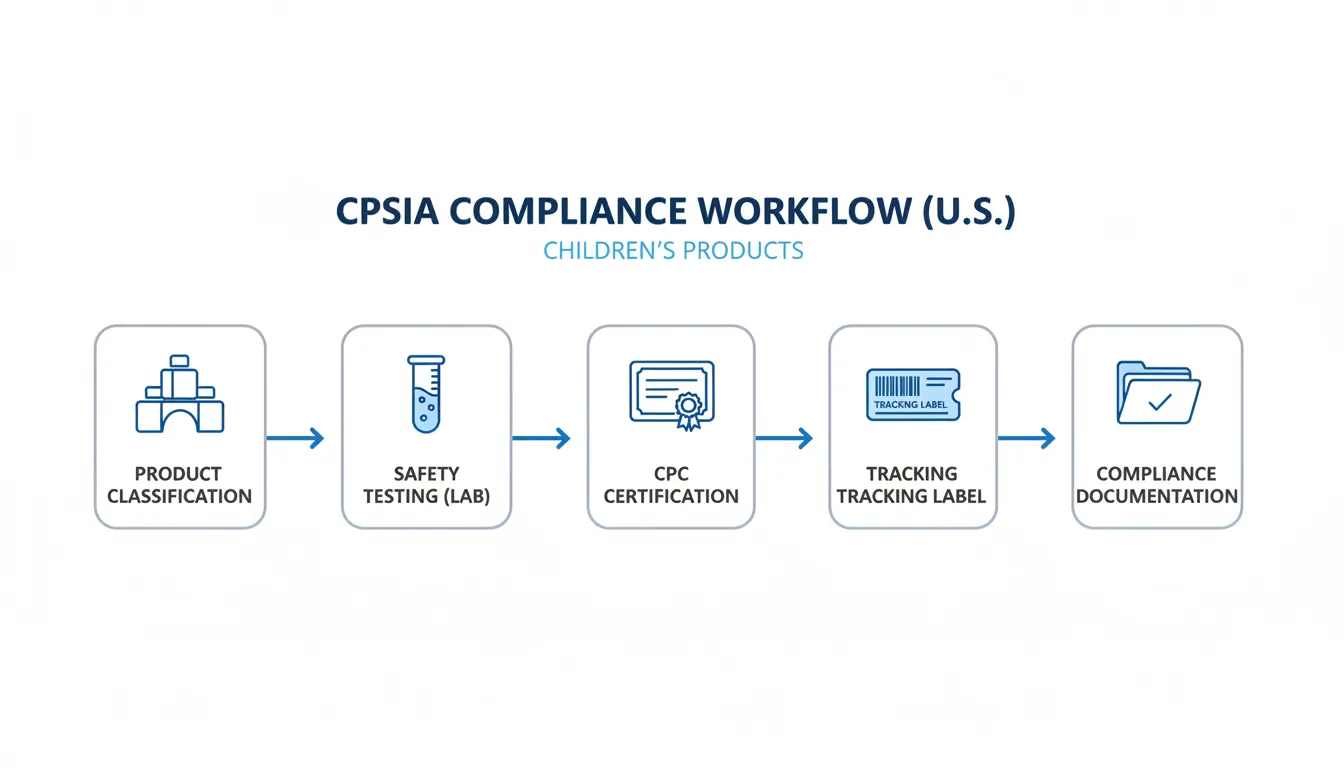
For manufacturers and importers selling in the United States, the Consumer Product Safety Improvement Act (CPSIA) represents the gold standard of product safety regulation. Enacted in 2008 and enforced by the Consumer Product Safety Commission (CPSC), this law fundamentally changed how children’s products are regulated, shifting from reactive recalls to proactive, mandatory pre-market testing.
In 2026, compliance is non-negotiable. Amazon and major retailers utilize automated bots to suppress listings missing a valid Children’s Product Certificate (CPC), and customs officials routinely seize non-compliant shipments. This guide provides the definitive operational framework for navigating CPSIA requirements, from lead testing to tracking labels.
What Is CPSIA?
The Consumer Product Safety Improvement Act (CPSIA) is a federal law designed to make children’s products safer by requiring them to comply with strict chemical and safety standards before they are sold.
Purpose and Goals
The law targets the “most vulnerable consumers”-children aged 12 and under. Its primary goals are:
- Reduce Exposure: Limit children’s exposure to toxic chemicals like lead and phthalates.
- Prevent Injury: Mandate testing for mechanical hazards (choking, sharp points) in toys.
- Traceability: Require permanent tracking labels to facilitate effective recalls.
Scope
CPSIA applies to all “children’s products” sold in the US, regardless of where they are manufactured. It covers everything from clothing and shoes to toys, books, furniture, and childcare articles.
What Qualifies as a Children’s Product?
A common pitfall is misclassification. A product is defined as a “children’s product” if it is designed or intended primarily for use by children 12 years of age or younger.
Classification Framework
The CPSC uses four statutory factors to determine if an item is a children’s product:
- Marketing: Is the product sold in the “Toys” or “Baby” section? Are the ads targeting parents or kids?
- Packaging: Does the packaging feature cartoons, bright colors, or images of children?
- Appearance: Is the product sized for a child? Does it have “play value” (e.g., a small tool set vs. a real tool set)?
- Age Grading: What age determination does the manufacturer state? (Note: You cannot simply label a toy “For Ages 14+” to avoid CPSIA if it clearly looks like a toy for a 6-year-old. The CPSC will override your label).
Children’s Product vs. General Use Product
Correct classification determines your entire testing burden.
| Feature | Children’s Product | General Use Product |
|---|---|---|
| Target Age | 0 to 12 years. | 13+ years or “General Audience.” |
| Testing | Mandatory third-party testing at a CPSC-accepted lab. | Testing recommended but not always mandatory (unless specific bans apply). |
| Certification | Children’s Product Certificate (CPC) required. | General Certificate of Conformity (GCC) required for some items (e.g., clothing). |
| Tracking Label | Mandatory permanent label on product & packaging. | Not required. |
| Lead Limits | Strict limits (100 ppm substrate / 90 ppm paint). | Lead in paint limit (90 ppm) applies, but substrate limits often don’t. |
CPSIA Product Safety Requirements
Compliance requires meeting specific chemical and mechanical safety limits.
1. Lead Content (Substrates)
- Limit: Maximum 100 ppm (parts per million) total lead content.
- Scope: Applies to accessible parts (metal, plastic, fabric) that a child could touch, lick, or ingest.
- Exemptions: Pure wood, paper, CMYK printing ink, and certain natural fibers are naturally exempt from testing but must still comply.
2. Lead in Paint / Surface Coatings
- Limit: Maximum 90 ppm.
- Scope: Applies to paint, lacquer, varnish, or screen printing on any consumer product (children’s or adult).
3. Phthalates
- Limit: Maximum 0.1% (1000 ppm) for each of 8 specific phthalates (DEHP, DBP, BBP, DINP, DIBP, DPENP, DHEXP, DCHP).
- Scope: Applies to plasticized parts in toys and childcare articles (e.g., soft vinyl, rubber ducks, teethers).
4. Toy Safety Standard (ASTM F963-23)
- Requirement: All “toys” (intended for play for <14 years) must comply with ASTM F963-23.
- Includes: Heavy metals screening (antimony, arsenic, etc.), mechanical testing (drop test, compression), and battery safety.
5. Small Parts (Choking Hazard)
- Rule: Products for children under 3 must not have small parts that fit into the CPSC “small parts cylinder.”
- Labeling: Products for children 3–6 years containing small parts must carry a specific warning label (e.g., “⚠️ WARNING: CHOKING HAZARD”).
6. Flammability
- Clothing: Must meet 16 CFR 1610 (General Wearing Apparel). Most plain fabrics (cotton, polyester) pass easily or are exempt based on weight.
- Sleepwear: Strict standards (16 CFR 1615/1616) requiring flame resistance and tight-fitting dimensions.
Role of the Consumer Product Safety Commission (CPSC)
The CPSC is the federal enforcement agency. They do not “approve” products pre-market. Instead, they enforce the rules through:
- Port Surveillance: Working with Customs (CBP) to seize non-compliant shipments.
- Market Surveillance: Buying products from Amazon/retailers to test them.
- Recalls: Ordering companies to remove dangerous products from the market.
CPSIA Testing Requirements
This is the most expensive part of compliance. You cannot test products yourself; you must use a CPSC-Accepted Third-Party Laboratory.
1. Initial Certification Testing
Before selling a single unit, you must send samples of the finished product (not just raw materials) to the lab. The lab tests for all applicable rules (Lead, Phthalates, ASTM F963, etc.).
2. Material Change Testing
If you change a supplier, manufacturing process, or material (e.g., switching from blue plastic to red plastic), you must re-test the new component.
3. Periodic Testing
Even if nothing changes, you must re-test your product periodically (typically once a year) to ensure ongoing compliance, unless you have a robust “Reasonable Testing Program” in place, which can extend the interval to 2-3 years.
Children’s Product Certificate (CPC)
The CPC is a document you create based on passing test results. It is not a certificate issued by the lab or the government.
Responsibility
- Importers: Must issue the CPC for products made overseas.
- US Manufacturers: Must issue the CPC for products made domestically.
Anatomy of a Valid CPC
A valid CPC must contain these 7 specific sections:
- Identification of the Product: Specific description (SKUs, colors).
- Citation to each CPSC Safety Regulation: List the exact rules passed (e.g., “15 USC 1278a” for lead).
- Importer/Manufacturer Information: Name, full address, and phone number.
- Contact Information for Records: The person maintaining the test results.
- Date and Place of Manufacture: Month/Year and City/Country/Factory.
- Date and Place of Testing: When and where the third-party lab tested the sample.
- Third-Party Lab Identification: Name, address, and ID number of the lab.
CPSIA Tracking Labels
Every children’s product and its packaging must have a permanent tracking label. Stickers are generally not acceptable unless the product surface (e.g., plush toy) makes printing impossible.
Required Information
- Manufacturer/Private Labeler Name: Who is responsible for the product.
- Location of Production: City, State/Country.
- Date of Production: Month and Year (or specific date).
- Cohort Information: Batch number, run number, or other code helping identify the specific production run.
Placement: Must be visible on the product itself (e.g., printed on the bottom of a toy, sewn into a shirt neck) AND on the retail packaging.
CPSIA Compliance Workflow
Step 1: Product Classification
Determine if it is a “Children’s Product” (Age ≤12) and if it is a “Toy” (Intended for play).
Step 2: Safety Rule Mapping
Identify which rules apply.
- Example: A cotton baby onesie needs Lead (snaps), Phthalates (if plastic prints), and Flammability (fabric). It does not need ASTM F963 (not a toy).
Step 3: Sourcing & Material Review
Select materials that are inherently compliant or have high likelihood of passing. Avoid cheap alloys or recycled plastics for high-risk parts.
Step 4: Third-Party Lab Testing
Send production samples to a CPSC-accepted lab (e.g., QIMA, Intertek, SGS, BV). Get the passing test report.
Step 5: Create the CPC
Draft the Children’s Product Certificate using the data from the test report.
Step 6: Tracking Labels
Ensure the factory prints the permanent tracking info on the final production run.
Step 7: Import & Sale
Provide the CPC to the importer/broker for Customs entry. Upload the CPC to Amazon/retailer portals.
Roles & Responsibilities
| Role | Responsibility |
|---|---|
| Foreign Manufacturer | Produces safe product; prints tracking labels. Does NOT issue the CPC for US imports. |
| US Importer | Compliance Owner. Defined as the “manufacturer” under CPSIA. Must organize testing, issue the CPC, and hold records. |
| Private Labeler | If branding a generic product, you assume full manufacturer responsibilities (Testing + CPC + Tracking Label). |
| Retailer (Amazon) | Verifies compliance. Will suppress listings without a valid CPC and test reports. |
CPSIA for Importers & Amazon Sellers
Amazon is the strictest enforcer of CPSIA compliance for small businesses.
- The “Gatekeeper” Rule: Amazon requires you to upload the CPC and the Test Report. The information on the CPC (SKUs, Manufacturer Name) must exactly match the Amazon listing.
- Small Batch Manufacturers: If you are a registered “Small Batch Manufacturer” with the CPSC (sales <$1M range), you may be exempt from some third-party testing (Group B requirements), but Lead testing is always mandatory. You still need a CPC.
Documentation & Records
You must keep compliance records for 5 years.
- Test Reports: The full PDF from the lab.
- CPC: The certificate you created.
- Bill of Materials (BOM): Proof of material inputs.
- Production Records: Evidence linking the tracking label batch code to specific manufacturing dates.
Lifecycle CPSIA Compliance
- Design: Engineer out hazards (e.g., remove small parts for baby toys).
- Production: Implement “Undue Influence” policies ensuring factory managers don’t pressure labs for passing results.
- Import: Ensure CPC accompanies the shipment manifest.
- Sale: Monitor CPSC updates. If a standard changes (e.g., ASTM F963 updates), you typically have 180 days to comply with the new rule for future production.
Common CPSIA Compliance Mistakes
- Relying on Supplier “Certificates”: A factory saying “We are ISO certified” or sending a generic Chinese test report is not compliant. You need a CPSC-accepted lab report for your specific finished product.
- Missing Tracking Labels: Printing the info on the box but forgetting the product itself.
- Wrong Age Grade: Labeling a toy “14+” to avoid testing when it clearly appeals to an 8-year-old.
- Incomplete CPC: Missing the lab address or the exact date of manufacture.
Risks of Non-Compliance
- Customs Seizure: Shipment destroyed at the port.
- Forced Recall: You pay to ship products back and refund customers.
- Civil Penalties: Fines can reach $100,000 per violation, up to $15 million for a series of violations.
- Listing Suppression: Amazon removes your ASIN, freezing your inventory.
Frequently Asked Questions
What is a children’s product?
A consumer product designed or intended primarily for children 12 years of age or younger.
Do I need CPSIA testing?
Yes. If it is a children’s product, third-party testing by a CPSC-accepted lab is mandatory. There are almost no exceptions for lead content.
Who issues the CPC?
The US Importer (for foreign goods) or the US Manufacturer (for domestic goods). The lab does not issue the CPC.
Do handmade items need CPSIA?
Yes. Even if you knit sweaters at home and sell on Etsy, you are a “manufacturer.” You must comply with lead limits, flammability, and labeling. (You may register as a Small Batch Manufacturer to reduce some testing costs, but compliance is still required).
Does CPSIA apply to imports?
Yes. Imported products must meet the exact same standards as US-made products. The Importer of Record is responsible for certification.