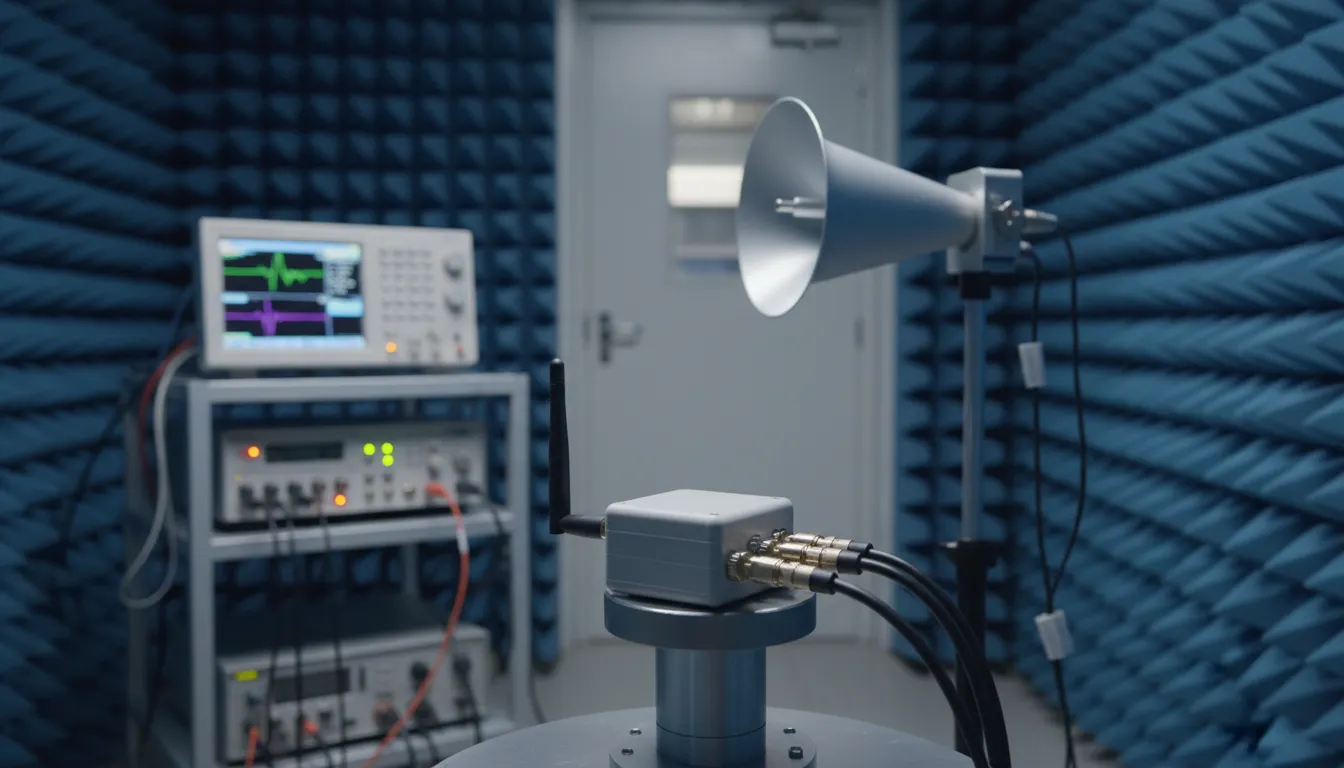
For any electronics manufacturer targeting the United States market, FCC certification is not optional-it is a federal requirement enforced by law. If your device oscillates at a frequency higher than 9 kHz, you fall under the jurisdiction of the Federal Communications Commission (FCC).
The landscape of FCC compliance has evolved significantly. With the FCC’s recent crackdowns on non-compliant RF devices and stricter rules for “modular” integrations, the “sell first, certify later” approach is a guaranteed path to Customs seizures, listing suppression on Amazon, and fines reaching tens of thousands of dollars per day.
This guide provides the definitive engineering and regulatory framework to navigate FCC Part 15, choose the right authorization pathway (Certification vs. SDoC), and execute a compliant product launch in 2026.
What Is FCC Certification?
FCC Certification is the process of validating that an electronic device does not cause harmful electromagnetic interference (EMI) to other devices and, for wireless products, operates effectively within its allocated frequency spectrum.
Purpose and Authority
The FCC’s authority stems from Title 47 of the Code of Federal Regulations (47 CFR). The primary goal is to manage the radio frequency (RF) spectrum-a finite natural resource. Without these rules, your Wi-Fi router would jam your neighbor’s baby monitor, and a cheap phone charger could knock out emergency radio communications.
Key Concept: “Harmful Interference”
Certification does not prove your product works well or is “safe” in a general sense (that’s UL/ETL). It specifically proves your product is a “good neighbor” electromagnetically-it doesn’t shout too loud (emit interference) and stays in its lane (frequency stability).
FCC Regulations Framework
The FCC rules are divided into “Parts.” Knowing which Part applies to your device is the first step in the engineering lifecycle.
| Part | Scope | Typical Devices |
|---|---|---|
| Part 15 | Radio Frequency Devices (Most Common) | Consumer electronics, Wi-Fi, Bluetooth, computers. |
| Part 18 | Industrial, Scientific, & Medical (ISM) | Microwaves, induction heaters, medical equipment. |
| Part 22/24 | Cellular/Wide Area Networks | Phones, LTE/5G modules. |
| Part 68 | Terminal Equipment | Modems, landline phones. |
| Part 95 | Personal Radio Services | Walkie-talkies (FRS/GMRS), CB radios. |
Note: Most consumer electronics fall under Part 15, which regulates both unintentional and intentional radiators.
Devices That Require FCC Certification
Your certification pathway depends entirely on how your device creates and uses RF energy.
1. Unintentional Radiators
These devices generate RF energy internally to function (e.g., via clocks, microprocessors, switching power supplies) but are not intended to broadcast radio waves.
- Examples: USB drives, coffee makers, wired mice, LED lights, power banks.
- Requirement: Usually Supplier’s Declaration of Conformity (SDoC).
2. Intentional Radiators
These devices actively transmit radio waves as their primary function.
- Examples: Bluetooth speakers, Wi-Fi routers, smartphones, remote controls, wireless chargers.
- Requirement: FCC Certification (FCC ID required).
3. Incidental Radiators
Devices that generate RF energy only as a byproduct of mechanical operation.
- Examples: DC motors, mechanical light switches.
- Requirement: No certification/SDoC, but must use “good engineering practice” to minimize interference.
FCC Authorization Pathways
The FCC recently phased out the “Verification” process, simplifying the system into two main paths: SDoC and Certification.
Decision Tree: Which Path?
- Does the device have a wireless transmitter (Wi-Fi, BT, Zigbee)?
- Yes: FCC Certification (requires FCC ID).
- No: Go to Q2.
- Does it contain digital circuitry (clocks >9 kHz)?
- Yes: SDoC (Supplier’s Declaration of Conformity).
- No (e.g., passive cable): No action required.
Supplier’s Declaration of Conformity (SDoC)
- For: Wired devices, unintentional radiators.
- Process: Self-declaration. You test the product (can be non-accredited lab, but accredited is safer) and keep the file on hand.
- Label: No FCC ID required. Must display a specific compliance statement and the Responsible Party (must be US-based) in the manual/on product.
FCC Certification
- For: Wireless devices (Intentional Radiators).
- Process: Strict. Must test at an FCC-Accredited Lab. Application is reviewed by a Telecommunications Certification Body (TCB).
- Label: FCC ID required on the product.
FCC ID Explained
The FCC ID is a unique alphanumeric string that acts as a regulatory fingerprint for wireless devices.
Structure: FCC ID: [Grantee Code] - [Product Code]
- Grantee Code (3 or 5 chars): Assigned by the FCC to your company permanently.
- Product Code (up to 14 chars): Assigned by you (the manufacturer) to identify the specific model.
The Grant of Equipment Authorization
When a TCB approves your application, they issue a “Grant.” This is your legal proof of compliance. The Grant lists the frequencies, power output, and emission designators. You cannot sell until this Grant is listed in the FCC database.
FCC Testing Requirements
Testing validates that your hardware design meets Part 15 limits.
1. Radiated Emissions
Measures the RF energy leaking from your device into the air.
- Limit: Devices must stay below specific field strength limits (measured in dBµV/m) across a frequency range (e.g., 30 MHz to 40 GHz).
2. Conducted Emissions
Measures noise your device pushes back into the AC power grid.
- Limit: Strict limits on the “noise” permitted on power lines.
3. RF Output Power & Bandwidth
For wireless devices: Validates you are transmitting at the allowed power (e.g., 1 Watt for some Wi-Fi bands) and staying within your assigned channel.
4. Specific Absorption Rate (SAR)
For body-worn devices (phones, smartwatches): Measures how much RF heat is absorbed by human tissue.
- Note: SAR testing is expensive and time-consuming.
FCC Certification Process Step-by-Step
Step 1: Design for Compliance
Don’t wait until the end. Use pre-scans during prototyping to catch EMI issues early. Shielding cans and proper grounding planes are cheaper than redesigning a PCB later.
Step 2: Obtain FRN and Grantee Code
- Register for an FCC Registration Number (FRN) in the CORES system.
- Pay the fee to get your Grantee Code.
Step 3: Select an Accredited Lab
You cannot test intentional radiators in your garage. You must use an FCC-listed accredited laboratory.
Step 4: Testing & Documentation
Submit samples (often modified with SMA connectors for direct measurements) and documentation (block diagrams, schematics). The lab performs the tests.
Step 5: TCB Submission
The lab sends the test report to a TCB (Telecommunications Certification Body). The TCB reviews the technical file.
Step 6: Grant Issued
Once approved, the TCB uploads the info to the FCC database and issues the Grant. You can now label and sell the product.
Pre-Certified RF Modules Strategy
The “Hack” for Startups: Using a pre-certified module (e.g., an ESP32 or Nordic nRF module) can save you $10k+ and months of time.
Modular Approval Logic
If you use a module that already has an FCC ID, you act as an “integrator.” You don’t need to recertify the radio if you follow the module maker’s strict antenna and layout rules.
“Contains FCC ID”
You certify the rest of your device (the unintentional digital parts) under SDoC.
- Label: Your product label must say: “Contains FCC ID: [Module’s ID]”.
- Caveat: If you modify the antenna or co-locate it with another radio, the modular grant is invalid, and you need a “Class II Permissive Change” or full certification.
FCC Technical Documentation
The TCB requires a robust “Technical File.” Missing documents are the #1 cause of delays.
- Block Diagram: Shows all clocks/oscillators and signal paths.
- Schematics: Full circuit diagrams.
- Operational Description: A narrative explaining how the radio works (modulation, antenna gain).
- BOM (Bill of Materials): List of components.
- User Manual: Must include required FCC interference statements.
- Label Artwork: Showing placement of FCC ID.
- Test Report: Generated by the lab.
Labeling & User Manual Requirements
Physical Label
- FCC ID: Must be visible on the exterior.
- Statement: “This device complies with Part 15 of the FCC Rules…” (required for SDoC devices or larger wireless devices).
- SDoC Unique Rule: Wired products must identify the US Responsible Party (Name, Address, Phone/Internet) either on the label or in the manual.
E-Labeling
Devices with a screen (like a phone) can display the FCC ID in the software menu, but a physical label (or packaging label) is still required for the point of sale.
Costs & Timelines
Estimates for 2026:
| Device Type | Certification Type | Estimated Cost | Time |
|---|---|---|---|
| Wired Device (Mouse, LED) | SDoC | $1,000 – $3,000 | 1-2 Weeks |
| Wireless Device (Standard) | FCC ID (Certification) | $3,000 – $5,000 | 3-5 Weeks |
| Body-Worn Wireless (Phone) | FCC ID + SAR Testing | $10,000 – $25,000+ | 6-10 Weeks |
| Module Integration | SDoC + “Contains FCC ID” | $1,500 – $3,000 | 1-2 Weeks |
Note: Re-spins (failing a test and fixing it) will double your lab costs.
Ongoing FCC Compliance
FCC compliance is not “one and done.”
- Product Changes: If you change a component (e.g., different inductor, new plastic enclosure), you must evaluate if it impacts emissions. Minor changes might need internal documentation; major changes (new antenna, higher power) need a Class II Permissive Change filing.
- Market Surveillance: The TCBs are required to audit 5% of the products they certified every year. They may ask for a sample off the shelf to re-test.
FCC vs. CE vs. Other Certifications
| Feature | FCC (USA) | CE (Europe) | ISED (Canada) |
|---|---|---|---|
| Focus | EMC & RF only. | Safety, EMC, RF, RoHS, Eco. | EMC & RF (similar to FCC). |
| Process | Certification via TCB. | Self-Declaration (DoC). | Certification via CB. |
| Marking | FCC ID / Statement. | CE Mark. | IC ID. |
| Testing | Accredited Lab required for ID. | Lab recommended, not strictly mandatory for all. | Accredited Lab required. |
Note: Most manufacturers test for FCC, ISED, and CE simultaneously to save lab setup fees.
Common FCC Certification Mistakes
- Wrong Grantee Code: Applying for a grant under the factory’s code instead of your brand’s code. (You lose control of the ID).
- “China Export” Confusion: Assuming the “CE” mark covers the US. It does not.
- Module Misuse: Using a pre-certified module but adding a high-gain antenna that wasn’t on the original grant.
- Missing US Rep: For SDoC, foreign manufacturers must have a contractual US Responsible Party. You cannot just list your China address.
Risks of Non-Compliance
- Customs Seizure: FCC and Customs (CBP) share data. Uncertified radio goods are routinely blocked.
- Listing Removal: Amazon requires FCC ID entry for wireless goods. No ID = No ASIN.
- Fines: The FCC Enforcement Bureau issues Notices of Apparent Liability (NAL). Fines for marketing unauthorized devices can exceed $10,000 per day.
Frequently Asked Questions
Do all electronics need FCC certification?
Almost all. If it oscillates above 9 kHz (digital logic, switching power), it needs at least SDoC. Only simple passive devices (batteries, wire, resistive loads) are exempt.
Is FCC only for wireless?
No. “Unintentional radiators” (wired digital devices) must still meet EMC limits to prevent noise pollution.
What is the FCC ID?
It is the unique code assigned to a specific wireless product model, linking it to your company and the test data held by the FCC.
Can I self-declare (SDoC) for wireless products?
No. Intentional radiators must go through the full Certification process with a TCB. SDoC is only for wired/unintentional devices (or the non-radio parts of a combined device).
How long does FCC certification take?
Plan for 4-6 weeks for a standard wireless device. If you fail emissions testing (very common), add 2-4 weeks for debugging and re-testing.