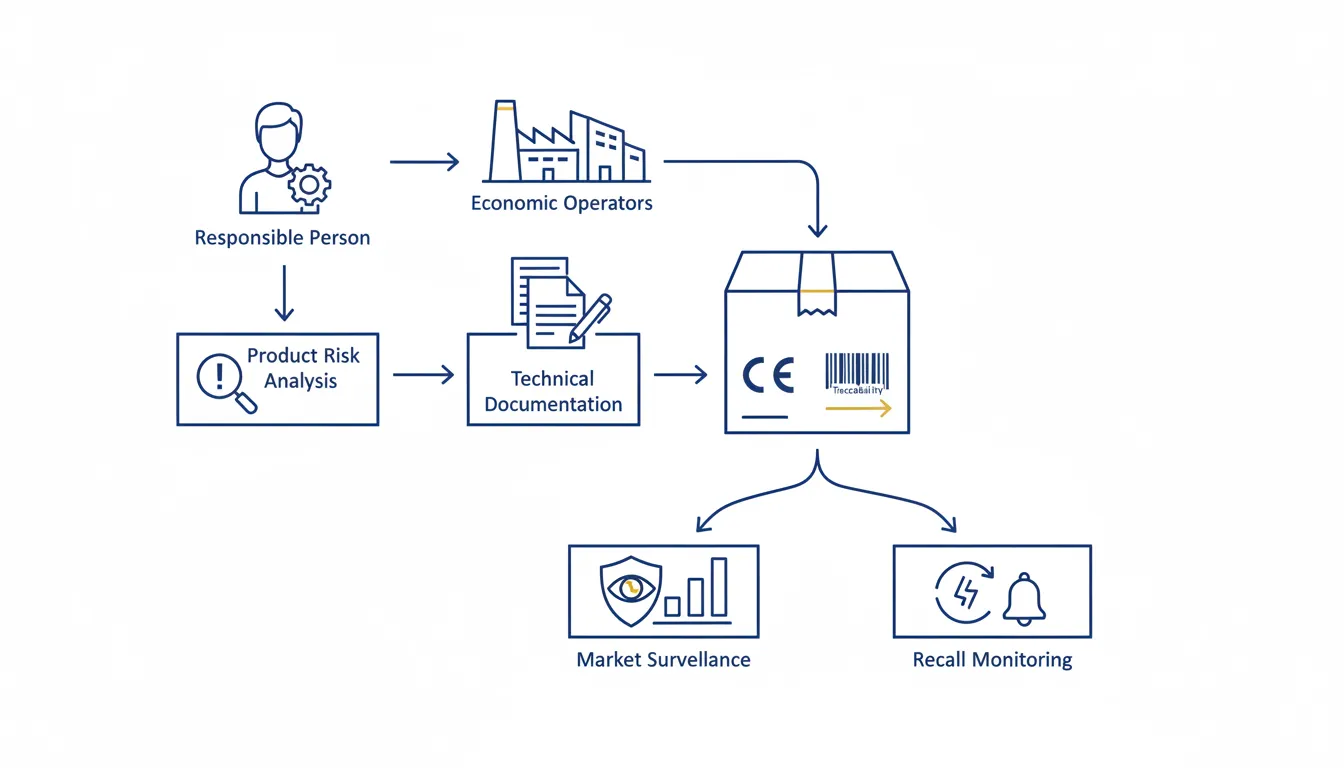
In the European Union, the era of reactive product safety is over. With the full implementation of the General Product Safety Regulation (EU) 2023/988 (GPSR)-which became applicable on December 13, 2024-the EU has established the world’s most rigorous “safety net” for consumer goods.
For manufacturers, importers, and online sellers, the GPSR is not optional. It applies to all consumer products sold in the EU that are not covered by specific harmonized legislation (like toys or electronics), and it fills the gaps where specific legislation exists. Failure to comply leads to immediate listing suppression on Amazon/eBay, customs blockages, and Safety Gate alerts.
This guide provides the definitive operational framework for navigating the GPSR, establishing a Responsible Person, and constructing the mandatory technical documentation.
What Is the EU General Product Safety Regulation (GPSR)?
The General Product Safety Regulation (GPSR) is the foundational legal framework ensuring that only safe products are placed on the EU market. It repealed and replaced the outdated General Product Safety Directive (GPSD) of 2001, modernizing the rules to address e-commerce, software-connected devices, and complex supply chains.
Purpose and “Safety Net” Function
The core purpose of the GPSR is to ensure a high level of consumer protection. It operates as a legislative “safety net.”
- If no specific EU law exists for your product (e.g., gym equipment, furniture, clothing, lighters), the GPSR applies in full.
- If specific EU law exists (e.g., Toy Safety Regulation), the GPSR applies to any risks not covered by that specific law (e.g., cyber-safety risks in connected toys).
Regulation vs. Directive
Unlike the old Directive (which required local transposition laws in each country), the GPSR is a Regulation. It applies directly and uniformly across all 27 EU Member States. This eliminates the patchwork of national rules, creating a single standard for product safety, traceability, and enforcement.
Scope: Products Covered by GPSR
Understanding the scope is the first step in compliance. The GPSR applies to any product-whether new, used, or reconditioned-that is intended for consumers or likely to be used by consumers under reasonably foreseeable conditions.
1. Non-Harmonized Products (Full Scope)
For products without a specific CE marking directive, the GPSR is the primary law.
- Examples: Childcare articles (dummies, cribs), furniture, gym equipment, clothing (drawstrings/flammability), lighters, bicycles, stationery, candles.
2. Harmonized Products (Partial Scope)
For products like electronics (LVD/EMC), toys, or PPE, the specific legislation takes precedence. However, the GPSR applies to aspects not covered by those laws, particularly regarding online sales obligations and accident reporting.
3. Exclusions
The GPSR does not apply to:
- Medicinal products (human or veterinary).
- Food and feed.
- Living plants and animals.
- Aircraft and antiques.
- Products clearly marked as needing repair or reconditioning before use.
Economic Operators Under GPSR
The GPSR assigns specific legal liabilities to every actor in the supply chain. You must identify which role you play to understand your obligations.
Roles and Responsibilities Matrix
| Role | Definition | Key Responsibilities |
|---|---|---|
| Manufacturer | The entity that manufactures the product or has it designed/manufactured under their name/trademark. | Perform risk analysis, draw up technical documentation, affix labels, ensure instructions are present. |
| Importer | The entity established in the EU that places a product from a third country on the EU market. | Ensure the manufacturer has complied. Verify technical files exist. Keep a copy of documentation. You are liable if the manufacturer fails. |
| Distributor | Any person in the supply chain (other than manuf/importer) who makes a product available. | Verify the product has the correct labels and manufacturer/RP contact info. Do not sell non-compliant goods. |
| Fulfillment Service Provider | Warehousing/packaging services (e.g., Amazon FBA) located in the EU. | If no other operator is established in the EU, the fulfillment provider assumes the responsibilities of the Responsible Person. |
| Authorized Representative | An EU entity appointed by a non-EU manufacturer to handle compliance tasks. | Keep documentation, cooperate with authorities, and serve as the contact point. |
The Responsible Person Requirement
Article 16 of the GPSR introduces a strict requirement: A product cannot be placed on the EU market unless there is an economic operator established in the Union responsible for tasks related to product safety.
Who Can Be the Responsible Person (RP)?
The RP must be physically located in the EU (or Northern Ireland). It can be:
- The Manufacturer (if based in the EU).
- The Importer (if the manufacturer is non-EU).
- An Authorized Representative appointed by the manufacturer.
- A Fulfillment Service Provider (if none of the above exist).
Obligations of the Responsible Person
The RP is not just a mail drop. They legally verify compliance. Their duties include:
- Documentation Verification: Verifying that the EU Declaration of Conformity (if applicable) and technical documentation have been drawn up.
- Storage: Keeping the documentation available for market surveillance authorities for 10 years.
- Communication: Providing all information and documentation necessary to demonstrate conformity upon request.
- Incident Response: Cooperating with authorities to eliminate risks (recalls, corrective actions).
- Labeling Presence: Their name and contact details (postal and email) must appear on the product or packaging.
Core GPSR Product Safety Requirements
The “General Safety Requirement” states that economic operators shall place only safe products on the market. But what defines “safe”?
Safe Design Principles
A product is safe if it presents no risk or only minimum risks compatible with the product’s use. This assessment must consider:
- Characteristics: Composition, packaging, assembly.
- Effect on Other Products: Interconnectivity (e.g., smart home devices).
- Presentation: Labeling, warnings, instructions for use and disposal.
- Consumers: Vulnerable groups (children, elderly, disabled).
Standards and Presumption of Conformity
You demonstrate safety by complying with:
- European Standards (EN): References published in the Official Journal of the EU.
- National Standards: In the absence of EN standards.
- Voluntary Standards: ISO or ASTM (if relevant to the EU safety level).
- Codes of Good Practice: Industry safety guidelines.
GPSR Risk Analysis & Safety Assessment
Under the GPSR, manufacturers must conduct an internal Risk Analysis before placing a product on the market. This is the cornerstone of your technical file.
Risk Analysis Framework
You cannot simply “guess” a product is safe. You must document the methodology:
- Hazard Identification: Identify potential hazards (chemical, mechanical, electrical, thermal, flammability, hygiene).
- Example: A hoodie has drawstrings (Strangulation hazard).
- Exposure Scenarios: Determine how a user interacts with the product during intended use and reasonably foreseeable misuse.
- Example: A child chewing on a toy (Ingestion).
- Risk Evaluation: Assess the Severity of injury and the Probability of occurrence.
- Tool: Use the RAPEX Risk Assessment Guidelines (RAG) matrix.
- Risk Mitigation: If the risk is not “acceptable,” you must redesign the product or add warnings.
- Action: Shorten drawstrings to meet EN 14682 standards.
GPSR Technical Documentation (Technical File)
Article 9 requires manufacturers to draw up technical documentation. This file must be kept for 10 years and provided to authorities upon request.
Anatomy of a Compliant Technical File
Your technical file should be organized into these sections:
- General Description: Photos, drawings, bill of materials (BOM), intended use.
- Risk Assessment Report: The documented analysis of hazards and risks (as described above).
- List of Standards: Which EN standards or regulations were applied (e.g., EN 71 for toys, EN 14682 for children’s clothes).
- Test Reports: Evidence from internal or third-party labs proving the product meets those standards.
- Instruction Manual: Copies of user guides and safety warnings.
- Labeling Copies: Proof of traceability and Responsible Person labeling.
- Production Control: Description of how you ensure mass production remains compliant (QC checks).
Labeling & Traceability Requirements
The GPSR significantly tightens traceability rules to ensure unsafe products can be quickly identified and recalled.
On-Product Labeling
The following must be clearly visible on the product (or packaging if the product is too small):
- Manufacturer Identification: Name, registered trade name, and postal address.
- Electronic Contact: An email address or website URL (New GPSR requirement!).
- Traceability: Type, batch, serial number, or other element ensuring identification.
- Responsible Person: Name and postal/email address of the EU Responsible Person.
- Safety Information: Warnings and instructions in the language of the Member State where sold.
Note: A QR code or website link alone is generally not sufficient for safety warnings; they must be physically present.
GPSR for Online Marketplace & Distance Sales
The GPSR explicitly targets online marketplaces (like Amazon, eBay, Zalando) and distance sellers. If you sell online, the compliance requirements extend to your digital listing.
The “Compliance on Listing” Rule
Article 19 requires that the product offer on the website must clearly display:
- Manufacturer Name & Contact: Physical address and email.
- Responsible Person Name & Contact: Physical address and email.
- Product Identification: A picture enabling identification (labels, packaging).
- Warning & Safety Info: The same warnings present on the physical product (e.g., “Not suitable for children under 3 years”).
Impact on Amazon Sellers: Amazon now requires you to upload Responsible Person information and safety images to the “Compliance” tab of your ASIN. Failure to do so results in listing deactivation.
Marketplace Obligations
Online marketplaces are now legally required to:
- Design interfaces that allow sellers to input this information.
- React to government takedown orders within 2 days.
- Process consumer safety notices within 3 days.
Market Surveillance & Incident Reporting
Enforcement is handled by national authorities (e.g., DGCCRF in France, BAM in Germany), coordinated via the EU Safety Gate (formerly RAPEX).
Authority Powers
Market surveillance authorities can:
- Perform unannounced inspections and buy samples (mystery shopping).
- Request technical documentation (must be provided typically within a few days).
- Order product withdrawals or recalls.
- Order websites to geo-block listings.
Incident Reporting (Safety Business Gateway)
If a manufacturer considers a product dangerous, they must immediately notify authorities via the Safety Business Gateway.
- Accidents: Under GPSR, you must report any accident associated with the product that results in death or serious health effects.
GPSR Compliance Workflow
To ensure full compliance, implement this lifecycle model:
Step 1: Product Classification & Standard Mapping
Determine if the product is harmonized (CE) or non-harmonized (GPSR only). Identify applicable EN standards.
Step 2: Risk Analysis
Conduct a formal risk assessment. Document hazards and mitigation strategies.
Step 3: Testing & Validation
Test the product against identified standards. Secure test reports from suppliers or labs.
Step 4: Technical Documentation
Compile the technical file. Ensure it is accessible to the EU Responsible Person.
Step 5: Labeling & Traceability
Design labels including Manufacturer, RP, and Batch ID. Ensure instructions are translated for all target markets.
Step 6: Online Listing Compliance
Update e-commerce listings with Manufacturer and RP contact details and safety images.
Step 7: Post-Market Monitoring
Monitor customer reviews for safety complaints. Report serious accidents to the Safety Business Gateway.
GPSR vs. CE Marking & Harmonized Legislation
It is crucial to distinguish between the GPSR and CE marking.
| Feature | CE Marking Legislation | GPSR (General Product Safety) |
|---|---|---|
| Applicability | Specific categories (Toys, Electronics, PPE). | All consumer products (Safety Net). |
| Marking | CE Mark required. | No specific mark required. |
| Standard | Harmonized Standards (hEN). | European Standards (EN), National standards. |
| Safety Logic | “Presumption of Conformity” via specific tests. | “General Safety Requirement” via risk assessment. |
| Overlap | Applies. | Applies for aspects not covered by CE laws (e.g., online duties). |
Note: You do NOT put a CE mark on a product regulated solely by GPSR (e.g., a chair or a gym weight). Doing so is illegal.
Common GPSR Compliance Mistakes
- Missing Responsible Person: Selling into the EU from China/USA without appointing an EU-based RP. This leads to instant customs seizure.
- No Risk Assessment: Having test reports but no document explaining why those tests were chosen or analyzing the risks.
- Digital-Only Warnings: Assuming a QR code replaces the need for a physical warning label on the product.
- Incomplete Online Listings: Failing to display the RP email address on the Amazon product page.
- Ignoring “Foreseeable Misuse”: Failing to test how a child might misuse a product (e.g., swallowing a button battery).
Risks of Non-Compliance
- Market Withdrawal: Authorities can order you to stop sales immediately.
- Forced Recall: You bear the cost of retrieving products from consumers.
- Financial Penalties: Fines vary by Member State but can reach percentages of annual turnover.
- Brand Damage: Listing on the public Safety Gate database destroys consumer trust.
Frequently Asked Questions
What is GPSR?
The General Product Safety Regulation is the EU law ensuring all consumer products are safe. It replaces the GPSD and mandates a Responsible Person for all goods.
Who needs a Responsible Person?
Every manufacturer located outside the EU must appoint an EU-based Responsible Person. Without one, the product cannot legally enter the EU market.
Does GPSR apply to online sellers?
Yes. It specifically targets online marketplaces. Listings must display manufacturer and RP contact info and safety warnings visible before purchase.
What documentation is required?
You need a Technical File containing a general description, risk assessment, test reports, list of standards, and label copies. It must be kept for 10 years.
What is market surveillance?
It is the system of checks by national authorities (customs, inspectors) to ensure products meet safety rules. They use the Safety Gate system to alert all EU countries of dangerous goods.