For brands, importers, and e-commerce sellers, product compliance is not optional-it is the license to sell. Whether you are launching a private label on Amazon or distributing electronics to the EU, one missing document or incorrect label can lead to customs seizures, listing blocks, or mandatory recalls.
This guide provides a definitive roadmap for navigating the complex world of consumer product safety and regulatory certification. We explain the process, the documentation, and how to choose the right compliance partners to protect your business.
Who this guide is for:
- Brands & Private Labelers: Selling on Amazon, Walmart, or Shopify.
- Importers: Sourcing goods from China/Vietnam for US/EU markets.
- Manufacturers: seeking market access for new products.
1. Definitions: What You Must Know
Before spending money on testing, you must understand the terminology.
What is Product Compliance?
Product compliance is the process of ensuring a product meets all legal regulations, safety standards, and performance requirements of the target market. It is an ongoing obligation, not a one-time event.
What is Product Safety?
Product safety specifically refers to preventing harm to the user. A product can be “compliant” (have the right paperwork) but “unsafe” (battery explodes). True compliance ensures safety.
Compliance vs. Certification vs. Testing
- Testing: A lab checks a sample against a standard (e.g., “Does this toy contain lead?”). Output: Test Report.
- Certification: A third-party body reviews the test report and factory process to officially validate compliance. Output: Certificate (e.g., UL, FCC, CB).
- Compliance: The holistic status of the product, including testing, certification, labeling, and documentation.
Key Concepts
- Conformity Assessment: The entire procedure (testing + inspection + documentation) used to demonstrate a product meets the rules.
- Marking: Physical symbols on the product (CE, FCC, UKCA) proving compliance.
- DoC (Declaration of Conformity): A legal document signed by the manufacturer/importer stating, “I take full responsibility that this product meets regulations.”
- CoC (Certificate of Conformity): Similar to DoC, often issued by a third party for specific markets (e.g., SASO for Saudi Arabia).
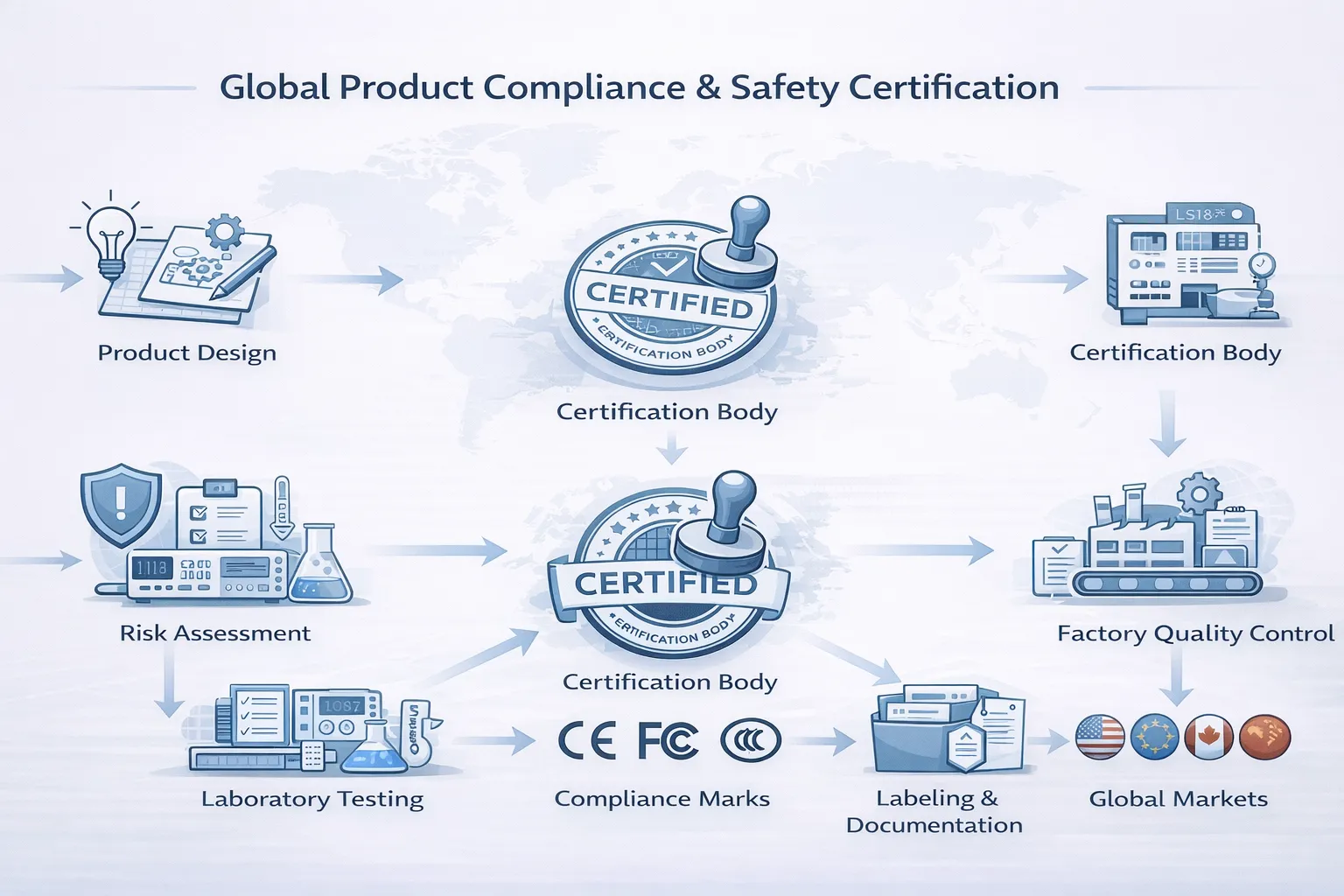
2. Compliance Roadmap: The Framework
Treat compliance as a project with a start and end, not an afterthought.
- Market Selection & Scoping: Decide where you will sell. (US rules $\neq$ EU rules).
- Risk Assessment: Identify hazards (choking, fire, chemical). Design them out before manufacturing.
- Standards Identification: List the specific standards (e.g., UL 62368 for power adapters, ASTM F963 for toys).
- Test Plan & Sampling: Determine how many samples to test and which components (e.g., just the battery or the whole unit?).
- Lab Testing: Send “Gold Samples” to an ISO 17025 accredited lab. Get the Test Report.
- Certification (If required): Submit reports to a Certification Body (e.g., for FCC ID or Bluetooth SIG).
- Labeling & Manuals: Draft labels with required symbols and warnings. Write the user manual.
- Technical File Compilation: Gather all docs into a “Technical Construction File” (TCF).
- Production Alignment: Ensure the factory uses the exact materials tested in mass production.
- Post-Market Surveillance: Monitor customer complaints and keep the file updated.
3. Regulations by Market: A Quick Matrix
Regulations vary wildly. Here is a navigation aid for common consumer products.
| Region | Regulatory Approach | Key Marking | Typical Documentation |
|---|---|---|---|
| USA | CPSC / FCC / EPA Self-declaration for most goods; Third-party testing for children’s products (CPSA). | FCC (Electronics) Tracking Label (Kids) | GCC (General Certificate of Conformity) or CPC (Children’s Product Certificate). |
| EU | CE Marking (New Approach Directives) Self-declaration allowed for many; Notified Body required for high-risk. | CE WEEE (Trash can) | EU DoC (Declaration of Conformity) Technical File Reach/RoHS reports. |
| Canada | Health Canada (CCPSA) Similar to US but distinct labeling (Bilingual: Eng/Fr). | ISED (Wireless) CSA/cUL (Safety) | Test Reports Bilingual Warnings. |
| China | CCC (China Compulsory Certification) Strict third-party testing + factory audit. | CCC | CCC Certificate GB Standard Reports. |
4. What Compliance Services Include
When you hire a compliance partner (like a lab or consultant), understand the division of labor.
| What The Provider Does | What You (The Client) Must Do |
|---|---|
| Regulatory Gap Analysis: “You need standards X, Y, and Z.” | Define Product Specs: “Here is exactly what we are building.” |
| Test Coordination: Managing the lab, booking slots, troubleshooting failures. | Supply Samples: Provide “Gold Samples” and spare parts. |
| Label Review: “Your font size is too small; add this warning.” | Apply Labels: Ensure the factory actually prints them correctly. |
| Certification Management: Submitting paperwork to FCC/Notified Bodies. | Sign Documents: You (Importer) are legally responsible. |
| Technical File Creation: Compiling the 50+ page dossier. | Provide Data: BOMs, schematics, and factory info. |
5. Documentation Checklist: The “Compliance Pack”
A Test Report alone is not enough. You need a full Technical File.
- Bill of Materials (BOM): List of every component (glue, plastic, screw) with supplier names.
- Schematics & PCB Layout: For electronics, showing how the circuit works.
- Materials Declarations: REACH/RoHS reports for every material in the BOM.
- Label Artwork: PDF showing product label and packaging label (to scale).
- User Manual: Including all safety warnings and intended use instructions.
- Traceability Info: Batch codes / Serial number format.
- Test Reports: The actual pass/fail data from the lab.
- DoC / Certificate: The signed legal statement.
- Risk Assessment: A document proving you analyzed safety risks (ISO 12100).
6. Common Mistakes & Risks
- “Compliance After Production”: Testing after you made 5,000 units. If it fails, you scrap everything. Fix: Test before mass production.
- Missing Traceability: No batch code on the product. If one unit is bad, you must recall all units ever sold.
- The “Golden Sample” Trap: The sample you sent to the lab was perfect, but the factory used cheaper plastic for production. Fix: Implement IQC (Incoming Quality Control).
- Labeling Errors: Missing “Made in China” or using the wrong CE logo dimensions. Customs loves to stop shipments for this.
- Thinking Amazon is the Regulator: Amazon asks for specific docs, but the law requires more. Don’t just satisfy the bot; satisfy the government.
7. How to Choose a Compliance Partner
Don’t just pick the cheapest lab.
- Accreditation: Must be ISO 17025 accredited for the specific standards you need.
- Scope: Do they cover Safety, EMC, and Chemicals? Or will you need 3 different vendors?
- Market Coverage: Can they do a “Global Access” report (one test accepted in 30 countries)?
- Speed: Lab testing usually takes 2-3 weeks. If they say 3 days, be suspicious.
- Support: Will they help you fix a failure, or just send a “FAIL” report and bill you?
8. FAQ
What is a product compliance certificate?
It is a formal document issued by a certification body (like UL, TUV, or Intertek) verifying that a product meets specific standards based on test results and often factory audits.
How do I get a compliance certificate?
- Identify standards. 2. Send samples to an accredited lab. 3. Pass tests. 4. Submit report to the certifier. 5. Pay fees and receive certificate.
When do I need CE vs FCC vs UL?
- CE: Mandatory for almost all goods sold in Europe.
- FCC: Mandatory for any electronics (radio/digital) sold in the USA.
- UL: Voluntary (but effectively mandatory for retailer acceptance) safety mark for USA.
What documents do labs require?
They need the General Application Form, User Manual, Schematics/Block Diagram (for electronics), and the Component List (BOM).
How long does certification take?
- Simple Testing (REACH, Toys): 1–2 weeks.
- FCC/CE Testing: 2–4 weeks.
- Full Certification (UL/medical): 2–6 months.
What’s the difference between testing and certification?
Testing generates data (“Lead content is 10ppm”). Certification validates the product (“This product is UL Listed”). Testing is a step in certification.
How to reduce recall risk?
Design for safety (eliminate hazards), test rigorously, maintain strict quality control in production, and have a robust traceability system (batch codes).
Conclusion
Product compliance is the bridge between a factory prototype and a global brand. It protects your customers from harm and your business from liability. Do not cut corners.
Ready to secure your product? Start by creating your Risk Assessment and Standards List today.