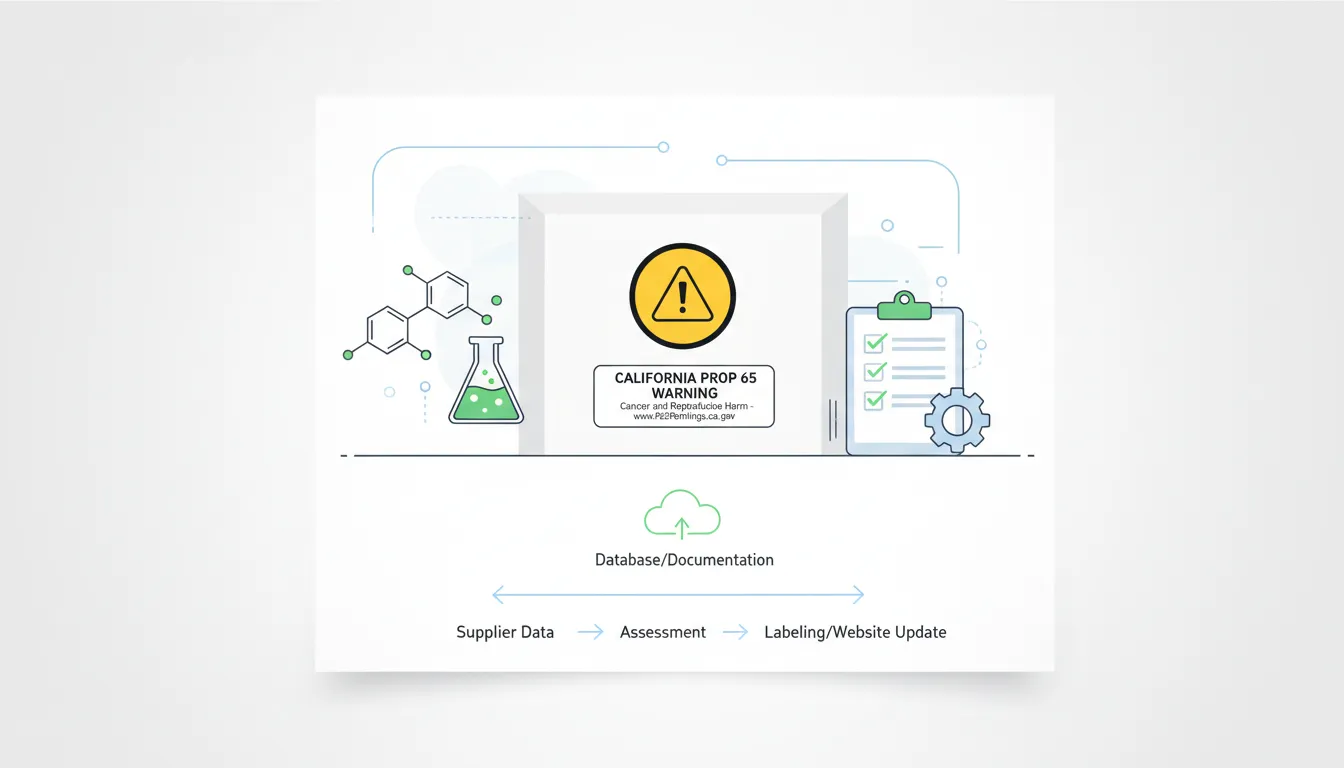
For companies selling products in California, Proposition 65 (The Safe Drinking Water and Toxic Enforcement Act of 1986) represents a unique compliance challenge. Unlike federal regulations that ban hazardous substances, Prop 65 is a “right-to-know” law that requires businesses to warn consumers about significant exposures to chemicals that cause cancer, birth defects, or other reproductive harm.
In 2026, compliance has become more complex with amended short-form warning rules, stricter online labeling requirements, and aggressive private enforcement targeting e-commerce sellers. This guide provides a comprehensive operational playbook for manufacturers, importers, and retailers to manage Prop 65 obligations, minimize legal risk, and build a defensible compliance program.
What Is Proposition 65 (and What It Is NOT)
A “Right-to-Know” Law
Proposition 65 requires businesses to provide a “clear and reasonable” warning before knowingly and intentionally exposing anyone in California to a listed chemical. The law does not ban these chemicals; it simply mandates that consumers be informed if exposure exceeds specific safety thresholds.
Not a Product Safety Standard
A common misconception is that a Prop 65 warning means a product is “unsafe” or “illegal.” This is incorrect. A product can be perfectly legal to sell and safe for use but still require a warning because it contains a listed chemical above the extremely conservative “safe harbor” limits set by California’s Office of Environmental Health Hazard Assessment (OEHHA).
Why Warnings Are Everywhere
You see Prop 65 warnings on everything from coffee shops to parking garages because the cost of defending a lawsuit is high, while the cost of adding a warning is low. Many companies choose to “over-warn” rather than risk litigation, even if exposure levels are negligible.
Who Must Comply (Roles & Liability)
Prop 65 liability extends across the entire supply chain, but the primary responsibility typically falls on the company that places the product into the stream of commerce in California.
| Role | Primary Responsibility | Common Scenario |
|---|---|---|
| Manufacturer / Brand Owner | Primary Liability. Responsible for determining if a warning is needed and affixing it to the product/packaging. | A tool brand must test handles for phthalates and label accordingly. |
| Importer | High Liability. Acts as the “domestic manufacturer” for foreign goods. Must ensure compliant labeling before goods enter CA. | An importer of leather bags must ensure suppliers don’t use high-lead tanning agents. |
| Distributor | Pass-Through. Must not obscure existing warnings and must pass warning notices to retailers. | A distributor ensures the warning label remains visible on master cartons. |
| Retailer (Brick & Mortar) | Point of Sale. Responsible for posted signs and ensuring product labels aren’t removed. Liable for “private label” house brands. | A hardware store posts signs for bulk nails that lack individual packaging. |
| E-Commerce Seller | Online Warnings. Must display warnings before purchase on the product page, in addition to the physical label. | An Amazon seller adds the warning text to the “Compliance” section of their listing. |
Shared Responsibility: Retailers can be held liable if they knowingly sell unwarned products, but they often have indemnity clauses forcing manufacturers to cover legal costs.
What Triggers a Prop 65 Warning (Presence vs Exposure)
A Prop 65 warning is not automatically required just because a listed chemical is present. It is required only if the exposure to that chemical poses a “significant risk.”
The Exposure Trigger
The law focuses on exposure, not just content. You must consider how a consumer interacts with your product:
- Dermal: Skin contact (e.g., holding a tool handle, wearing jewelry).
- Ingestion: Eating/drinking or hand-to-mouth transfer (e.g., tableware, toys).
- Inhalation: Breathing fumes or dust (e.g., spray paint, sanding wood).
- Foreseeable Use: How a reasonable person would use (or misuse) the product.
Decision Tree: To Warn or Not to Warn?
- Does the product contain a listed chemical?
- No: Stop. No warning needed.
- Yes: Proceed to Step 2.
- Unknown: Test or ask supplier.
- Is there a pathway for exposure?
- No (Chemical is bound/internal): E.g., a battery inside a sealed unit. No warning needed (document this).
- Yes: Proceed to Step 3.
- Is the exposure level below the Safe Harbor (NSRL/MADL)?
- Yes: You have an exposure assessment proving it’s safe. No warning needed.
- No / Unknown: WARNING REQUIRED.
The Prop 65 Chemical List + Updates
The Prop 65 list contains over 900 chemicals, including naturally occurring and synthetic substances.
- Additions: Chemicals are added annually via scientific committees or authoritative bodies (like IARC or EPA).
- Monitoring: Companies must monitor the list monthly. Once a chemical is listed, you have 12 months to comply before warnings are enforced.
Notable Chemicals:
- Lead & Cadmium: Jewelry, ceramics, brass, leather.
- Phthalates (DEHP, DINP, etc.): Soft plastics, vinyl, synthetic leather.
- Formaldehyde: Textiles, wood composites.
- Acrylamide: Roasted/fried foods (coffee, chips).
- Bisphenol A (BPA): Polycarbonate plastics, canned food liners (mostly phased out).
Safe Harbor Levels Explained (NSRL & MADL)
OEHHA establishes “Safe Harbor” levels for some (but not all) chemicals. Exposure below these levels does not require a warning.
- NSRL (No Significant Risk Level): For carcinogens. Exposure at this level would result in no more than 1 excess cancer case in 100,000 people over a 70-year lifetime.
- Example: Lead NSRL = 15 micrograms/day (oral).
- MADL (Maximum Allowable Dose Level): For reproductive toxicants. Exposure at this level is 1,000 times lower than the level at which no observable effect occurs.
- Example: Lead MADL = 0.5 micrograms/day.
Common Misconception: Just because a chemical is present doesn’t mean it exceeds the Safe Harbor. However, proving exposure is below the NSRL/MADL requires an expensive exposure assessment by a toxicologist. Most companies simply warn rather than pay for this assessment.
Warning Rules: Labeling, Packaging, and Online Sales
Warnings must be “clear and reasonable.” OEHHA provides “safe harbor” warning methods that are deemed compliant. Using these exact methods protects you from liability regarding the warning’s adequacy.
1. On-Product / Packaging Warnings
- Symbol: A yellow equilateral triangle with a black exclamation point. (Can be black/white if the label is monochrome).
- Signal Word: “WARNING” in all caps and bold.
- Text (Short Form – Updated 2025): Must name at least one chemical.
- Example: ⚠️ WARNING: Cancer and Reproductive Harm – www.P65Warnings.ca.gov.
- New Rule (Effective Dec 2025 or similar timeline): Short form warnings must now identify the chemical. E.g., ⚠️ WARNING: Cancer risk from Lead – www.P65Warnings.ca.gov.
- Size: No smaller than the word “WARNING,” and typically no smaller than 6-point type.
2. Point-of-Sale Warnings (Retail)
- Signs posted at the shelf or display unit.
- Must be prominent and likely to be seen before purchase.
- Must name the product and the specific chemical.
3. Online / Catalog Warnings (Crucial for E-Commerce)
- Requirement: The warning must be provided to the consumer prior to completing the purchase.
- Placement: On the product display page, or clearly linked (e.g., “CA Prop 65 Warning”) next to the price/add-to-cart button.
- Cart/Checkout: A popup or text during checkout is also acceptable but riskier if missed.
- Note: Placing a warning only on the physical product is NOT sufficient for online sales. You must warn digitally too.
How to Build a Prop 65 Compliance Program (Step-by-Step)
Phase 1: Assessment
- Product Inventory: Map all SKUs sold in California.
- Risk Screening: Identify “high risk” materials (soft plastics, painted metal, leather, synthetic foam).
- Chemical Identification: Use the “Chemicals of Concern” list (see below) to narrow down potential risks.
Phase 2: Supplier Engagement
- Data Collection: Ask suppliers for Full Material Disclosures (FMD) or specific Prop 65 declarations.
- Contract Updates: Add indemnity clauses requiring suppliers to disclose Prop 65 chemicals or cover legal costs if they fail to do so.
Phase 3: Testing & Evaluation
- Targeted Testing: Test high-risk materials (e.g., handle grips for phthalates, zippers for lead). Do not test everything-it’s too expensive.
- Exposure Analysis: If a chemical is found, determine if exposure is plausible. (Is the lead accessible, or buried inside a motor?)
Phase 4: Implementation
- Decision: Warn or Reformulate?
- Reformulate: Remove the chemical (e.g., switch to phthalate-free PVC).
- Warn: Apply compliant labels and update online listings.
- Documentation: File test reports and supplier certs in a central “Technical File.”
Phase 5: Maintenance
- Monitoring: Check the Prop 65 list quarterly for new additions.
- Change Control: If a supplier changes a material (e.g., new paint source), re-evaluate immediately.
Supply Chain & Documentation Toolkit
To defend against a “60-Day Notice” (lawsuit threat), you need proof of diligence.
Supplier Questionnaire Topics:
- “Does the product contain any Prop 65 listed chemicals >0.1%?”
- “If yes, provide Chemical Name and CAS Number.”
- “Can you certify the product is free of Lead, Cadmium, and Phthalates?”
Technical File Structure:
- Folder per SKU.
- Sub-folder: Supplier Declaration.
- Sub-folder: Test Reports (dated within 12 months).
- Sub-folder: Labeling Proof (photos of product with label).
- Sub-folder: Online Proof (screenshot of Amazon/web listing with warning).
Traceability: Ensure you can link a specific production batch to a specific test report.
Enforcement Reality (What Actually Happens)
Prop 65 is enforced primarily by private parties (“bounty hunters”) who file lawsuits on behalf of the public.
- 60-Day Notice: The enforcer sends a notice alleging a violation. They don’t need to prove you harmed anyone-just that you failed to warn.
- Settlements: Most cases settle out of court. Costs typically range from $20,000 to $100,000+ (mostly attorney fees).
- Defense: If you have valid test reports showing non-detect levels or exposure assessments below Safe Harbor, you can often make the case go away quickly.
- No Documentation: If you have no data, you will likely have to pay to settle.
Common Product Categories & Risk Hotspots
| Category | Risk Hotspot | Typical Chemicals |
|---|---|---|
| Apparel / Footwear | Synthetic leather (PU/PVC), zippers, buttons, screen prints. | Phthalates (DEHP), Lead, Cadmium. |
| Electronics | Cords/cables, housings, soldering. | Lead, Phthalates, Flame Retardants. |
| Tools / Hardware | Soft handle grips, brass fittings, painted tools. | Phthalates (DINP), Lead. |
| Kitchenware | Ceramic glazes, decorated glassware, non-stick coatings. | Lead, Cadmium, PFOA/PFOS. |
| Furniture | Foam padding, flame retardant fabrics, wood dust (if sawing). | TDCPP (Flame Retardant), Formaldehyde. |
| Cosmetics | Pigments, impurities. | Titanium Dioxide (airborne), Lead (imparity). |
Common Mistakes to Avoid
- “Prop 65 Compliant” Marketing: There is no official “Prop 65 Certified” status. Avoid using this as a marketing claim; it implies safety certification, which Prop 65 is not.
- Missing Online Warnings: Putting a sticker on the box is not enough for Amazon/Shopify sales. You must show the warning digitally before checkout.
- Warning for Everything: While “over-warning” is a strategy, it can hurt sales and dilute the warning’s value. Reformulation is often better for brand image.
- Ignoring Reformulation: Often, switching to a compliant material (e.g., switching from PVC to Silicone) costs pennies but eliminates the risk entirely.
- Assuming Supplier Compliance: Suppliers outside the US often don’t understand Prop 65. “We comply with international standards” is meaningless for California. Verify with testing.
FAQ (Answer Like a Compliance Lead)
Do I need a warning if I sell online only?
Yes. You must provide the warning on the website (product page or checkout) and typically on the product/packaging itself, so the consumer is warned upon receipt.
Do I need testing?
Testing is the only way to be sure. Relying on supplier word is risky. You don’t need to test every unit, but “representative testing” of high-risk materials is standard practice.
What if my supplier says “compliant”?
Ask for the test report or a specific declaration signed by an officer of their company. A vague email saying “we are compliant” will not protect you in court.
Are warnings required outside California?
No. However, most national brands label all inventory because segregating “California-only” stock is logistically impossible.
How often do I need to review?
Review your program annually and whenever a supplier changes. Monitor the OEHHA list updates monthly.
Does a warning mean my product is toxic?
Not necessarily. It means the product contains a chemical that might cause exposure above California’s extremely low thresholds. It is a legal notification, not a toxicological verdict.
Conclusion & Next Steps
Prop 65 compliance is manageable with a proactive approach. Don’t wait for a Notice of Violation. Start by assessing your high-risk products, engaging your suppliers, and deciding whether to warn or reformulate.
Need Help?
- Download: [Prop 65 Supplier Declaration Template]
- Checklist: [E-Commerce Warning Audit Checklist]
- Guide: [High-Risk Materials Identification Guide]
Disclaimer: This guide is for informational purposes only and does not constitute legal advice. Always consult with a qualified professional regarding specific compliance requirements.