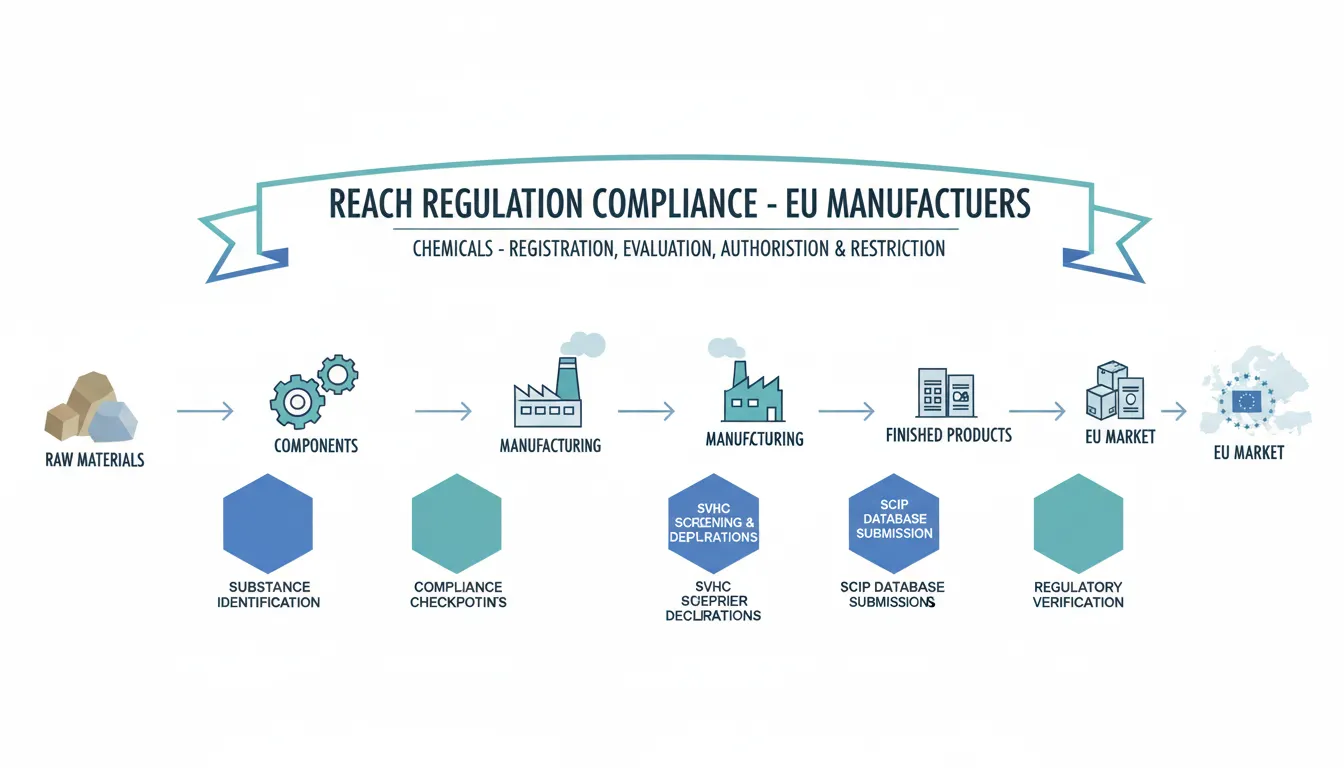
For manufacturers targeting the European Union, the REACH Regulation (EC) No 1907/2006 represents the world’s most complex and far-reaching chemical compliance framework. Unlike sector-specific laws (like RoHS for electronics), REACH applies to all industry sectors-from textiles and furniture to automotive and aerospace.
Compliance is not merely about chemical safety; it is a market access license. Non-compliance can lead to immediate customs blockages, product recalls, and fines exceeding 4% of annual turnover. This guide provides the definitive operational framework for manufacturers to manage REACH obligations, supply chain transparency, and ECHA requirements.
What Is the REACH Regulation?
REACH stands for Registration, Evaluation, Authorisation, and Restriction of CHemicals. Enacted in 2007, it shifted the burden of proof from regulators to industry. Companies must now prove their substances are safe before they can be placed on the EU market.
Purpose and Scope
The regulation serves two primary goals:
- Protection: Enhance human health and environmental safety by identifying and managing risks from chemicals.
- Innovation: Promote alternative test methods and the free circulation of substances on the EU internal market.
The “No Data, No Market” Principle
The core tenet of REACH is “No Data, No Market.” If a manufacturer or importer cannot provide the required safety data for a substance (manufactured/imported >1 tonne/year), that substance-and often the products containing it-cannot be legally sold in the EU.
How REACH Applies to Manufacturers
A critical error manufacturers make is assuming REACH only applies to chemical companies. It applies to almost every physical product. Your obligations depend entirely on whether you are producing substances, mixtures, or articles.
1. Substances
A chemical element and its compounds in the natural state or obtained by any manufacturing process (e.g., Acetone, Silver, Polypropylene pellets).
- Obligation: Full registration if >1 tonne/year.
2. Mixtures
A mixture or solution composed of two or more substances (e.g., Paint, Ink, Cleaning solutions, Adhesives).
- Obligation: Registration of individual substances contained in the mixture; Safety Data Sheet (SDS) provision.
3. Articles (Most Manufacturers)
An object which during production is given a special shape, surface, or design which determines its function to a greater degree than does its chemical composition (e.g., Cars, Clothing, Electronics, Toys, Furniture).
- Obligation: Communication of “Substances of Very High Concern” (SVHCs), notification to ECHA, and restriction compliance.
Substance vs Article Compliance Pathways
Correctly classifying your product is the first step in compliance. A wrong classification leads to either unnecessary registration costs or dangerous non-compliance.
Decision Framework
| Question | Answer = Substance/Mixture | Answer = Article |
|---|---|---|
| What defines the function? | The chemical properties (e.g., ability to stick, clean, or paint). | The shape, surface, or design (e.g., ability to hold weight, conduct electricity). |
| Example | A wet wipe’s cleaning fluid. | The wipe textile itself. |
| Obligation Focus | Registration & SDS. | SVHC Communication (Art. 33) & SCIP. |
The “Intended Release” Criteria
A rare but critical category exists: Articles with substances intended to be released.
If an article releases a substance to function (e.g., a scented bin liner releasing fragrance, or an ink cartridge releasing ink), that released substance must be registered as if it were a standalone chemical.
- Note: Release due to wear and tear (e.g., tires wearing down) is NOT “intended release.”
SVHC and Restricted Substances Management
For article manufacturers, REACH compliance revolves around three specific lists managed by the European Chemicals Agency (ECHA).
1. The Candidate List (SVHCs)
Substances of Very High Concern (SVHCs) are candidates for future authorization. The list is updated twice yearly (typically June and December).
- Threshold: 0.1% weight by weight (w/w) in any component article.
- Duty: If >0.1% w/w, you must inform customers immediately (Article 33) and notify ECHA via the SCIP database.
2. Annex XIV (Authorization List)
These are SVHCs that have been moved from the Candidate List to a “banned” status.
- Rule: You cannot use these substances in the EU after the “Sunset Date” unless you have been granted a specific authorization (which is rare and expensive).
- Impact: If you manufacture outside the EU, you can import articles containing these substances (unless restricted), but EU manufacturers cannot use them to make products.
3. Annex XVII (Restriction List)
This is the “safety net.” It restricts specific substances in specific applications where risks are unacceptable.
- Example: Lead is restricted in jewelry; Cadmium is restricted in plastics.
- Rule: Strict limits (e.g., <0.01% by weight). Placing non-compliant products on the market is illegal.
Roles Under REACH
Your legal liability changes based on your position in the supply chain.
| Role | Definition | Primary Obligations |
|---|---|---|
| EU Manufacturer | Produces substances or articles within the EU. | Registration (>1t/y), SVHC communication, Restrictions check. |
| EU Importer | Buys goods from outside the EU and clears customs. | Assumes full REACH liability. Must register substances and notify SVHCs as if they were the manufacturer. |
| Non-EU Manufacturer | Produces goods outside the EU for export. | No direct legal obligations unless an Only Representative is appointed. Must provide data to EU importers. |
| Downstream User | Uses chemicals in industrial activities (e.g., painting, blending). | Follow SDS instructions; check for restrictions. |
| Only Representative (OR) | A legal entity in the EU appointed by a non-EU manufacturer. | Takes over the importer’s registration duties, shielding customers from regulatory burdens. |
REACH Supply Chain Communication Requirements
REACH forces supply chain transparency. “Don’t ask, don’t tell” is no longer a viable defense.
1. Article 33 (The “Right to Know”)
If an article contains an SVHC >0.1% w/w, suppliers must provide the recipient with:
- The name of the substance.
- Information on safe use.
- Timeline: Immediately to B2B customers; within 45 days to consumers upon request.
2. SCIP Database Notification
Since 2021, suppliers must notify ECHA’s Substances of Concern In Products (SCIP) database if articles contain SVHCs >0.1%. This data helps waste operators manage hazardous disposal.
3. Safety Data Sheets (SDS)
Required for substances and mixtures (not articles). Manufacturers must provide an SDS compiled according to REACH Annex II standards. If a chemical is hazardous, an Extended SDS (eSDS) including exposure scenarios is required.
4. Full Material Declaration (FMD)
While not explicitly mandated by REACH text, FMD is the gold standard for compliance. Instead of asking suppliers “Does this contain SVHCs?” (which requires re-surveying every 6 months), manufacturers request a full chemical breakdown (CAS numbers + weight). This data can be screened digitally against updated lists instantly.
REACH Compliance Workflow for Manufacturers
To ensure robust compliance, implement this 6-step lifecycle model:
Step 1: Material Data Collection
Do not rely on “Certificates of Conformity” alone. Demand granular data.
- Action: Launch supplier campaigns using IPC-1752A or IEC 62474 standards to collect FMD or regulatory declarations.
Step 2: Substance Identification & Screening
Map collected data against regulatory lists.
- Action: Screen Bills of Materials (BOMs) against the current Candidate List, Annex XIV, and Annex XVII.
Step 3: Registration Check (Substances Only)
If you manufacture chemicals or import mixtures:
- Action: Verify if volumes exceed 1 tonne/year. If so, prepare a registration dossier via REACH-IT.
Step 4: Article Assessment (O5A)
Apply the “Once an Article, Always an Article” (O5A) ruling.
- Action: Calculate SVHC threshold (0.1%) at the component level (e.g., the O-ring), not the finished product level (e.g., the engine).
Step 5: Communication & Notification
- Action: If SVHC >0.1%:
- Update B2B documentation (Article 33).
- Submit dossier to SCIP database.
- Check if the use is exempt from authorization.
Step 6: Monitoring & Updates
- Action: Re-screen your BOM every 6 months when ECHA updates the Candidate List.
REACH vs. RoHS vs. Other EU Regulations
Manufacturers often confuse REACH with RoHS (Restriction of Hazardous Substances).
| Feature | REACH | RoHS (2) |
|---|---|---|
| Scope | All products (Substances, Mixtures, Articles). | Electrical & Electronic Equipment (EEE) only. |
| Substances | Thousands (SVHCs, Annex XVII). | 10 specific substances (Lead, Mercury, Cd, CrVI, PBB, PBDE, 4 Phthalates). |
| Mechanism | Registration + Risk Management + Communication. | Hard ban (threshold limits apply). |
| Exemptions | Authorization required for banned substances. | Specific time-limited exemptions (Annex III/IV). |
Common REACH Compliance Challenges
1. The “Black Box” Supply Chain
Suppliers outside the EU often treat formulations as trade secrets.
- Solution: Use Non-Disclosure Agreements (NDAs) combined with “Trust but Verify” testing for high-risk materials (e.g., soft plastics, recycled PVC).
2. Changing Candidate Lists
The SVHC list grows twice a year. A product compliant in January may be non-compliant in July.
- Solution: Move from “compliance certificates” (static) to “data-driven compliance” (dynamic BOM screening).
3. Complex Objects (O5A)
Understanding that a bicycle is not one article, but a “complex object” made of 50+ articles (handlebar grips, tires, frame, saddle).
- Solution: Break down BOMs to the lowest component level for calculation.
Risks of Non-Compliance
Enforcement is coordinated by the ECHA Forum, but penalties are set by member states.
- Market Ban: Regulators can order the immediate withdrawal of products from the market.
- Customs Block: Goods can be held at the border indefinitely.
- Fines: Penalties vary widely-from €50,000 in some nations to prison sentences for intentional violations in others.
- REACH-EN-FORCE (REF): ECHA conducts coordinated enforcement projects. REF-12 (2024-2025) specifically targets imported products sold online.
Future of REACH Compliance
Digital Product Passport (DPP)
Part of the Ecodesign for Sustainable Products Regulation (ESPR), the DPP will link REACH data directly to a product’s digital twin, making chemical data accessible to consumers via QR code.
PFAS Restriction
The “Universal PFAS Restriction” proposal aims to ban an entire class of 10,000+ per- and polyfluoroalkyl substances. This will force massive reformulation across manufacturing sectors.
Chemical Strategy for Sustainability (CSS)
The EU is moving toward “Generic Risk Management,” meaning carcinogenic, mutagenic, or reprotoxic (CMR) substances will be banned in consumer products automatically, without needing deep risk assessments.
Frequently Asked Questions
What is REACH compliance for manufacturers?
It is the continuous process of identifying chemicals in your products, ensuring banned substances are not used, registering imported chemicals >1 tonne, and communicating SVHC presence to customers and authorities.
Do non-EU manufacturers need to comply with REACH?
Technically, the obligation falls on the EU importer. However, if a non-EU manufacturer does not provide compliance data, the importer will likely refuse to buy the product to avoid legal liability.
What is the difference between Annex XIV and Annex XVII?
Annex XIV requires permission (authorization) to use a substance in the EU. Annex XVII acts as a prohibition (restriction) on using the substance in specific applications.
How do I ensure REACH compliance without testing every product?
Testing is too expensive to do for everything. The industry standard is Supply Chain Data Collection (FMD) combined with targeted analytical testing (XRF/GC-MS) only for high-risk materials or untrusted suppliers.
Is REACH compliance a one-time event?
No. It is a lifecycle commitment. You must re-evaluate compliance every time ECHA adds new substances to the Candidate List (every ~6 months).