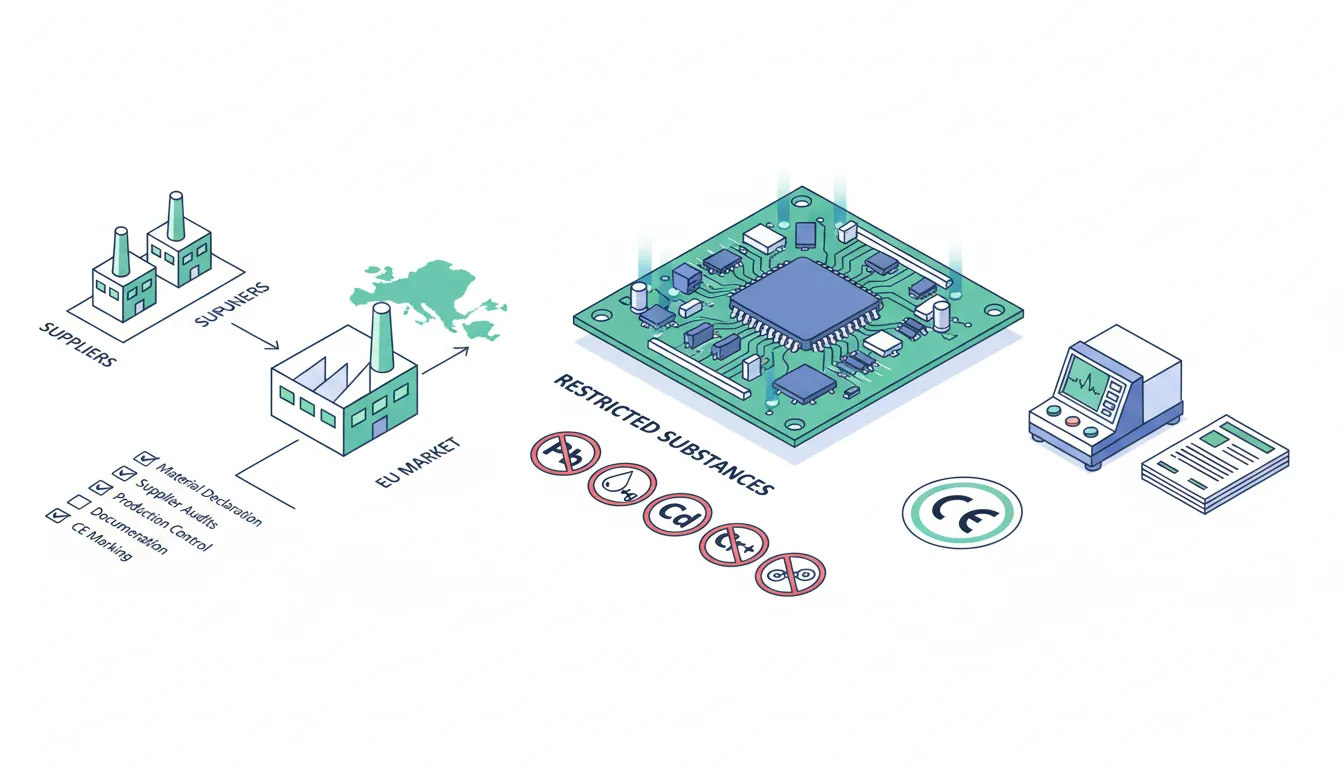
For electronics manufacturers selling into the European Union, the RoHS Directive (Restriction of Hazardous Substances) is the gatekeeper to market access. Unlike voluntary eco-labels, RoHS is a mandatory legislative requirement. Non-compliance is a criminal offense in many EU member states, carrying penalties that range from unlimited fines and product recalls to imprisonment.
In 2026, the landscape of RoHS compliance is more complex than ever, with expiring exemptions, new phthalate restrictions (RoHS 3), and tighter integration with the EU’s Green Deal. This guide provides the definitive technical framework for engineering, quality, and compliance teams to manage hazardous substance control, technical documentation, and supply chain due diligence.
What Is RoHS Compliance?
RoHS (Restriction of Hazardous Substances) refers to Directive 2011/65/EU and its amendments, which restrict the use of 10 specific hazardous materials in electrical and electronic equipment (EEE).
Purpose and Goals
The directive’s primary goal is not just product safety, but end-of-life safety. It ensures that when electronic waste is recycled or landfilled, it does not release toxic heavy metals or flame retardants into the environment. By removing these substances at the design stage, the EU enables safe recycling and reduces occupational health risks for waste workers.
The “Homogeneous Material” Principle
Crucially, RoHS limits apply to each homogeneous material, not the finished product.
- Definition: A material of uniform composition throughout that cannot be mechanically disjointed into different materials.
- Example: A computer mouse is not tested as one unit. The plastic casing, the rubber wheel, the PCB, the solder, and the copper wire insulation are all tested separately. If any single material exceeds the limit, the entire product is non-compliant.
The RoHS Directive Framework
The regulation has evolved through three major phases. Understanding the difference is critical for accurate Declaration of Conformity (DoC) referencing.
- RoHS 1 (Directive 2002/95/EC): The original directive, effective 2006. It restricted 6 substances (Lead, Mercury, Cadmium, Hexavalent Chromium, PBB, PBDE). It is now repealed.
- RoHS 2 (Directive 2011/65/EU): The current legal base. It turned RoHS into a “CE Marking” directive, meaning compliance is a prerequisite for the CE mark. It also expanded the scope to all electrical equipment (open scope).
- RoHS 3 (Directive (EU) 2015/863): An amendment to RoHS 2, not a new directive. It added 4 phthalates (DEHP, BBP, DBP, DIBP) to the restricted list, effective July 2019 for most equipment.
- Correct DoC Reference: You declare conformity to Directive 2011/65/EU as amended by (EU) 2015/863.
Products Covered by the RoHS Directive
RoHS applies to nearly all Electrical and Electronic Equipment (EEE)-defined as equipment dependent on electric currents or electromagnetic fields to work, rated under 1000V AC or 1500V DC.
EEE Categories
- Large household appliances (Fridges, Washing machines)
- Small household appliances (Toasters, Vacuums)
- IT and telecommunications equipment (Laptops, Phones)
- Consumer equipment (TVs, Instruments)
- Lighting equipment (LED lamps, Bulbs)
- Electrical and electronic tools (Drills, Saws)
- Toys, leisure, and sports equipment (Video games, Electric trains)
- Medical devices (Scanners, Analyzers)
- Monitoring and control instruments (Thermostats, Smoke detectors)
- Automatic dispensers (Vending machines)
- Other EEE: The “catch-all” category for anything not listed above (e.g., cables, connectors).
Key Exclusions
- Equipment designed for military/defense purposes.
- Equipment designed for space applications.
- Large-scale stationary industrial tools (LSIT).
- Large-scale fixed installations (e.g., airport baggage conveyors).
- Active implantable medical devices.
RoHS Restricted Substances List
Manufacturers must control these 10 substances. Thresholds apply by weight at the homogeneous material level.
| Substance | Symbol | Threshold | Common Applications to Watch |
|---|---|---|---|
| Lead | Pb | 0.1% (1000 ppm) | Solder, brass alloys, CRT glass, cable stabilizers. |
| Mercury | Hg | 0.1% (1000 ppm) | Fluorescent lamps, relays, sensors, improper recycled plastics. |
| Cadmium | Cd | 0.01% (100 ppm) | Contacts, switches, plating, pigments (red/yellow/orange). Note the stricter limit. |
| Hexavalent Chromium | Cr VI | 0.1% (1000 ppm) | Anti-corrosion coatings on metal (gold/rainbow sheen), chromate conversion coatings. |
| Polybrominated Biphenyls | PBB | 0.1% (1000 ppm) | Flame retardants in plastics (historic use, rarely found now). |
| Polybrominated Diphenyl Ethers | PBDE | 0.1% (1000 ppm) | Flame retardants in plastics, coatings, and wire insulation. |
| Bis(2-ethylhexyl) phthalate | DEHP | 0.1% (1000 ppm) | PVC plasticizer (wire insulation, gaskets, tubing). |
| Butyl benzyl phthalate | BBP | 0.1% (1000 ppm) | PVC plasticizer, adhesives, synthetic leather. |
| Dibutyl phthalate | DBP | 0.1% (1000 ppm) | Plasticizer in resins, coatings, adhesives. |
| Diisobutyl phthalate | DIBP | 0.1% (1000 ppm) | Plasticizer similar to DBP. |
RoHS Exemptions Explained
Because substitution is not always technically feasible, the EU grants temporary, application-specific exemptions. These are listed in Annex III (general EEE) and Annex IV (medical/monitoring).
Critical Exemption Status (2026-2027 Update)
Exemptions have expiration dates that vary by category. Do not rely on old tables.
- 6(c) – Lead in Copper Alloys (Brass): Critical for machined parts (up to 4% lead). Renewed until July 2026/2027 pending final decision for Category 1-10.
- 7(a) – Lead in High-Melting Temp Solder: Vital for power electronics. Renewal adopted; effective until July 2027.
- 7(c)-I – Lead in Glass/Ceramic (Electronic Components): Used in resistors/capacitors. Renewal adopted; effective until July 2027.
- 6(a) – Lead in Steel: Expired for most categories; limited renewal.
Management Rule: Never assume an exemption applies forever. You must track “Pack 22/23/24” consultation outcomes. If an exemption expires, you must redesign the product immediately.
Who Must Ensure RoHS Compliance?
| Role | Responsibility |
|---|---|
| Manufacturer | Ultimate liability. Must design the product, collect technical files, perform testing, affix the CE mark, and sign the DoC. |
| Importer (EU) | Before placing goods on the market, must ensure the manufacturer has completed the conformity assessment. If the manufacturer is non-compliant, the importer is liable. |
| Distributor | Must verify the product bears the CE mark and has required documentation. Must not sell non-compliant goods. |
| OEM (Private Label) | If you rebrand a product under your name, you become the “Manufacturer” legally and assume all RoHS duties. |
How to Ensure RoHS Compliance: Step-by-Step
Do not rely on a “certificate” from a sales rep. Follow this technical workflow:
1. Material Data Collection
Request Full Material Declarations (FMD) from suppliers.
- Best Practice: Do not ask “Is it RoHS compliant?” Ask “What is it made of?”
- Standard: Use IPC-1752A Class D or IEC 62474 standards for data exchange. This reveals the chemical breakdown (CAS numbers) of every component.
2. BOM Screening
Screen your Bill of Materials (BOM) against the 10 restricted substances.
- Action: Identify high-risk components (e.g., PVC cables for phthalates, brass standoffs for lead, zinc-plated steel for Cr6+).
3. Supplier Verification
Categorize suppliers by risk.
- High Risk: Unknown distributors, cheap plastics, non-standard metal plating.
- Action: Demand test reports (ISO 17025 accredited) for high-risk items.
4. Testing (Risk-Based)
You cannot test every component. Implement risk-based XRF Screening.
- XRF (X-Ray Fluorescence): A handheld gun that scans for Pb, Hg, Cd, Cr, Br. It is a screening tool, not a final pass/fail for PBB/PBDE or Cr6+.
- Wet Chemistry: Send inconclusive samples to a lab for GC-MS (phthalates) or UV-Vis (Cr6+).
5. Technical File Assembly
Compile the “Technical Documentation” required by Annex II, Module A of Decision 768/2008/EC.
- Must include: Product description, BOM, supplier declarations, test reports, risk assessment, and conceptual design drawings.
6. Declaration of Conformity
Sign the EU Declaration of Conformity (DoC).
- Statement: “The object of the declaration described above is in conformity with Directive 2011/65/EU…”
RoHS Supply Chain Compliance Requirements
RoHS compliance is a supply chain data challenge.
- Traceability: You must be able to link every part in your product to a specific supplier declaration.
- Change Control: Suppliers must notify you of material changes. A switch from a brand-name capacitor to a generic one can introduce non-compliance.
- Contractual Clauses: Update purchase orders to legally require RoHS 3 compliance and indemnity for non-compliance costs.
RoHS Testing & Verification Standards
When testing is required, laboratories must follow the IEC 62321 series of standards:
- IEC 62321-1: Introduction and overview.
- IEC 62321-2: Disassembly and mechanical sample preparation (Crucial: separating homogeneous materials).
- IEC 62321-3-1: XRF Screening.
- IEC 62321-5: Determination of Cadmium, Lead, and Chromium.
- IEC 62321-6: Determination of PBB and PBDE.
- IEC 62321-7-1/2: Determination of Hexavalent Chromium.
- IEC 62321-8: Determination of Phthalates (DEHP, BBP, DBP, DIBP) using GC-MS.
RoHS vs. REACH vs. CE
Manufacturers often confuse these frameworks.
| Feature | RoHS | REACH | CE Marking |
|---|---|---|---|
| Scope | Electronics (EEE) only. | All products (furniture, clothing, chemicals, EEE). | Safety/Performance of specific product groups. |
| Restriction | 10 specific substances. | 1000s of substances (SVHCs, Annex XVII). | Umbrella framework. |
| Logic | Ban (with exemptions). | Register (>1t), Communicate (SVHC >0.1%), or Restrict. | Declare Conformity. |
| Relation | RoHS is a CE directive. | Separate regulation (no CE mark). | RoHS compliance is required to affix the CE mark. |
Risks of Non-Compliance
Enforcement is conducted by national bodies (e.g., KEMI in Sweden, BAM in Germany).
- Market Block: Customs will detain shipments lacking a valid DoC or showing positive XRF scans.
- Recall (RAPEX/Safety Gate): You may be forced to recall products from end-users at your cost.
- Fines:
- Ireland: Up to €3,000,000 or imprisonment.
- Germany: Fines up to €100,000 per violation.
- Reputation: Listing on the public EU Safety Gate (formerly RAPEX) database destroys brand trust.
Future of RoHS Compliance
- New Substances: Oeko-Institut is assessing TBBP-A (flame retardant) and MCCPs (flame retardant) for future restriction.
- Digital Product Passport (DPP): Future directives will require RoHS data to be embedded in a digital twin of the product, accessible via QR code.
- Circular Economy: Exemptions will become harder to renew as the EU pushes for products that are 100% recyclable and toxin-free.
Frequently Asked Questions
Is RoHS compliance mandatory?
Yes. Placing non-compliant electronics on the EU market is illegal.
Do I need to test every single component?
No. You need a “reasonable” compliance assurance system. This typically involves a mix of supplier declarations (for low risk) and analytical testing (for high risk).
What happens if my product has lead inside but is exempt?
You can sell it, but you must strictly control the expiration date of that exemption. You must also declare the lead as an SVHC under REACH if it exceeds 0.1%.
Does RoHS apply to packaging?
No. Packaging is covered by the Packaging and Packaging Waste Directive (94/62/EC), which restricts Pb, Cd, Hg, and Cr6+ to <100 ppm combined.
Does RoHS apply to batteries?
No. Batteries are covered by the new EU Battery Regulation (2023/1542). However, the device using the battery must be RoHS compliant.