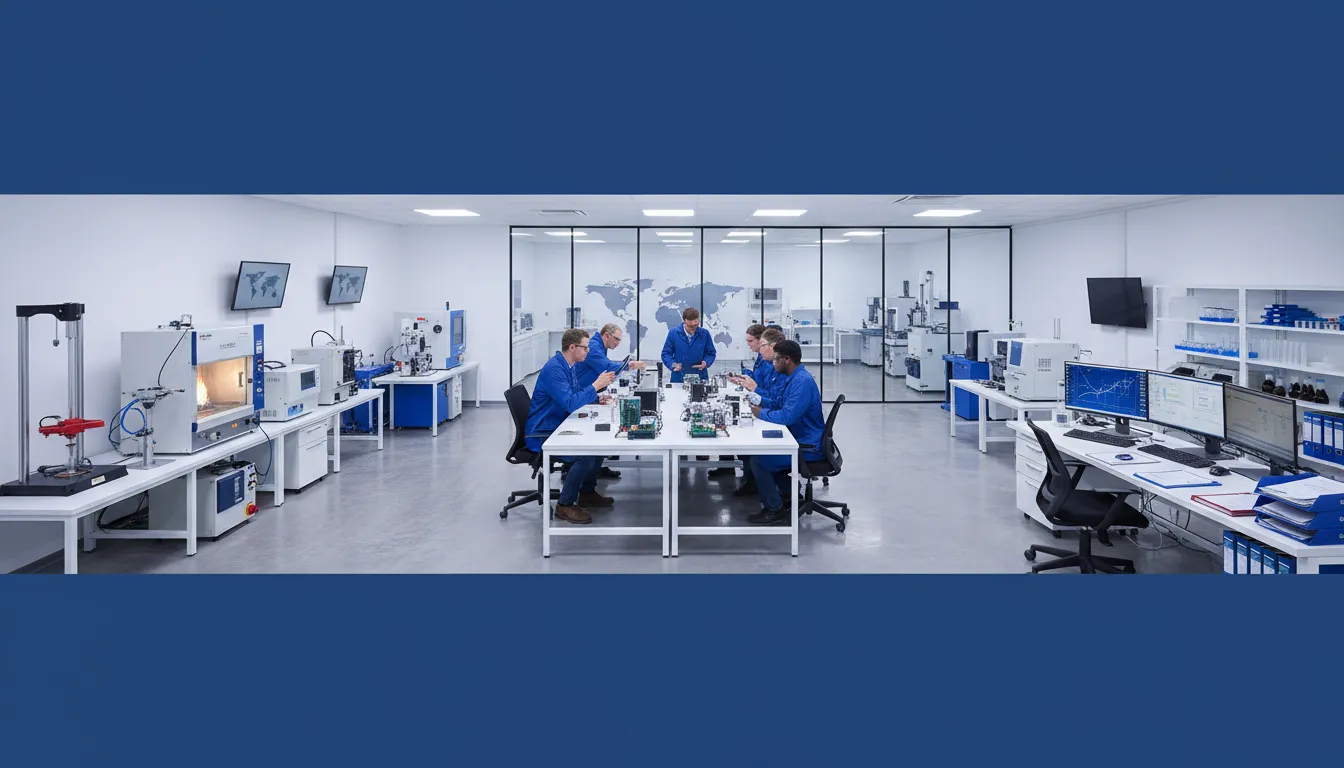
In the modern global marketplace, product testing is the invisible shield that protects brands from liability and consumers from harm. Whether you are launching a new toy in the European Union, selling electronics on Amazon in the US, or exporting cosmetics to Asia, verified laboratory testing is the non-negotiable gateway to market access.
For manufacturers and importers, navigating the labyrinth of chemical analysis, mechanical stress tests, and electromagnetic compatibility (EMC) can be overwhelming. This guide provides the definitive operational framework for understanding product testing, selecting the right ISO 17025 accredited laboratory, and distinguishing between mandatory regulatory testing and voluntary quality assurance.
What Is Product Testing?
Product testing is the process of verifying that a product meets specific requirements-whether those are regulatory safety limits, industry performance standards, or internal quality benchmarks-through scientific analysis and physical experimentation.
Purpose and Role
It serves three critical functions in the supply chain:
- Verification: confirming the product matches the design specifications.
- Validation: ensuring the product fulfills its intended use safely and effectively.
- Certification: providing legal proof of compliance to government authorities and retailers.
From a business perspective, product testing is risk management. It transforms the subjective claim “my product is safe” into objective, legally defensible data.
Why Product Testing Is Required
Testing is rarely optional for reputable brands. It is driven by four primary pressures:
1. Regulatory Compliance (The Law)
Governments mandate testing to protect public health. Selling a toy with high lead content or an electrical device that emits interference is illegal.
- Examples: CPSIA (USA), REACH (EU), FDA (Food/Drugs).
2. Liability Protection (The Courts)
If a product injures a consumer, the test report is your first line of defense. It demonstrates “due diligence”-that you took reasonable steps to ensure safety.
3. Retailer Requirements (The Market)
Major retailers (Walmart, Costco) and marketplaces (Amazon) act as gatekeepers. They often require test reports even for products that aren’t strictly regulated by the government, simply to protect their own reputation.
4. Brand Reputation (The Customer)
Voluntary performance testing (e.g., “drop tested to 10 feet”) builds trust. A product that breaks immediately destroys brand equity faster than any marketing campaign can build it.
Types of Product Testing
Product testing is a vast field. To manage it, we categorize tests by the nature of the analysis.
1. Safety Testing
The most critical category. Focuses on preventing injury or death.
- Electrical Safety: Checking for shock hazards, insulation breakdown, and overheating (e.g., UL 60950).
- Flammability: How easily a material burns (e.g., 16 CFR 1610 for clothing).
- Mechanical Safety: Checking for sharp edges, small parts (choking hazards), and structural collapse.
2. Chemical Testing
Analyzing materials at the molecular level to detect restricted toxic substances.
- Heavy Metals: Lead, Cadmium, Mercury (RoHS, CPSIA).
- Organics: Phthalates, Azo dyes, Formaldehyde (REACH).
- Migration: Ensuring chemicals don’t leach from food containers into food (FDA 21 CFR).
3. Performance & Reliability Testing
Does the product work as advertised? Will it last?
- Lifecycle Testing: Opening/closing a hinge 10,000 times.
- Battery Testing: Charge/discharge cycles and capacity verification.
- Lumen Testing: Verifying the brightness of an LED bulb.
4. Electromagnetic Compatibility (EMC)
Ensuring electronic devices don’t interfere with others.
- Emissions: Measuring the radio noise a device generates (FCC Part 15).
- Immunity: Measuring if a device keeps working when exposed to radio noise (CE RED).
5. Environmental Testing
Simulating harsh real-world conditions.
- Climatic: Extreme heat, cold, and humidity cycling.
- Salt Spray: Accelerating corrosion to test rust resistance.
- UV Aging: Testing if plastic becomes brittle or fades under sunlight.
6. Microbiological Testing
Critical for food, cosmetics, and medical devices.
- Pathogen Screening: Salmonella, E. coli, Listeria.
- Preservative Efficacy: “Challenge testing” to see if a cosmetic’s preservative stops mold growth.
Regulatory vs. Quality Testing
Understanding this distinction saves budget.
| Feature | Regulatory Testing | Quality Testing |
|---|---|---|
| Driver | Government Laws (Mandatory). | Brand Standards (Voluntary). |
| Goal | Safety & Legality. | Performance & Satisfaction. |
| Standard | Fixed limits (e.g., Lead < 90 ppm). | Internal specs (e.g., “Must allow 50 washes”). |
| Lab Requirement | Must be ISO 17025 Accredited (usually). | Can be internal or 3rd party. |
| Result | Pass/Fail against law. | Pass/Fail against spec. |
| Example | Testing a toy for lead content. | Testing a toy to see if it breaks when dropped. |
Compliance & Certification Testing
For many products, “passing a test” isn’t enough; you need a formal certification.
CE Marking (Europe)
- Self-Declaration: For most products, you test to EN standards and sign a Declaration of Conformity.
- Notified Body: For high-risk items (medical devices, PPE), a government-authorized lab (“Notified Body”) must audit the testing.
FCC (USA)
- SDoC: For wired electronics, you test and self-declare.
- Certification: For wireless devices (Wi-Fi, Bluetooth), an accredited lab test report must be reviewed by a TCB (Telecommunications Certification Body) to issue an FCC ID.
CPSIA (USA – Children’s Products)
- Third-Party Testing: Mandatory testing by a CPSC-accepted lab.
- CPC: Based on the test, the importer issues a Children’s Product Certificate.
RoHS / REACH (Chemicals)
- Screening: XRF screening provides a quick “pass/fail” for heavy metals.
- Wet Chemistry: Detailed lab analysis is needed to quantify specific restricted substances like phthalates.
Laboratory Accreditation & Standards
Not all labs are equal. A test report from a non-accredited lab is often worthless to customs officials.
ISO/IEC 17025
This is the Gold Standard for testing laboratories.
- It certifies that the lab is technically competent and can generate valid results.
- It is specific to the test. A lab can be accredited for Lead testing but not for Phthalates. Always check the lab’s Scope of Accreditation.
ISO 9001
This certifies the lab’s management system (customer service, document control). It does not certify technical competence. ISO 9001 is good, but ISO 17025 is mandatory for regulatory acceptance.
GLP (Good Laboratory Practice)
A specific quality system mandated for non-clinical health and environmental safety studies (e.g., toxicology for FDA/EPA).
Industries That Require Product Testing
1. Electronics & Appliances
- Key Tests: EMC (FCC/CE), Electrical Safety (UL/LVD), Energy Efficiency (DoE/ErP), RoHS.
- Focus: Preventing fire, shock, and radio interference.
2. Toys & Children’s Products
- Key Tests: Physical/Mechanical (sharp points), Flammability, Heavy Metals (Lead), Phthalates.
- Standards: ASTM F963 (USA), EN 71 (EU), ISO 8124 (Global).
3. Textiles & Apparel
- Key Tests: Fiber identification, Colorfastness (washing/rubbing), Flammability, Azo dyes, Formaldehyde.
- Focus: Accurate labeling and chemical safety.
4. Food & Beverage
- Key Tests: Microbiology (Pathogens), Nutritional Analysis (Calories/Fat), Shelf-life, Pesticides, Heavy Metals.
- Focus: Preventing foodborne illness and fraud.
5. Cosmetics & Personal Care
- Key Tests: Microbio (USP 61/62), Heavy Metals, Stability (Shelf-life), Skin Irritation (Patch testing).
- Focus: Safety in direct skin contact.
6. Medical Devices
- Key Tests: Biocompatibility (ISO 10993), Sterility, Electrical Safety (IEC 60601), Performance validation.
- Focus: Efficacy and patient safety.
Product Testing Process
Testing is a workflow, not a single event.
Step 1: Requirement Definition
Identify where you are selling.
- Scenario: Selling a blender in the US and EU requires two different voltages (110V vs 230V) and two different safety standards (UL vs EN).
Step 2: Lab Selection & Quote
Send your product details (photos, specs, bill of materials) to 2-3 labs.
- Ask: “Are you accredited for [Specific Standard]?”
Step 3: Sampling
Send “Golden Samples” (perfect production units) to the lab.
- Warning: Do not send prototypes for regulatory testing unless you are sure the final production will be identical.
Step 4: Testing
The lab performs the tests. This can take 3 days (chemical) to 3 months (reliability/lifecycle).
Step 5: Reporting
The lab issues a formal Test Report.
- Check: Does the report list the correct standard, product name, and model number?
Step 6: Certification / Declaration
Use the test report to create your DoC (EU), CPC (US), or GCC.
How to Choose a Testing Laboratory
Selecting the right partner is strategic.
1. Accreditation (The Dealbreaker)
Check their ILAC-MRA signatory status. If the lab is in China (CNAS accredited), ensure their accreditation is recognized by the US CPSC or EU authorities for your specific product category.
2. Scope of Capabilities
Does the lab do everything in-house?
- Risk: Some labs outsource complex tests (like flammability) to other labs, adding cost and time.
3. Location
- Source-Based (e.g., China/Vietnam): Cheaper, faster (fix issues before shipping). Best for routine QC and chemical testing.
- Destination-Based (e.g., US/EU): More expensive, but higher credibility with western retailers/regulators. Best for certification and complex disputes.
4. Service Level
Can they help you interpret a failure? Big labs (Intertek, SGS) provide ironclad reports but may offer less consulting support than boutique specialized labs.
Product Testing Costs & Timelines
Estimates for general guidance:
| Test Type | Typical Cost (USD) | Timeline |
|---|---|---|
| RoHS Screening (XRF) | $100 – $300 | 2-3 Days |
| Phthalates (7 items) | $150 – $400 | 3-5 Days |
| Toy Safety (ASTM F963) | $300 – $800 | 5-7 Days |
| FCC SDoC (Wired) | $1,000 – $2,500 | 1-2 Weeks |
| FCC ID (Wireless) | $3,000 – $5,000 | 3-4 Weeks |
| Food Microbio Panel | $50 – $150 | 2-5 Days |
| UL / ETL Listing | $5,000 – $15,000+ | 4-8 Weeks |
Documentation & Test Reports
A test report is a legal document. It must contain:
- Lab Details: Name, Address, Accreditation Number.
- Client Details: Your company name and address.
- Sample Description: Photos, Model Number, Batch Number.
- Test Date: When the analysis happened.
- Test Method: The specific standard used (e.g., “CPSC-CH-E1001-08.3”).
- Results: Specific data points (not just “Pass”).
- Signature: Authorized lab signatory.
Archive Strategy: Keep reports for 10 years (EU requirement) or 5 years (US CPSIA requirement).
Common Testing Mistakes
- “Golden Sample” Bias: Testing a hand-made prototype that is higher quality than mass production. If production units fail later, you are liable.
- Wrong Standard Version: Testing to ASTM F963-16 when F963-17 is now mandatory. Always confirm the current standard.
- Component vs. Finished Product: Testing raw plastic pellets for lead is good, but you must test the finished toy to be compliant. Contamination can happen during molding.
- Assuming “UL” is Mandatory: In the US, OSHA requires testing by an NRTL (Nationally Recognized Testing Laboratory). It doesn’t have to be UL; it can be ETL (Intertek), CSA, or TUV.
Frequently Asked Questions
Do all products need testing?
Legally? No. But functionally? Yes. While a plain ceramic mug might not require a complex FCC test, it still needs FDA (lead leaching) and general safety testing. Liability risks make testing essential for almost all consumer goods.
Can I self-test?
For some regulations (like FCC SDoC or CE self-declaration), you can technically use internal labs if they are calibrated. However, for Children’s Products (CPSIA) or Wireless Certification (FCC ID), you must use an accredited third-party lab. Retailers usually reject self-test reports.
How long does testing take?
Simple chemical tests take 3-5 business days. Electrical safety takes 2-3 weeks. Complex certifications (UL Listing) or biological studies (shelf life) can take months.
What is ISO 17025?
It is the international standard for testing laboratories. It certifies that the lab has a quality management system and the technical competence to produce valid results. Always look for this accreditation.
How much does testing cost?
It varies wildly. A simple lead test is $50. A full certification for a Bluetooth medical device could be $20,000. Budget 1-3% of your initial production cost for testing.