In the complex landscape of global manufacturing, chemical testing is the critical firewall between your product and the market. With regulations like REACH (EU), Prop 65 (USA), and RoHS tightening every year, invisible chemical hazards have become the number one reason for product recalls and customs seizures globally.
For manufacturers and importers, chemical compliance is no longer just about avoiding lead paint. It involves navigating a web of restricted substances-from phthalates in soft plastics to PFAS “forever chemicals” in textiles. This guide provides the definitive technical framework for understanding chemical testing, selecting the right methods (Screening vs. Wet Chemistry), and ensuring your supply chain is clean.
What Is Chemical Testing in Product Compliance?
Chemical testing is the analytical process of decomposing a product’s materials to identify and quantify specific substances at the molecular level. Unlike physical testing (which checks if a toy breaks), chemical testing checks if a toy is toxic.
Purpose and Role
- Verification: Confirming that restricted substances (e.g., Lead, Cadmium) are below legal thresholds (e.g., <90 ppm).
- Identification: Detecting unknown contaminants introduced during manufacturing (e.g., mold release agents or dyes).
- Certification: Providing the “golden data” required for documents like the EU Declaration of Conformity or US Children’s Product Certificate (CPC).
Why Chemical Testing Is Required
1. Consumer Safety (The “Why”)
Restricted substances are not arbitrary; they are known carcinogens, reproductive toxins, or endocrine disruptors. Testing prevents chronic exposure to consumers, particularly vulnerable groups like children and pregnant women.
2. Market Access (The “Gatekeeper”)
You cannot legally import products into major markets without compliance.
- EU: Customs officers use XRF guns to screen incoming shipments for RoHS compliance.
- USA: The CPSC routinely buys products from Amazon to test for lead and phthalates.
3. Risk Reduction (The “Shield”)
A single positive test result for a banned substance can trigger a recall, which costs an average of $1M – $10M in logistics, refunds, and brand damage. Testing is your insurance policy.
Products That Require Chemical Testing
Almost every consumer product has chemical compliance obligations, but high-risk categories face stricter scrutiny.
| Category | Key Risks | Common Regulations |
|---|---|---|
| Electronics | Solder, batteries, flame retardant plastics, PVC cables. | RoHS, REACH, WEEE, Prop 65 |
| Toys & Childcare | Painted surfaces, soft plastics (phthalates), metal substrates. | CPSIA, EN 71-3, ASTM F963 |
| Textiles & Apparel | Azo dyes, formaldehyde, PFAS, heavy metal zippers. | REACH (Annex XVII), Prop 65 |
| Food Contact | Plastics leaching BPA, ceramics leaching lead. | FDA 21 CFR, EU 10/2011 |
| Cosmetics | Preservatives (parabens), heavy metals in pigments. | FDA MoCRA, EU Cosmetic Reg |
Hazardous Substances Tested in Products
The list of restricted chemicals runs into the thousands, but 80% of compliance failures stem from these “High-Risk” substances:
- Lead (Pb): Found in paint, brass, zippers, and soldered electronics. Neurotoxic to children.
- Cadmium (Cd): Found in cheap jewelry, coatings, and batteries. Carcinogenic.
- Phthalates (DEHP, DBP, etc.): Plasticizers used to make PVC soft (e.g., vinyl toys, wire insulation). Endocrine disruptors.
- Mercury (Hg): Found in batteries and skin-lightening creams.
- Formaldehyde: Found in wood glues (composite wood) and wrinkle-free fabrics.
- PFAS (Per- and Polyfluoroalkyl Substances): “Forever chemicals” in water-repellent fabrics and non-stick cookware.
- PAHs (Polycyclic Aromatic Hydrocarbons): Found in rubber, soot, and recycled plastics.
Global Regulations Requiring Chemical Testing
European Union (The Strictest Standard)
- REACH (EC 1907/2006): The “Mother of All Regulations.”
- Annex XVII: Bans substances (e.g., Nickel in jewelry) completely.
- SVHC Candidate List: Requires notification if “Substances of Very High Concern” exceed 0.1% w/w.
- RoHS (2011/65/EU): Restricts 10 substances (Lead, Mercury, Cadmium, Hexavalent Chromium, PBB, PBDE, + 4 Phthalates) in electronics.
United States
- CPSIA: Mandates third-party testing for Lead (<100 ppm substrate) and Phthalates (0.1%) in children’s products.
- California Prop 65: A “Right-to-Know” law. If your product exposes Californians to any of 900+ chemicals (e.g., Lead in a brass handle), you must warn or reformulate.
- TPCH: Regulates heavy metals in packaging (boxes, tape, bubble wrap).
Chemical Testing Methods & Technologies
Understanding the difference between Screening and Wet Chemistry is the key to managing testing costs.
1. XRF Screening (X-Ray Fluorescence)
- Method: A handheld “gun” shoots X-rays at the material and reads the energy that bounces back.
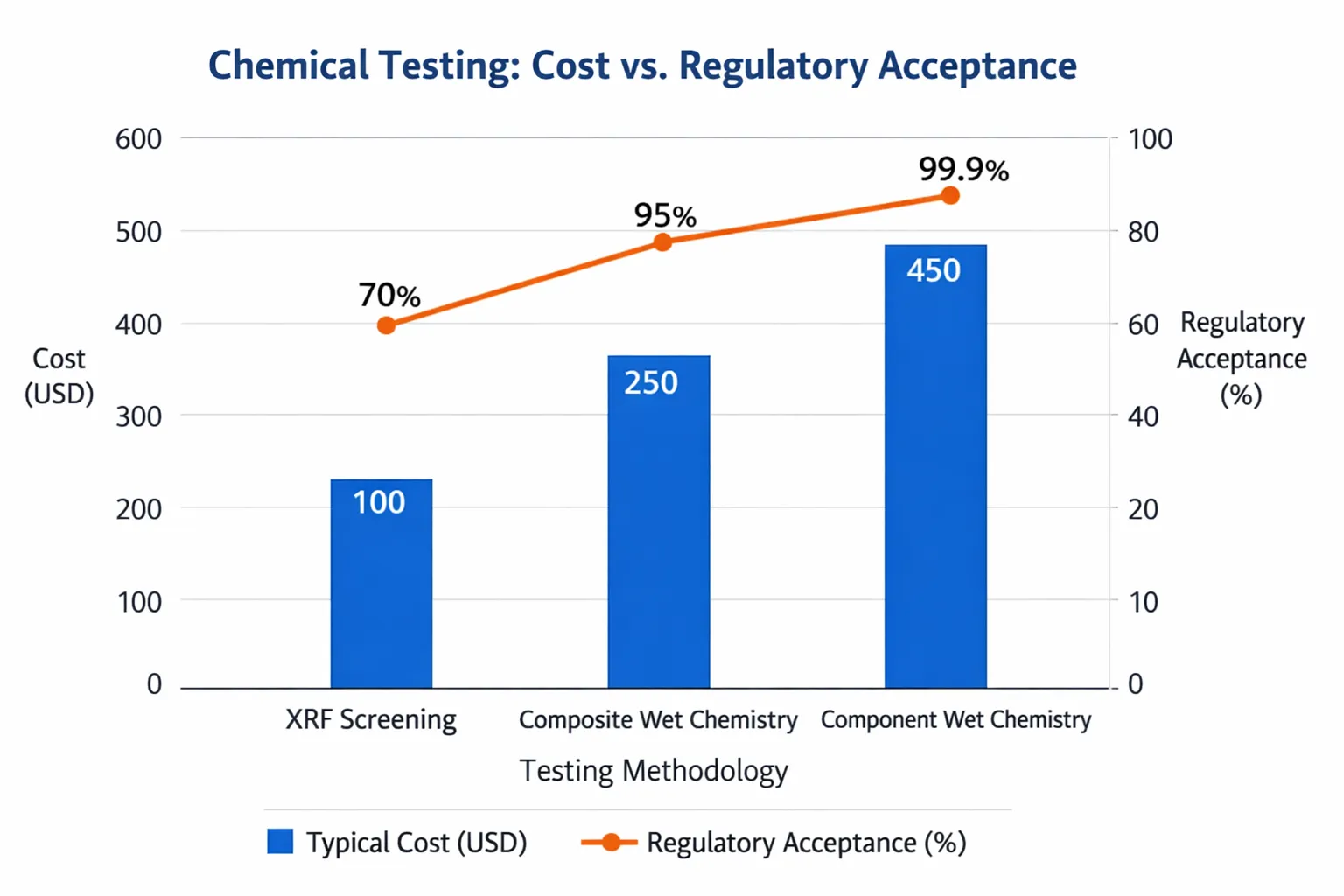
- Pros: Fast (seconds), non-destructive, cheap (~$100-$300).
- Cons: Not precise. Can only detect elements (Lead, Cadmium), NOT molecules (Phthalates, PFAS). Good for “Pass/Fail” screening of metals.
- Use Case: Quick check of zippers, buttons, and electronics for RoHS.
2. ICP-MS (Inductively Coupled Plasma Mass Spectrometry)
- Method: The sample is dissolved in acid (digested) and vaporized in plasma.
- Pros: Extremely accurate (Parts Per Billion).
- Cons: Destructive (sample is destroyed), expensive, slow.
- Use Case: Final certification for Lead/Cadmium in toys (CPSIA requires this).
3. GC-MS (Gas Chromatography Mass Spectrometry)
- Method: Sample is vaporized and separated in a gas column.
- Pros: The only way to detect organic compounds like Phthalates, PAHs, and Solvents.
- Use Case: Testing soft plastics, rubber, and glues.
Screening vs. Quantitative Chemical Testing
Compliance Strategy: Do not pay for full wet chemistry on every component. Use a tiered approach.
| Feature | XRF Screening | Wet Chemistry (ICP/GC-MS) |
|---|---|---|
| Cost | Low ($) | High ($$$) |
| Accuracy | +/- 30% | +/- 1% |
| Speed | Instant | 3-7 Days |
| Limit of Detection | ~10-50 ppm | ~0.1 ppm |
| Accepted By | Internal QC, RoHS Screening | CPSC, FDA, EU Authorities |
| Best For | Metals, hard plastics, glass | Paints, coatings, soft plastics, liquids |
Chemical Testing Process
1. Sampling & Bill of Materials (BOM) Review
Don’t just send a finished shoe. Send the BOM. The lab needs to know: “This shoe has 14 materials: leather, rubber sole, glue, metal eyelet, polyester lace…”
2. Sample Preparation
- Component Testing: The lab scrapes paint off a toy or snips a piece of fabric.
- Composite Testing: To save money, labs can mix up to 3 similar materials (e.g., 3 colors of plastic) and test them as one “mash.” If the result is passing, all 3 pass. If it fails, they must be tested individually.
3. Analysis
The lab runs the specific method (XRF, ICP, etc.) against the requested standard (e.g., “Total Lead per CPSC-CH-E1001-08”).
4. Reporting
The lab issues a report listing:
- Each component tested (Component 001: Red Plastic).
- The result (e.g., “Lead: 14 ppm”).
- The limit (e.g., “Limit: 90 ppm”).
- Pass/Fail conclusion.
Laboratory Accreditation for Chemical Testing
Never use a non-accredited lab for regulatory compliance.
ISO/IEC 17025
This is the global standard for testing labs.
- Scope matters: A lab can be ISO 17025 accredited for Physical Testing but NOT for Chemical Testing.
- Check the Scope: Ensure their accreditation certificate specifically lists the Test Method (e.g., “CPSC-CH-E1003-09”) you need.
- CPSC Acceptance: For US children’s products, the lab must be on the CPSC’s list of accepted labs.
Common Chemical Compliance Failures
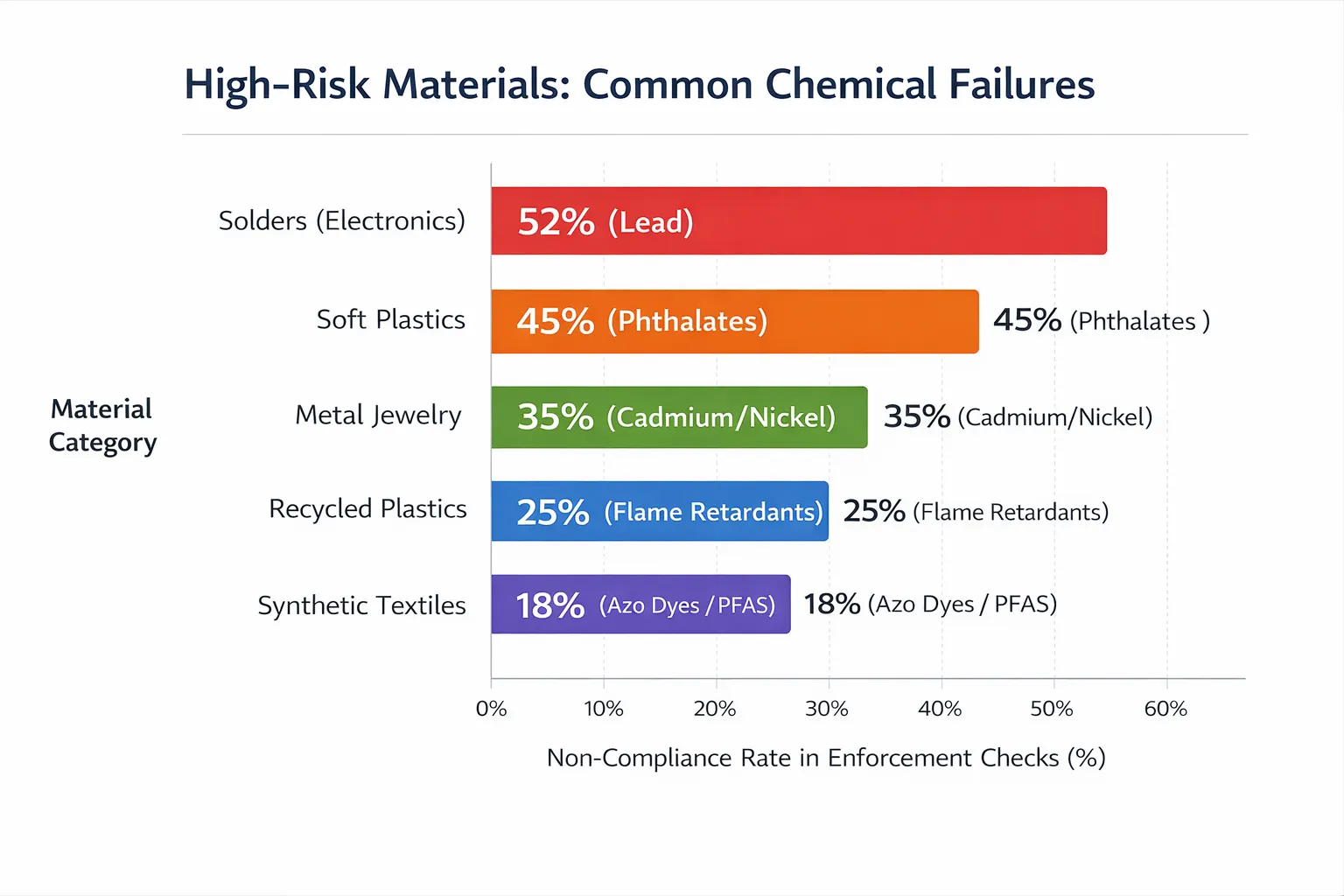
- “Recycled” Black Plastic: Often contains brominated flame retardants from old electronics. Highly risky for RoHS/REACH.
- Coatings & Prints: The fabric might be clean, but the screen-printed logo often contains phthalates or lead.
- Supply Chain Drift: A supplier changes the glue formulation without telling you, introducing formaldehyde.
- Contaminated Solder: Even “lead-free” factories sometimes have cross-contamination in their solder baths.
Frequently Asked Questions
What is chemical testing?
It is the scientific analysis of a material to verify it does not contain restricted toxic substances above legal limits.
What substances are restricted?
The “Big Three” globally are Lead, Cadmium, and Phthalates. Beyond that, lists like REACH SVHC cover 200+ chemicals.
How much does chemical testing cost?
- XRF Scan: ~$100 (for multiple points).
- Lead (Wet Chem): ~$40 – $80 per component.
- Phthalates (7-8 types): ~$150 – $250 per component.
- Full RoHS (Wet Chem): ~$300 – $600 per component.
Can suppliers test?
Suppliers can provide test reports, but you are legally responsible. “Trust but verify.” Accept supplier reports only if they are from a reputable ISO 17025 lab and are less than 12 months old.
How often should I test?
- Mandatory: At least once a year for children’s products (CPSIA).
- Best Practice: Test every new production batch for high-risk items (e.g., painted toys). Test randomly (1 in 10 lots) for low-risk items.
Common Chemical Compliance Failures by Material