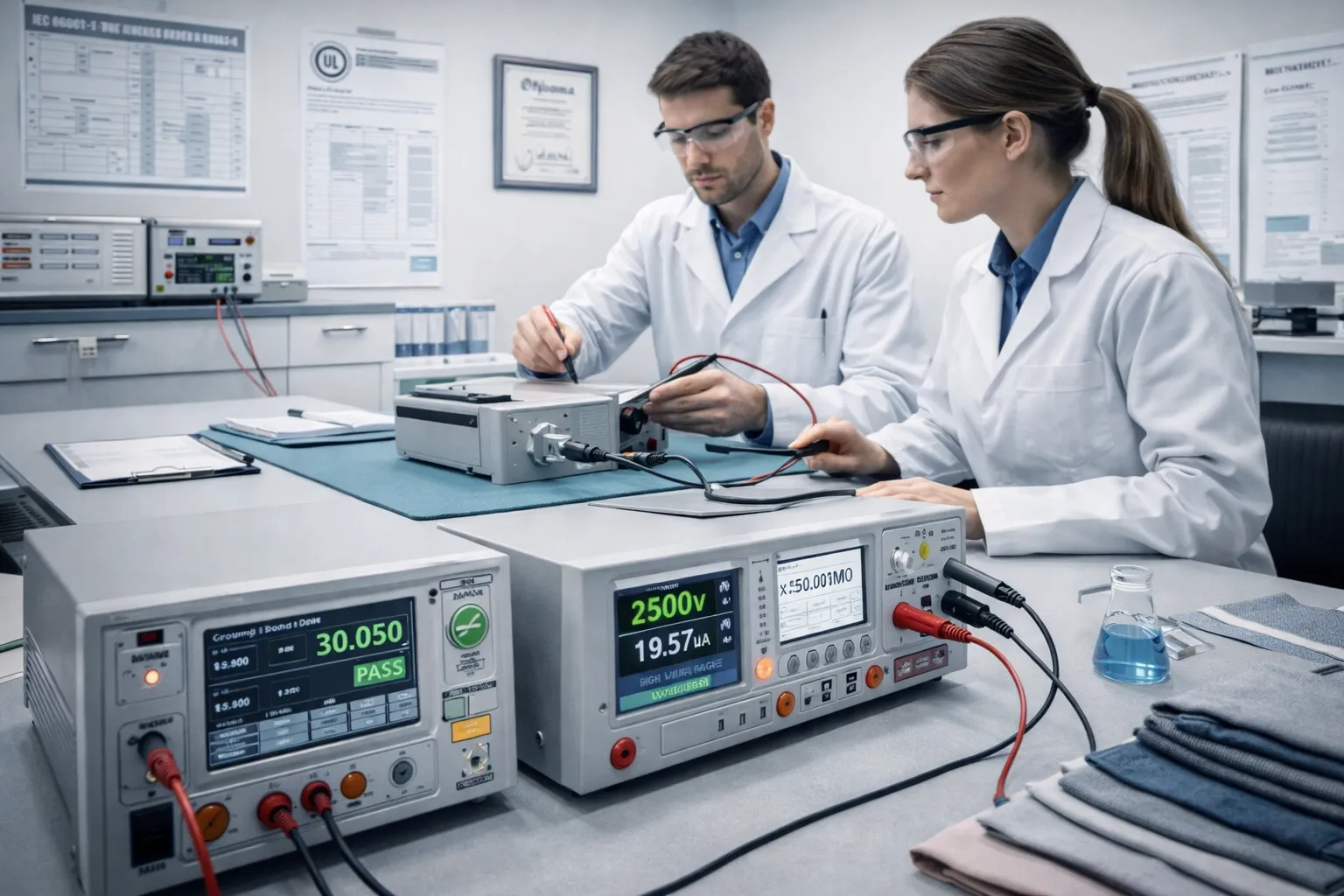
In the world of electronics, a product that functions perfectly but is unsafe is a product that cannot be sold. Electrical product safety testing is the non-negotiable gateway to the global market, ensuring that your device won’t shock a user, start a fire, or explode.
For manufacturers, the path to compliance is paved with acronyms: IEC, UL, CE, Hi-Pot, and Creepage. A misunderstanding here can be costly-redesigning a PCB because the spacing between traces is 0.5mm too narrow for IEC 62368-1 can delay a launch by months.
This guide provides a definitive technical framework for electrical safety, from the core physics of insulation testing to the bureaucratic workflow of global certification.
What Is Electrical Product Safety Testing?
Electrical product safety testing is the rigorous verification process that ensures an electronic device is designed and manufactured to prevent injury during normal use and foreseeable misuse.
Scope and Purpose
It is distinct from performance testing (does it work?) and reliability testing (will it last?). Safety testing asks:
- Insulation: Is the user isolated from high voltage?
- Fire Resistance: Will the plastic enclosure self-extinguish if a component burns?
- Leakage: Is the current flowing through the user safe (micro-amps)?
Why Electrical Safety Testing Is Critical
1. Shock Risk (The Invisible Killer)
A breakdown in insulation can make a metal casing “live” at 110V or 230V. Testing verifies that the protective barriers (insulation) are robust enough to withstand voltage spikes.
2. Fire Risk
Bad connections or failed components can generate intense heat. Safety standards require flame-retardant materials (V-0 rated plastics) and fuse protection to contain potential fires.
3. Compliance & Liability
You cannot sell in the EU without a CE Mark (LVD Directive) or in the US without a NRTL Mark (like UL or ETL). Selling uncertified equipment is illegal and exposes the company to massive liability.
Electrical Safety Requirements for Products
Safety is built on four pillars of design.
- Insulation: The non-conductive material separating live parts from the user. (e.g., The plastic coating on a wire).
- Grounding (Earthing): A low-resistance path to earth that trips the breaker if insulation fails.
- Clearance: The shortest distance through air between two conductive parts (to prevent arcing).
- Creepage: The shortest distance along the surface of insulation between two conductive parts (to prevent tracking).
Core Electrical Safety Testing Methods
These are the “Big Four” tests performed on the production line for 100% of units.
1. Dielectric Strength (Hi-Pot) Testing
- Purpose: Stresses the insulation to ensure it can handle high voltage without breaking down.
- Procedure: Apply a high voltage (e.g., 1000V + 2x Rated Voltage) between the power line and the chassis.
- Pass Criteria: No breakdown (arcing) and leakage current below a set limit.
- Note: This is a stress test. It finds pinholes or thin spots in insulation.
2. Ground Bond & Continuity Testing
- Purpose: Verifies the ground pin on the plug is actually connected to the metal case.
- Procedure: A high current (e.g., 25A) is passed through the ground path.
- Pass Criteria: Resistance must be very low (typically < 0.1 Ω). High resistance means a loose screw or bad solder joint.
3. Insulation Resistance (IR) Testing
- Purpose: Measures the total resistance of the insulation in Mega-Ohms (MΩ).
- Procedure: Apply 500V DC.
- Pass Criteria: Typically > 2 MΩ to 100 MΩ.
- Difference from Hi-Pot: Hi-Pot checks for breakdown (flashover); IR checks for quality (how good is the insulation?).
4. Leakage Current Testing
- Purpose: Measures the tiny current that flows through a person touching the device.
- Types:
- Earth Leakage: Current flowing to ground.
- Touch Current: Current flowing through a simulated human body impedance network.
- Limits: Very strict for medical devices (IEC 60601-1 allows only micro-amps).
Electrical Safety vs EMC Testing
Don’t confuse the two.
| Feature | Electrical Safety | EMC (Electromagnetic Compatibility) |
|---|---|---|
| Goal | Protect People from shock/fire. | Protect Devices from interference. |
| Hazard | High Voltage (>50V). | Radio Frequency (RF) Noise. |
| Standard | IEC 62368-1, UL 60950. | FCC Part 15, EN 55032. |
| Test | Hi-Pot, Ground Bond. | Radiated Emissions, ESD. |
Electrical Safety Standards
The landscape has shifted significantly in the last 5 years.
IEC 62368-1 (The New Global Standard)
Replaces the old IEC 60950 (IT equipment) and IEC 60065 (AV equipment).
- Concept: Hazard-Based Safety Engineering (HBSE). Instead of prescriptive rules (“use 1mm plastic”), it asks: “What is the energy source? Is it hazardous? Is there a safeguard?”
- Status: Mandatory in EU and US since late 2020.
IEC 60335
For household appliances (Toasters, Washing Machines). Focuses heavily on mechanical hazards and water ingress.
IEC 60601-1
For Medical Electrical Equipment. The strictest standard. Requires “Means of Protection” (MOP) for both the Operator (MOOP) and Patient (MOPP).
UL vs IEC Electrical Testing
- IEC (International): Writes the standards. Countries adopt them (e.g., EN 62368 in Europe).
- UL (USA): A testing lab (NRTL) and standards writer. UL standards (e.g., UL 62368) are usually the IEC standard + “US National Differences.”
- Certification: In Europe, you can self-declare compliance (CE Mark). In the US, you generally need a third-party mark (UL, ETL, CSA) for retailer acceptance and OSHA compliance.
Electrical Product Certification Process
1. Risk Assessment (The Paperwork)
Before testing, map out the hazards. “If this capacitor fails short, does the battery explode?”
2. Construction Review
The lab inspects the PCB layout. Are Creepage and Clearance distances sufficient for the voltage? Are the critical components (fuses, transformers) already certified?
3. Type Testing
The lab tests a “Golden Sample.” This involves destructive tests (Short Circuit, Abnormal Heat, Impact).
4. Factory Inspection
To get a UL/ETL mark, inspectors visit your factory 4 times a year to ensure you are actually performing Hi-Pot tests on every unit.
Electrical Safety Verification Workflow
Design Phase:
- Select Certified Components: Use UL-recognized fuses, wires, and connectors.
- PCB Layout: Set CAD rules for Creepage/Clearance (e.g., 3mm for 230V primary-to-secondary).
Pre-Compliance:
- In-House Testing: Run Hi-Pot and thermal tests on prototypes.
- Design Review: Hire a consultant to catch spacing errors early.
Verification:
- Lab Submission: Send samples to Intertek/UL/TÜV.
- Performing Security Verification: The lab runs the test suite.
- Verification Successful: You receive the CB Report and Test Certificate.
Electrical Testing Equipment
- Hi-Pot Tester: The essential tool. Can output 5kV AC/DC.
- Ground Bond Tester: A high-current source (25A-40A).
- Leakage Current Tester: Highly sensitive ammeter with human body impedance simulation.
- Safety Analyzer: A “All-in-One” box that runs all 4 tests in sequence automatically.
Common Electrical Safety Failures
- Creepage Violation: Traces on the PCB are too close. Fix: Add a slot (air gap) in the PCB.
- Transformer Insulation: The isolation tape in the transformer melts or is too thin. Fix: Use Class B or F insulation systems.
- Labeling: Missing “Caution” markings or using labels that rub off with alcohol.
- Grounding: Paint on the chassis prevents the ground screw from making contact. Fix: Mask the grounding point during painting.
Frequently Asked Questions
What is the difference between Hi-Pot and Insulation Resistance?
Hi-Pot is a Stress Test (Pass/Fail) at high voltage to check for breakdown. Insulation Resistance is a Quality Check (Quantitative) at lower voltage to measure insulation health.
Do I need UL certification?
Legally, the US requires testing by an NRTL (Nationally Recognized Testing Laboratory). It doesn’t have to be UL; it can be ETL (Intertek), CSA, or TUV. However, many retailers specifically ask for “UL.”
What is a “Type Test” vs “Routine Test”?
- Type Test: Destructive testing on one sample during certification (e.g., setting it on fire).
- Routine Test: Non-destructive testing on every unit in the factory (e.g., Hi-Pot, Ground Bond).
What is the CB Scheme?
It is a passport for your test report. One certified lab (e.g., in Germany) issues a CB Report, which is accepted by other countries (e.g., Japan, Korea) so you don’t have to re-test.
How often do I need to re-test?
Only when you make a “Safety Critical” change (e.g., changing the power supply, transformer, or enclosure material). Minor changes usually don’t require re-testing.