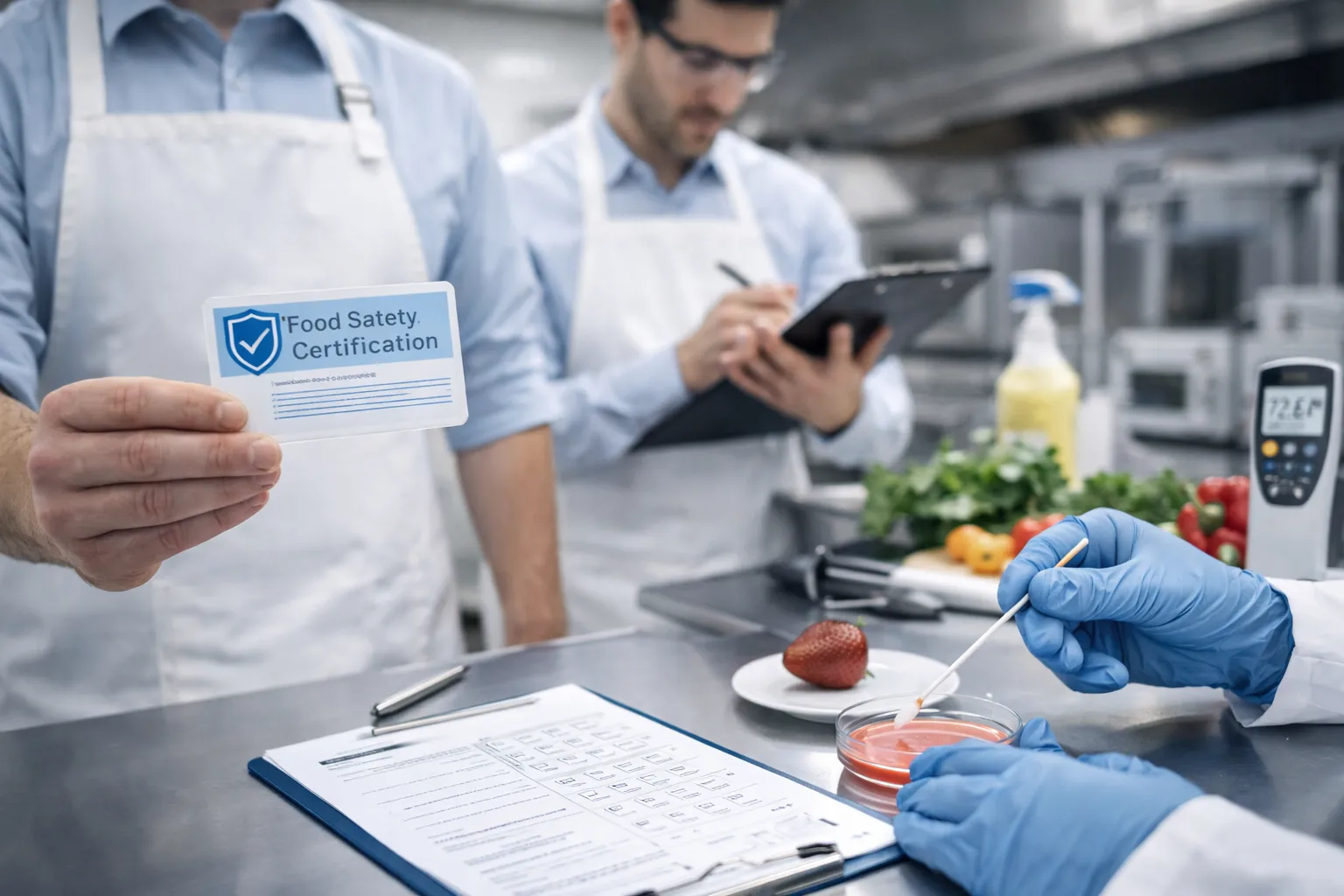
In the food industry, “I didn’t know” is not a defense-it’s a liability. Whether you run a pop-up taco stand or a multi-state manufacturing plant, food safety compliance is the bedrock of your operation.
Most guides confuse you with sales pitches for $15 courses. This guide is different. It is an operational roadmap for business owners, QA managers, and staff to navigate the two pillars of compliance: personnel certification (training humans) and verification testing (testing the environment and product).
What “Food Safety Certification” Actually Means
The term “certification” is often misused. In regulatory terms, there is a sharp distinction between a certificate of completion and a professional certification.
- Food Handler Card (Certificate): Proof of education. You watched the videos, took a short quiz, and printed a card. It verifies training.
- Food Protection Manager (Certification): Proof of competency. You passed a proctored, accredited exam (like ServSafe or NRFSP) that meets Conference for Food Protection (CFP) standards. It verifies knowledge.
Who Recognizes It?
Health departments (local/state) do not issue these directly; they recognize third-party programs.
- ANSI/ANAB Accredited: The gold standard. If your card/cert has this logo, it is valid in 99% of US jurisdictions.
- Local Health Depts: Some specific counties (e.g., San Bernardino, CA or Maricopa, AZ) require their own specific test or a fee to “register” your ANSI card. Always check local rules.
What Inspectors Look For
During an inspection, the EHS (Environmental Health Specialist) wants to see:
- Person In Charge (PIC) with a Manager Certification (mandatory in most states).
- All staff with valid Food Handler Cards (often within 30 days of hire).
- Originals or Digital Copies: Not blurry photos. Keep a binder or a digital folder ready.
Food Handler vs Food Safety Manager: Who Needs What
Confusion here leads to fines. Use this breakdown to assign the right training.
| Role | Food Handler | Food Safety Manager |
|---|---|---|
| Who | Line cooks, servers, dishwashers, baristas, prep staff. | Owner, General Manager, Kitchen Manager, Chef de Cuisine. |
| Requirement | Typically required for everyone who touches food/surfaces. | At least one person per shift or per location (varies by state). |
| Depth | Basics: Wash hands, don’t cross-contaminate, cook to temp. | Advanced: HACCP, active managerial control, regulatory code, microbiology. |
| Cost/Time | ~$10–15 | ~2 hours. |
Business Examples
- Coffee Shop: 1 Manager (Manager Cert) + 5 Baristas (Handler Cards).
- Food Truck: The owner/operator needs Manager Certification. A helper needs a Handler Card.
- Manufacturing Plant: QA Manager needs PCQI (Preventive Controls) training (FDA requirement), not just ServSafe. Line workers need GMP training (similar to Handler).
How to Get a Food Handlers Card (Step-by-Step)
Don’t overpay third-party aggregators. Go to the source.
- Check Local Rules: Google “[Your County] food handler requirements.” Example: Texas accepts any ANSI course; San Diego requires a specific county exam.
- Select a Provider: Choose an ANSI-accredited provider (e.g., ServSafe, StateFoodSafety, 360training, Always Food Safe). Avoid “sketchy” sites without the ANSI logo.
- Purchase & Learn: Pay ~$10-15. Watch the course (usually 60–90 mins).
- Pass the Exam: usually 40 questions. You typically need 70% to pass. You can often retake it for free.
- Print & File: Download the PDF. Email a copy to your manager immediately.
- Pro Tip: Managers, keep a Google Drive folder named “Health Dept Docs” with subfolders for each employee.
Food Safety Training: What’s Covered (and What People Miss)
Passing the quiz is easy; applying it is hard. These are the core concepts that actually prevent outbreaks (and fines).
1. Time & Temperature Control (TCS)
- Danger Zone: 41°F – 135°F. Keep food out of this range.
- Cooling: The #1 cause of outbreaks in restaurants. You must cool food from 135°F to 70°F in 2 hours, and to 41°F in the next 4 hours.
2. Cross-Contamination
- Color Coding: Red boards for raw meat, green for veggies.
- Storage: Raw chicken (bottom shelf) never above lettuce (top shelf).
3. Personal Hygiene
- Handwashing: 20 seconds total (scrub for 10-15).
- Illness Policy: Never work with Vomiting, Diarrhea, Jaundice, or Sore Throat with Fever. (Inspectors will ask staff: “When do you call in sick?”)
4. Allergens
- The Big 9: Milk, Eggs, Fish, Shellfish, Tree Nuts, Peanuts, Wheat, Soy, Sesame.
- Protocol: Use a separate “purple” kit or sanitized gear for allergy orders.
Manager Certification: What Changes at the Manager Level
A Certified Food Protection Manager (CFPM) doesn’t just know how to cook; they know why safety systems fail.
- Active Managerial Control: You are responsible for training staff and verifying they do it. If a cook doesn’t wash hands, the Manager gets the violation.
- Documentation: You maintain the temp logs, cooling charts, and supplier invoices.
- Culture: You set the tone. If you bypass safety during a rush, your staff will too.
Validity: Manager certs are typically valid for 5 years. (Note: Some local jurisdictions require renewal every 3 years).
Food Safety Testing: What It Is and When You Need It
Beyond training people, you must test the environment and the product. This is “Verification.”
Types of Testing
- Microbiological Testing: Testing finished product or surfaces for pathogens (Salmonella, Listeria, E. coli).
- Environmental Monitoring (EMP): Swabbing drains, floors, and handles to find pathogens before they get into food.
- Allergen Testing: Verifying that your “gluten-free” cookie is actually gluten-free (ELISA testing).
- ATP Swabbing: A rapid test (15 seconds) to see if a surface is clean (not necessarily sterile, but free of organic matter).
- Water/Ice Testing: Required for private wells or ice machine compliance in some manufacturing settings.
Common Lab Tests (Plain English) + What the Results Mean
You don’t need to be a microbiologist, but you need to know what to order.
| Test Name | Target | When to Use It | Result Type |
|---|---|---|---|
| APC (Aerobic Plate Count) | General hygiene indicator. | To gauge overall sanitation or shelf life. | Quantitative (e.g., 10,000 CFU/g). High = dirty/spoiled. |
| Coliform / E. coli | Fecal contamination indicator. | Water, ice, or post-process verification. | Quantitative. Any generic E. coli usually indicates unsanitary conditions. |
| Listeria spp. | Environmental pathogen. | Swab drains & floors. Critical for wet environments (deli, dairy). | Qualitative (Presumptive Positive/Negative). |
| Salmonella | Pathogen. | Testing raw ingredients (spices, flour) or RTE foods. | Qualitative (Detected/Not Detected). |
| ATP Swab | Organic residue. | Immediate check after cleaning, before sanitizing. | RLU (Number). Pass/Fail based on your threshold. |
| Gluten / Allergen | Specific protein. | Verifying “Free-From” claims. | Quantitative (ppm). <20ppm is the gluten-free standard. |
Building a Simple Testing Plan (Risk-Based)
Do not test everything randomly. Use a risk-based approach.
Decision Tree: Do I Need to Test?
- Are you a standard Restaurant/Cafe?
- Lab testing: Rarely required unless you do specialized processing (sous vide, curing) or have a crisis.
- Routine testing: Use thermometers and sanitizer test strips daily. Maybe ATP swabs for training.
- Are you a Manufacturer / Co-packer?
- Yes. You need an Environmental Monitoring Program (EMP).
- Focus: Swab Zone 2 (equipment frames) and Zone 3 (floors/drains) for Listeria or Salmonella.
- Do you make “High Risk” items (Juice, Seafood, RTE Deli)?
- Yes. Mandatory pathogen testing is often required by FDA/USDA plans.
Minimum Viable Testing Plan (Small Manufacturer)
- Monthly: Send 1 composite product sample for APC/Yeast/Mold (shelf life check).
- Quarterly: Environmental swabs (drains/walls) for Listeria.
- Daily: Visual inspection + ATP swabs (optional but recommended).
Documentation Checklist (Inspection-Ready)
If it isn’t written down, it didn’t happen.
- Personnel: Copies of all active Food Handler Cards & Manager Certs.
- Temps: Cold hold logs (AM/PM checks of coolers).
- Cooking: Internal temp logs for cooked proteins.
- Sanitation: Chemical concentration logs (Dish machine / 3-comp sink).
- Calibration: Thermometer calibration log (weekly).
- Suppliers: Invoices and COAs (Certificates of Analysis) for ingredients.
- Corrective Actions: A log book where you write down “Cooler was 45°F, threw away food, called repair tech.” (Inspectors love this).
Mistakes That Get Businesses in Trouble
- Expired Cards: “I thought it was good for 5 years.” (Handler cards are often 2-3 years; Manager certs are 5).
- “My Manager is at the Store”: If the certified manager isn’t onsite (or accessible, depending on state), you can be cited.
- Relying on Suppliers: “My supplier said it’s pathogen-free.” Without a COA (Certificate of Analysis) or your own testing, you own the risk.
- No Sick Policy: Failing to document that staff signed a “Reporting of Illness” agreement.
- Pencil Whipping: Filling out temperature logs for the whole week in advance. (Inspectors catch this instantly-ink color is identical, handwriting is rushed).
FAQs
What is a food handler certification?
It is a basic credential proving an employee has been trained in safe food preparation (handwashing, temps, cross-contamination). It is required for most staff in food service.
How long is a food handlers card valid?
It varies by state and provider, but typically 2 to 3 years. Check the expiration date printed on the card.
Do I need manager certification?
If you are the Person in Charge (PIC) of a food establishment, yes. Most jurisdictions require at least one certified manager per facility.
Can I get certified on my own?
Yes. You can purchase the course and exam online as an individual. You do not need a corporate sponsor.
Is online training accepted?
Yes, as long as it is ANSI/ANAB accredited. Some jurisdictions require the exam to be proctored (monitored via webcam or in person).
What is food safety testing and who performs it?
It involves lab analysis of food or surfaces for bacteria, chemicals, or allergens. It is performed by private, ISO 17025 accredited third-party laboratories (like Eurofins, SGS, or local specialized labs).
What is the difference between Zone 1 and Zone 4 testing?
- Zone 1: Food contact surfaces (slicers, tables). rarely tested for pathogens (to avoid recalls). Tested for hygiene (ATP).
- Zone 4: Distant areas (locker rooms, loading dock). Tested to see if pathogens are entering the building.
Do I need to test for allergens?
If you make a claim like “Gluten-Free” or “Peanut-Free,” you must verify it through testing to ensure no cross-contact is happening.
How much does a lab test cost?
- Pathogen test (Salmonella): ~$25–50 per sample.
- Allergen test: ~$80–150 per sample.
- ATP Swab: ~$2–3 per swab (equipment cost ~$1,500).
What happens if I fail a health inspection?
You will receive a score and a list of violations. Critical violations (no hot water, sewage, pest infestation) can close you immediately. You must correct them and pay for a re-inspection.
Does a food truck need a commissary letter?
Yes. In most places, you cannot store food or wash dishes at home. You must prove you use a permitted commercial kitchen (commissary) for prep and sanitation.
Is ServSafe the only option?
No. It is the most famous, but other ANSI-accredited programs like National Registry (NRFSP), 360training, and StateFoodSafety are equally valid regulatory alternatives.
Quick Summary + Action Checklist
Do this this week:
- Audit Personnel: Check expiration dates on all Food Handler Cards and Manager Certs.
- Assign Training: Send links to any staff expiring within 30 days.
- Check Temps: Verify your walk-in cooler has a working thermometer inside.
- Review Chemicals: Ensure sanitizer bottles are labeled and test strips are available.
- Walk the Floor: Do a mock inspection. Look for mold in the ice machine and clutter by the hand sink.
- Update Logs: Ensure temp logs are being filled out honestly every day.
- Verify Suppliers: If you manufacture, request updated COAs from your top 3 ingredient suppliers.
Need help building a compliant training plan? Use the checklist above to audit your current status.