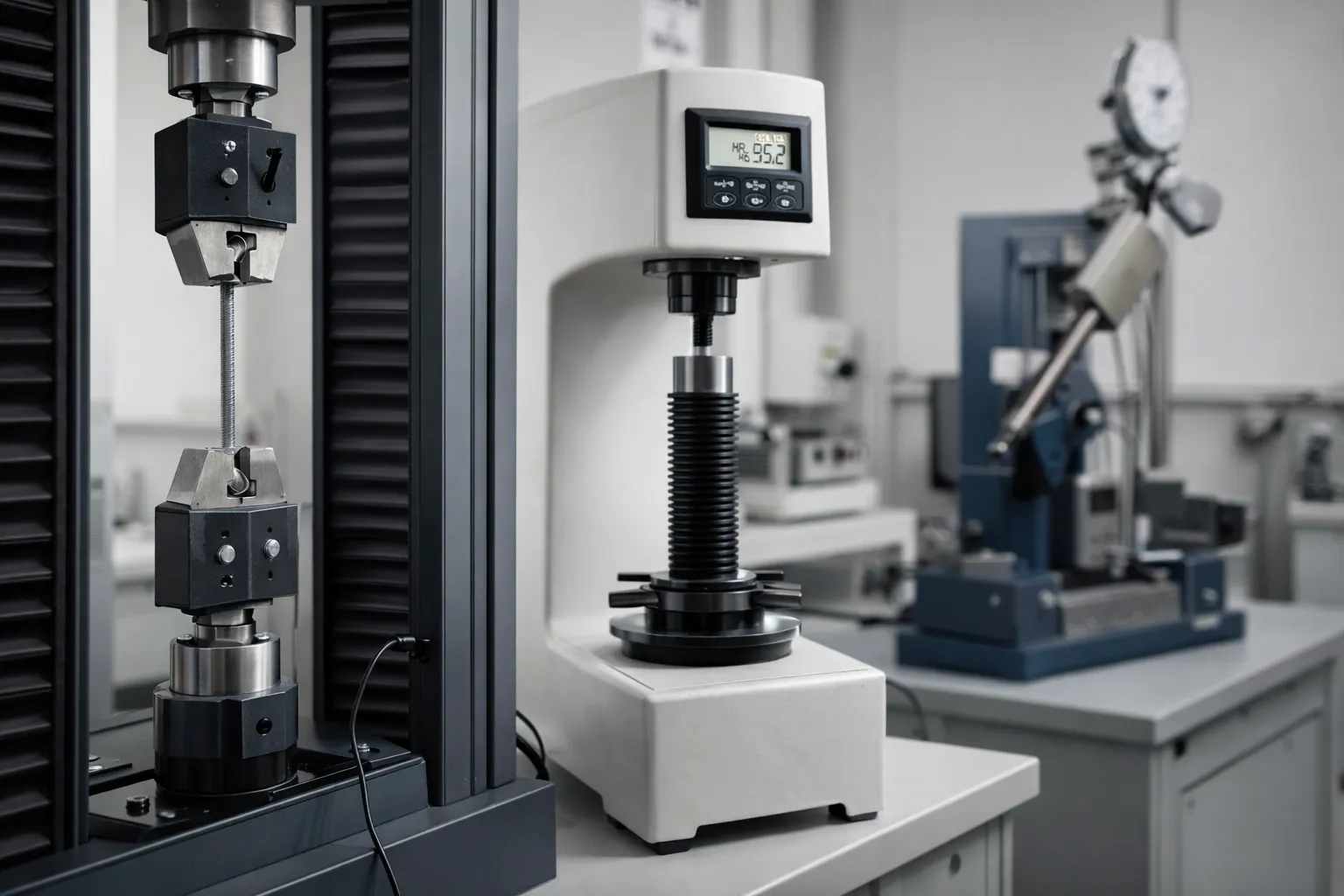
In engineering and manufacturing, assuming a material’s properties is a recipe for catastrophic failure. Whether you are designing a bridge, an aircraft landing gear, or a simple plastic clip, material testing provides the empirical data necessary to validate design safety factors and ensure regulatory compliance.
For engineers, the challenge lies not just in testing, but in selecting the correct method. A tensile test performed to ASTM E8 (standard for metals) yields different data nuance than one performed to ISO 6892. Understanding these distinctions-and knowing when to use Rockwell vs. Vickers hardness-is what separates robust engineering from guesswork.
This guide provides a definitive technical framework for mechanical testing, comparing ASTM and ISO standards, and outlining the operational best practices for validating metallic and polymeric materials.
What Is Material Testing?
Material testing is the rigorous process of characterizing the physical and mechanical properties of raw materials and components under specific conditions (force, temperature, environment).
Purpose and Role
It serves three critical engineering functions:
- Characterization: Determining fundamental properties (e.g., Yield Strength, Young’s Modulus) for simulation and design.
- Quality Control (QC): Verifying that a specific batch of material meets the mill certificate specifications.
- Failure Analysis: Understanding why a material failed by replicating service conditions.
Why Material Testing Is Critical in Engineering
1. Design Validation & Safety
Engineers use Finite Element Analysis (FEA) to predict stress. However, FEA is garbage-in, garbage-out. Material testing provides the accurate input data (stress-strain curves) that makes the simulation valid.
2. Manufacturing Consistency
A slight change in heat treatment can drastically alter a steel’s ductility without changing its chemical composition. Mechanical testing detects these invisible process drifts.
3. Regulatory Compliance
Aerospace (FAA), Automotive (IATF 16949), and Medical (FDA) regulations mandate traceable testing to specific standards (ASTM/ISO) before a product can be certified.
Categories of Material Testing
While this guide focuses on mechanical testing, it sits within a broader ecosystem.
- Mechanical Testing: Destructive tests measuring strength, ductility, and stiffness (Tensile, Impact, Hardness).
- Chemical Analysis: Determining elemental composition (OES, XRF) to ensure the alloy grade is correct (e.g., “Is this really 316 Stainless?”).
- Microstructural Analysis: Using microscopy to examine grain size, phase distribution, and inclusions.
- Non-Destructive Testing (NDT): Inspecting for flaws without damaging the part (Ultrasonic, X-Ray, Dye Penetrant).
Mechanical Testing Methods
The “Big Five” mechanical tests form the backbone of most engineering specifications.
1. Tensile Testing
The Fundamental Test. A specimen is pulled apart until failure. It measures Yield Strength, Ultimate Tensile Strength (UTS), and Ductility (Elongation).
2. Compression Testing
The opposite of tensile. Used for materials that operate under crushing loads (concrete, cast iron, ceramics).
3. Hardness Testing
Measures resistance to indentation. It is a quick, non-destructive proxy for tensile strength and wear resistance.
4. Impact Testing
Measures Toughness-the energy absorbed during sudden fracture. Critical for detecting brittle behavior at low temperatures.
5. Fatigue Testing
Cyclic loading below the yield point to determine the Endurance Limit (how many cycles before failure). Essential for rotating parts like shafts and gears.
Tensile Testing of Metallic Materials
Tensile testing provides the Stress-Strain Curve, the most valuable dataset for structural engineers.
Key Properties Measured
- Yield Strength (0.2% Offset): The stress at which plastic (permanent) deformation begins.
- Ultimate Tensile Strength (UTS): The maximum stress the material can withstand before necking.
- Elongation (%): A measure of ductility (how much it stretches before breaking).
- Modulus of Elasticity (Young’s Modulus): The stiffness of the material in the elastic region.
Standards Comparison: ASTM E8 vs. ISO 6892
| Feature | ASTM E8 / E8M (USA) | ISO 6892-1 (Global/EU) |
|---|---|---|
| Control Method | Historically focused on Strain Rate or Stress Rate. | Strongly prefers Strain Rate Control (Method A) to minimize variability. |
| Specimen Shape | Uses standard “dog bone” flat or round specimens with fixed gauge lengths (e.g., 2 inch). | Uses proportional gauge lengths ($L_0 = 5.65 \sqrt{S_0}$) to normalize results across sizes. |
| Testing Speed | Defines speed based on stress rate in elastic region. | Defines speed based on strain rate (feedback loop from extensometer). |
| Equivalence | Results are generally comparable, but subtle speed control differences can affect Yield Strength values by 1-2%. |
Compression Testing
Principles
The specimen is compressed between two platens. For ductile metals, it may simply flatten (pancake) without fracturing, so “Compressive Strength” is often defined at a specific deformation (e.g., 10%).
Standards
- ASTM E9: Standard test method for compression testing of metallic materials.
- ISO 604: Standard for plastics (metals are covered under general ISO mechanical standards).
Hardness Testing Methods
Hardness is not a fundamental property but a composite one. Selection depends on the material type.
| Method | Indenter | Load | Best Application | Standard (ASTM/ISO) |
|---|---|---|---|---|
| Rockwell (HRC/HRB) | Diamond Cone or Steel Ball | 60-150 kgf | Steel, Hard Metals. Fast, no optical reading needed. Good for QC. | ASTM E18 / ISO 6508 |
| Brinell (HBW) | 10mm Tungsten Carbide Ball | 3000 kgf | Cast Iron, Aluminum. Large indent averages out coarse grain structures. | ASTM E10 / ISO 6506 |
| Vickers (HV) | Diamond Pyramid | 1-100 kgf | All Materials. Continuous scale from soft to hard. High precision. | ASTM E92 / ISO 6507 |
| Micro-Vickers | Diamond Pyramid | <1 kgf | Coatings, Case Depth, Foil. Testing specific grains or thin layers. | ASTM E384 |
Engineering Insight: Never compare HRC directly to HBW without a reliable conversion table (ASTM E140), as the physics of deformation differ.
Impact Testing Methods
Impact testing answers: “Will this steel shatter like glass in winter?”
Charpy V-Notch (CVN)
- Setup: A pendulum strikes a notched bar supported at both ends (3-point bend).
- Data: Absorbed Energy (Joules or ft-lbs).
- Transition Temperature: Tests are run at multiple temps (-20°C, -40°C) to find the “Ductile-to-Brittle Transition Temperature” (DBTT).
- Standards: ASTM E23 vs. ISO 148-1. (Note: The striker radius differs-2mm for ISO vs 8mm for ASTM-so raw numbers are not directly comparable).
Izod
- Setup: The specimen is held as a cantilever (vertical) and struck on the top.
- Application: Common for Plastics (ASTM D256), rare for metals outside of old British standards.
ASTM vs ISO Material Testing Standards
Globalization requires engineers to navigate both systems.
- ASTM (American Society for Testing and Materials): Dominant in North America, Aerospace, and Oil & Gas. Tends to be more prescriptive about equipment and procedure.
- ISO (International Organization for Standardization): Dominant in Europe and Automotive. Tends to focus on uncertainty budgets and methodology (e.g., strain control).
- EN (European Norms): Often identical to ISO (e.g., BS EN ISO 6892), adopted by EU member states.
Key Difference: Units. ASTM E8M is the metric version of E8, but many US drawings still reference Freedom Units (psi, in). ISO is strictly SI (MPa, mm).
Selecting Material Testing Methods
By Material
- Steel/Aluminum: Tensile (ASTM E8), Rockwell Hardness (ASTM E18), Charpy (ASTM E23).
- Plastics: Tensile (ASTM D638), Flexural (ASTM D790), Izod Impact (ASTM D256).
- Composites: Tensile (ASTM D3039), Compression (ASTM D6641).
By Property Needed
- Stiffness: Tensile or Flexural Modulus.
- Durability: Fatigue (S-N Curve).
- Wear Resistance: Hardness (HRC).
Testing Equipment & Laboratory Setup
Universal Testing Machine (UTM)
The workhorse. A dual-column frame with a load cell and crosshead.
- Calibration: Must be verified to ASTM E4 (Force verification) annually.
- Extensometer: A clip-on sensor is mandatory for accurate Yield Strength measurement. Relying on crosshead travel is inaccurate due to machine compliance (stretching).
Laboratory Setup
- Temperature Control: Tests are standard at 23°C ±5°C.
- Specimen Prep: CNC machining or waterjet cutting is required to prevent heat-affected zones (HAZ) on the specimen edges, which ruins ductility data.
Material Testing in Quality Control
In production, testing verifies the Heat Lot.
- Mill Certs: The steel mill tests the ladle melt.
- Check Analysis: The factory tests a coupon from the actual bar stock to confirm the mill cert wasn’t faked (common in low-cost sourcing).
- Witness Coupons: A piece of metal travels with the part through heat treat. Testing the coupon verifies the part’s final properties without destroying the part.
Common Testing Errors
- Misalignment: If the specimen is gripped crookedly, it experiences bending moments, artificially lowering the measured strength.
- Surface Finish: Rough machining marks on a tensile specimen act as stress risers, causing premature failure (low elongation).
- Extensometer Slip: If the strain gauge slips on the metal, the Yield Point calculation will be wrong.
- Wrong Hardness Scale: Using Rockwell C on soft aluminum will yield no result (penetrator sinks too deep). Use Rockwell B or Brinell.
Frequently Asked Questions
What is the difference between ASTM E8 and ASTM A370?
ASTM E8 describes how to perform a tensile test. ASTM A370 describes how to test steel products specifically (pipes, fasteners) and often references E8 for the method but adds product-specific sampling rules.
Why is yield strength more important than tensile strength?
Yield strength marks the limit of permanent damage. Once a part yields, it is geometrically distorted and usually failed. UTS is just the point of fracture, which is often irrelevant if the part is already bent out of shape.
Can I convert Hardness to Tensile Strength?
Yes, for non-alloyed steels, there is a reliable correlation (approx. UTS = 3.45 x HBW). However, for aluminum, copper, and high-alloy steels, the correlation is poor and should not be relied upon for design.
What is the “Gauge Length”?
It is the specific section of the specimen where elongation is measured. If you stretch a 2-inch gauge length by 0.5 inches, you have 25% elongation. Comparing elongation from a 2-inch gauge to a 50mm gauge (ISO) requires conversion formulas.