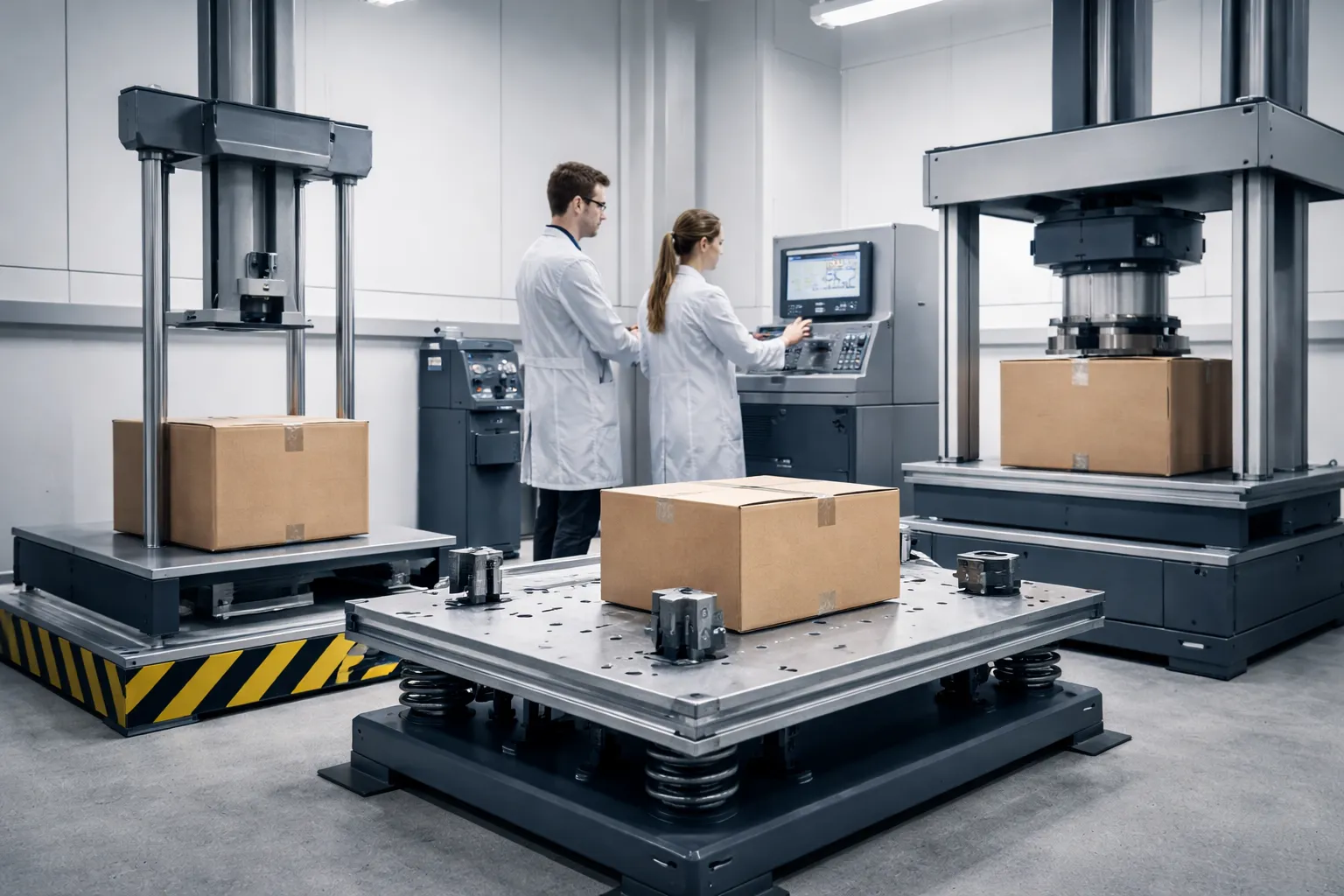
In the global supply chain, a product is only as good as the packaging that protects it. From the vibration of a truck axle to the compression of a warehouse stack, packaging faces a gauntlet of physical hazards. Packaging testing is the engineering discipline of simulating these hazards in a controlled laboratory environment to ensure product integrity before shipment.
For packaging engineers and logistics managers, the difference between a “good guess” and an ISTA-certified package is often the difference between a successful launch and a 20% return rate due to shipping damage. This guide provides the definitive technical framework for validation, covering drop tests, vibration profiles, and compression standards.
What Is Packaging Testing?
Packaging testing is the comprehensive evaluation of a packaging system’s ability to withstand the rigors of the supply chain. It involves subjecting the package (and the product inside) to mechanical and environmental stresses that replicate real-world distribution.
Purpose and Role
- Validation: Confirming the design meets protection requirements (e.g., “Must survive a 3-foot drop”).
- Optimization: Reducing material usage by identifying “over-packaging” (e.g., reducing cardboard grade if compression strength is excessive).
- Certification: Meeting retailer mandates (e.g., Amazon SIOC) or regulatory rules (e.g., UN 38.3 for batteries).
Why Packaging Testing Is Critical
1. Transport Damage Reduction
Damage in transit costs billions annually. Testing identifies weak points-like a corner that crumples or a seal that pops-before you ship 10,000 units.
2. Product Safety & Sterility
For medical devices and food, a breach in the package is a breach in safety. Testing verifies the Sterile Barrier System (SBS) remains intact after vibration and altitude changes.
3. Cost Optimization
Engineers often “guess high” on corrugated strength to be safe. Testing reveals the precise specification needed, often allowing companies to downgrade material (e.g., from double-wall to single-wall) and save millions.
Packaging Testing Requirements
Testing requirements are dictated by the Distribution Environment:
- Handling: How many times will it be dropped? (Courier delivery = high drop risk; Palletized freight = low drop risk).
- Stacking: How high will it be stacked in a warehouse? (Requires compression testing).
- Transport Mode: Truck (random vibration), Rail (shunting shock), Air (pressure drop).
- Climate: Will it sit on a tarmac in Dubai (60°C) or a dock in Alaska (-30°C)?
Categories of Packaging Testing Methods
We classify tests by the hazard they simulate.
| Category | Hazard Simulated | Key Tests |
|---|---|---|
| Mechanical | Physical impacts and forces. | Drop, Vibration, Shock, Compression. |
| Environmental | Climatic stress. | Temperature, Humidity, Altitude. |
| Integrity | Seal failure or leakage. | Bubble Leak, Dye Penetration, Burst Strength. |
| Material | Strength of the packaging material itself. | Edge Crush Test (ECT), Burst (Mullen). |
Drop Test Methods
The drop test is the most fundamental packaging test, simulating manual handling mishaps.
Free-Fall Drop (ASTM D5276 / ISO 2248)
- Method: The package is dropped from a set height onto a rigid steel plate.
- Protocol: Drops are not random. A standard sequence (e.g., 1-Corner, 3-Edges, 6-Faces) ensures every weak point is hit.
- Drop Height: Determined by package weight.
- < 21 lbs: 30 inches (typical courier drop height).
- 100 lbs: 6-12 inches (unlikely to be lifted high).
Rotational Edge Drop
For heavy packages that cannot be lifted manually. One end is lifted and dropped.
Vibration Test Methods
Vibration causes “fatigue” damage (loosening screws, scuffing labels) that a drop test misses.
Random Vibration (ASTM D4728 / ISTA)
- The Gold Standard. It simulates the non-repeating, chaotic motion of a truck or airplane.
- Profile: The lab programs a “Power Spectral Density” (PSD) plot that matches the specific mode (e.g., “Truck – US Highway”).
- Duration: Accelerated testing (e.g., 1 hour in the lab = 1000 miles on the road).
Sinusoidal Vibration (Fixed Frequency)
- Legacy Method: Vibrates at a constant frequency. Less realistic but useful for finding the Resonant Frequency of a product (the frequency where it shakes itself apart).
Compression & Stacking Tests
Warehouses stack pallets 3-4 high. The bottom box bears a massive load.
Static Compression (ASTM D642)
- Method: A machine slowly crushes the box to measure its Peak Load (when it buckles).
- Safety Factor: Engineers apply a safety factor (typically 3x to 5x) to the calculated stack load to account for humidity (which weakens cardboard) and time.
Vehicle Stacking (Dynamic)
- Simulates the load of other pallets sitting on top of your freight inside a bouncing truck.
Environmental Packaging Tests
Climatic Conditioning (ASTM D4332)
- Tropical: High heat + High humidity (weakens glue and cardboard).
- Frozen: Low temp (makes plastic brittle and tape fail).
- Cycle: Moving between hot and cold (causes condensation).
Altitude Testing (ASTM D6653)
- Hazard: Low pressure in an airplane cargo hold can cause sealed bags (chips, medical pouches) to expand and burst.
- Method: Vacuum chamber simulates 14,000 ft altitude.
Packaging Testing Standards
ISTA (International Safe Transit Association)
The industry leader.
- Series 1: Non-simulation screening (Pass/Fail benchmarks).
- Series 2: Partial simulation (adds atmospheric conditioning).
- Series 3: General simulation (replicates specific transport modes like “Parcel Delivery”).
- Series 6: Member performance tests (e.g., Amazon ISTA 6-Amazon.com-SIOC).
ASTM (American Society for Testing and Materials)
Provides the test method (how to drop), whereas ISTA provides the test protocol (how high to drop).
- ASTM D4169: The “Standard Practice for Performance Testing of Shipping Containers.” It is a customizable menu of tests (Drop + Vibe + Compression) used heavily in Medical Device packaging.
ISO
Common in Europe (e.g., ISO 11607 for medical packaging validation).
ISTA vs. ASTM Packaging Testing
| Feature | ISTA | ASTM (D4169) |
|---|---|---|
| Focus | Protocol: “Do Step A, then Step B.” | Methodology: “Here is how to run the test.” |
| Flexibility | Rigid. You follow the sequence exactly to get certified. | Flexible. You choose the “Distribution Cycle” (DC) that matches your logistics. |
| Key Use | Retailer compliance (Amazon, Walmart). | Medical Device (FDA) & Pharma validation. |
| Certification | ISTA Transit Tested Certification mark. | No formal mark; used for technical files. |
Packaging Validation Process (Workflow)
- Define the Distribution Cycle: How will it ship? (e.g., Palletized LTL -> Warehouse -> UPS Last Mile).
- Select the Protocol: Choose ISTA 3A (Parcel) or ISTA 3E (Pallet).
- Determine Sample Size: ASTM D4169 typically requires N=1 for non-medical, but N=3 or N=10 is statistically better.
- Pre-Conditioning: Store samples at standard temp/humidity (23°C, 50% RH) for 24 hours.
- Execute Tests: Run Drop, Vibration, Compression, and Low Pressure tests in sequence.
- Inspection: Open the package. Is the product damaged? Is the sterile barrier intact?
- Report: Generate the final engineering report (Pass/Fail).
Packaging Testing Equipment
You cannot do this with a forklift and a concrete floor.
- Precision Drop Tester: A machine with leaves that swing away instantly to ensure a flat, un-tumbled drop.
- Vibration Table: Hydraulic or electro-dynamic shaker capable of reproducing specific random vibration PSD profiles.
- Compression Tester: A giant press that measures force vs. deflection.
Industry-Specific Packaging Testing
Medical Devices (ISO 11607)
- Critical: Sterile Barrier Integrity.
- Tests: Dye Penetration (ASTM F1929), Bubble Leak (ASTM F2096), and Peel Strength (ASTM F88) after the carton has gone through distribution testing (ASTM D4169).
Electronics
- Critical: Shock (G-force) transmission.
- Tests: Accelerometers are placed inside the product during the drop test to measure how much shock the foam cushioning actually absorbed.
Cold Chain (Pharma/Food)
- Critical: Thermal insulation.
- Tests: ISTA 7D / 7E. The package is put in a thermal chamber that cycles external temps (summer/winter profiles) while internal probes measure if the product stays between 2°C-8°C.
Common Packaging Testing Failures
- Vibration Scuffing: The product vibrates inside the box, rubbing off the paint or label. Fix: Tighten the fit or add polybag.
- Corner Crushing: The box survives flat drops but crumples on a corner drop, transferring impact to the product. Fix: Add corner inserts.
- Closure Failure: Tape pops open during vibration. Fix: Change to “H-taping” method or stronger adhesive.
- Stack Collapse: Box walls buckle under humidity. Fix: Switch to High-Performance (HP) linerboard or B-flute to C-flute.
Frequently Asked Questions
What is the difference between ISTA 1A and ISTA 3A?
ISTA 1A is a basic screening test (fixed vibration, fixed drop height). It is good for internal benchmarking but does not simulate real life. ISTA 3A is a simulation test (random vibration based on actual road data, varied drop heights). 3A is much harder to pass but represents reality.
Does Amazon require packaging testing?
Yes. For many ASINs, Amazon requires Frustration-Free Packaging (FFP) or Ships in Own Container (SIOC) certification. This requires passing an ISTA 6-Amazon test at a certified lab.
What is a “shaker table”?
It is the machine used for vibration testing. It shakes the package at varying frequencies to mimic a truck engine and road bumps.
Can I perform my own drop tests?
For rough R&D, yes. But for certification or retailer compliance, you must use a certified third-party lab with calibrated equipment. A hand-drop is rarely perfectly flat and invalidates the data.
How many samples do I need to test?
For ISTA, usually 1 sample is the minimum. For Medical Device validation (ASTM D4169), 3 to 30 samples are required depending on risk tolerance and statistical confidence needed.