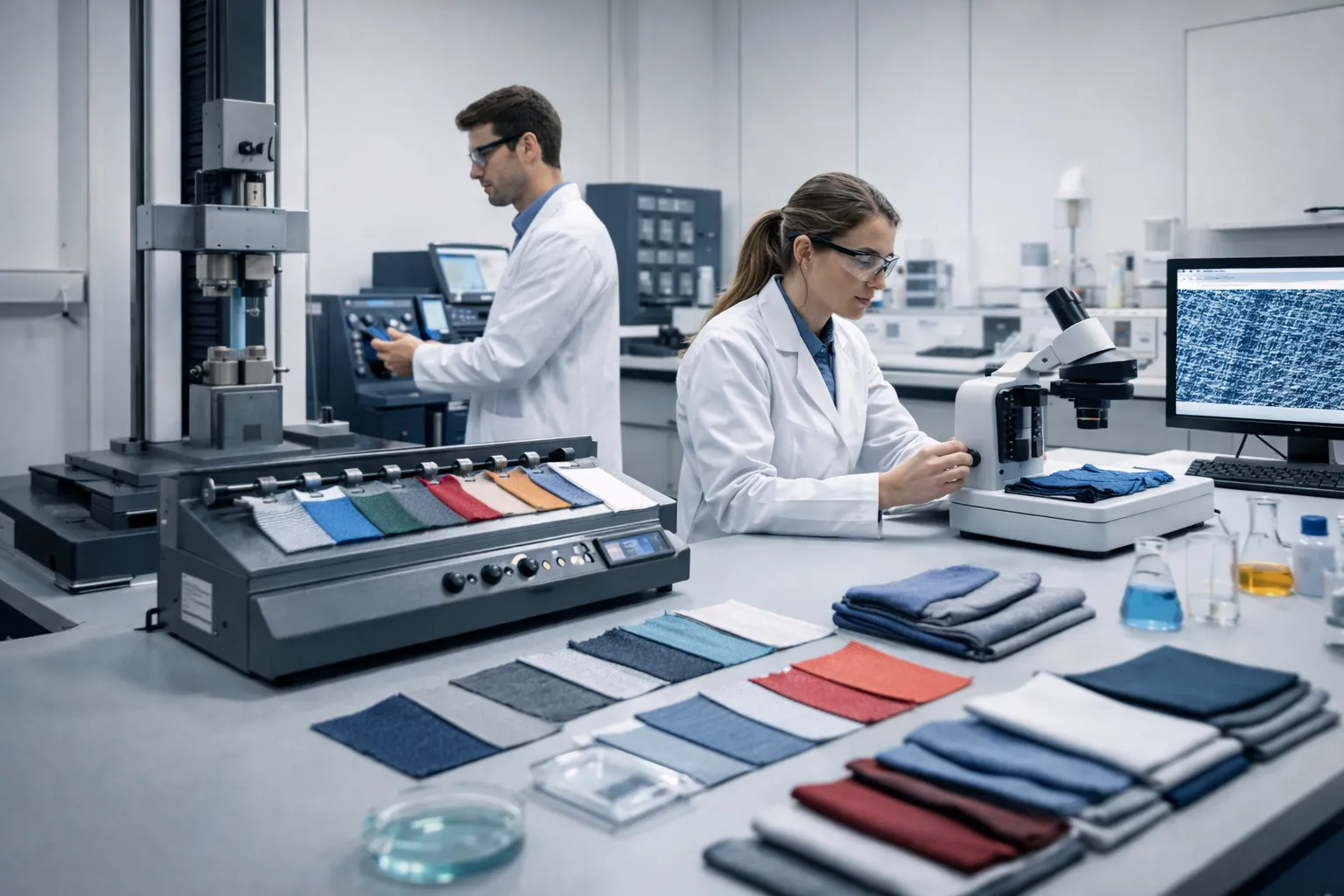
In the global fashion and textile industry, a fabric’s journey from a loom in Asia to a retail shelf in Europe or North America is paved with rigorous testing. Textile testing is not just about quality-it is the regulatory firewall that prevents flammable children’s sleepwear, carcinogenic dyes, and heavy metals from reaching consumers.
For brands and manufacturers, the challenge lies in navigating the “Alphabet Soup” of standards: ISO (global), AATCC (US wet processing), ASTM (US physical), and GB (China). A fabric that passes a US washing test might fail an EU perspiration test because the methods differ in temperature, detergent, and time.
This guide provides the definitive technical framework for textile testing, comparing major standards and outlining the compliance roadmap for global market entry in 2026.
What Is Textile Testing?
Textile testing is the scientific analysis of the physical, chemical, and biological properties of textiles. It applies to every stage of production: fiber, yarn, fabric, and finished garment.
Purpose and Scope
- Product Safety: Ensuring no harmful chemicals (e.g., Lead, Formaldehyde) are present.
- Quality Assurance: Verifying the fabric meets specifications (e.g., “Must withstand 50 wash cycles”).
- Regulatory Compliance: Meeting mandatory laws like REACH (EU) or CPSIA (USA).
- Performance Claims: Validating marketing claims like “waterproof,” “anti-bacterial,” or “UV protective.”
Why Textile Testing Is Critical
1. Product Safety & Liability
Textiles are the closest product to the human skin. Testing prevents allergic reactions, chemical burns, and flammability incidents. A single recall for high lead content can bankrupt a supplier.
2. Brand Reputation
Pilling (fuzzballs) and color bleeding are the top reasons for garment returns. Testing identifies these failures before mass production.
3. Global Market Access
You cannot legally sell in the EU without REACH compliance, nor in China without passing GB 18401. Testing provides the “Passport” for your goods.
Categories of Textile Testing
We categorize tests by the nature of the analysis.
| Category | Focus | Examples |
|---|---|---|
| Physical / Mechanical | Durability & Strength | Tensile strength, Pilling, Abrasion (Martindale), Bursting. |
| Colorfastness | Resistance to fading | Wash, Light, Rubbing (Crocking), Perspiration, Sea water. |
| Chemical / Analytical | Restricted substances | pH, Formaldehyde, Azo dyes, Heavy metals, Nickel release. |
| Performance | Functional properties | Waterproofness, Breathability, Thermal resistance, Stretch/Recovery. |
| Safety / Flammability | Fire resistance | 16 CFR 1610 (General apparel), EN 1103 (Curtains). |
Fabric Strength & Durability Testing
Does the fabric rip when you wear it?
Tensile Strength (Woven Fabrics)
- Grab Test (ASTM D5034 / ISO 13934-2): Grips the center of the fabric. Simulates how clothes are actually worn and pulled.
- Strip Test (ASTM D5035 / ISO 13934-1): Grips the full width. Used for technical textiles (e.g., parachutes) where precise engineering data is needed.
Tearing Strength
- Elmendorf Tear (ASTM D1424 / ISO 13937): A pendulum swings to rip a pre-cut slit. Critical for lightweight fabrics like silk or lining.
Bursting Strength (Knits)
- Mullen Burst (ASTM D3786 / ISO 13938): A rubber diaphragm expands until it pops the fabric. Essential for knitwear (t-shirts, leggings) which don’t have a simple “warp” direction.
Abrasion & Pilling
- Martindale (ISO 12947 / ISO 12945): Rubs fabric in a Lissajous figure (figure-8). Used globally for upholstery and apparel.
- Wyzenbeek (ASTM D4157): Rubs back and forth. Primarily used in the US for upholstery.
Colorfastness Testing Standards
Will the red shirt turn your white socks pink?
Colorfastness to Washing
- ISO 105-C06: Uses steel balls to simulate mechanical action.
- AATCC 61: An accelerated test (45 mins = 5 home washes).
Colorfastness to Light
- ISO 105-B02: Xenon arc lamp simulates sunlight. Graded 1-8 (8 is best).
- AATCC 16: Also uses Xenon, but graded 1-5 (5 is best). Note: A “4” in AATCC is not the same as a “4” in ISO.
Colorfastness to Rubbing (Crocking)
- ISO 105-X12 / AATCC 8: Rubs a white cloth against the dry and wet fabric. If color transfers, it fails. Critical for denim and deep-dyed cottons.
Chemical & Safety Textile Testing
The “Invisible” Hazards.
Restricted Substances List (RSL)
Brands (Nike, H&M) have their own RSLs, often stricter than the law.
- Azo Dyes: Banned in EU/China/India. They can break down into carcinogenic amines.
- Formaldehyde: Used for “wrinkle-free” finishes. Regulated in Japan and for baby clothes globally.
- Heavy Metals: Lead, Cadmium, Mercury. Often found in screen prints, zippers, and buttons.
pH Value (ISO 3071 / AATCC 81)
Fabric pH must be skin-neutral (4.0 – 7.5). High alkalinity causes skin irritation.
Flammability Testing Requirements
USA: 16 CFR 1610 (General Wearing Apparel)
- Class 1 (Normal): Flame spreads > 3.5 seconds. Safe.
- Class 3 (Rapid): Flame spreads < 3.5 seconds (flash burn). Illegal to sell.
- Exemptions: Plain surface fabrics > 2.6 oz/sq. yd (e.g., denim) are exempt because they are inherently safe.
Children’s Sleepwear (16 CFR 1615/1616)
Much stricter. The fabric must self-extinguish after the flame is removed. Often requires flame retardant treatment (chemical) or tight-fitting design (yellow tag).
ISO vs AATCC vs ASTM Textile Testing
The “Holy Trinity” of standards.
| Feature | ISO (International) | AATCC (USA – Wet) | ASTM (USA – Dry) |
|---|---|---|---|
| Full Name | Intl. Org. for Standardization | American Assoc. of Textile Chemists & Colorists | American Society for Testing & Materials |
| Focus | Everything (Physical + Chemical) | Wet Processing (Colorfastness, Water resistance, Laundering) | Physical Properties (Strength, Pilling, Flammability) |
| Primary Region | Europe, Asia, Global Brands | USA, North America | USA, North America |
| Grading System | 1-5 or 1-8 | 1-5 | Varies |
| Example | ISO 105-C06 (Wash) | AATCC 61 (Wash) | ASTM D5034 (Grab Tensile) |
- Key Insight: A US buyer will ask for AATCC for color/washing and ASTM for strength. An EU buyer will ask for ISO for everything.
Global Textile Compliance Regulations
European Union
- REACH: Regulates chemicals. Requires testing for SVHCs (Substances of Very High Concern).
- Regulation 1007/2011: Fiber composition labeling (e.g., “100% Cotton”). “Bamboo” is illegal; must be labeled “Viscose from Bamboo.”
United States
- CPSIA: Mandates lead (<90ppm paint, <100ppm substrate) and phthalate testing for children’s products.
- FTC Labeling: Care labels are mandatory.
China
- GB 18401: The National General Safety Technical Code. Mandatory for all textiles sold in China.
- Category A: Infant products (strict formaldehyde/pH).
- Category B: Direct skin contact (shirts, underwear).
- Category C: Non-direct contact (coats, curtains).
OEKO-TEX & Textile Certification
OEKO-TEX Standard 100 is the world’s most recognized voluntary ecolabel.
- Scope: Tests for harmful substances (legal + illegal + known harmful but not yet regulated).
- Product Classes:
- I: Babies (strictest).
- II: Skin contact.
- III: No skin contact.
- IV: Decoration.
- Benefit: Certifies the finished product (zippers, threads, prints included), saving brands from testing every component individually.
Textile Testing Laboratory Workflow
- Sampling: Selecting a representative piece (away from the selvage edge).
- Conditioning (ISO 139 / ASTM D1776):Critical Step. Samples must sit in a standard atmosphere (20°C ± 2°C, 65% ± 4% RH) for 4-24 hours.
- Why? Cotton is stronger when wet; Viscose is weaker. Testing unconditioned fabric gives wrong results.
- Testing: Technicians run the specific ISO/AATCC methods.
- Grading: Visual (Color Change) or Instrumental (Spectrophotometer) assessment.
- Reporting: Pass/Fail based on client requirements.
Textile Testing by Product Category
Apparel
- Focus: Dimensional Stability (Shrinkage), Colorfastness, Pilling, Seam Strength.
Home Textiles (Towels, Bedding)
- Focus: Absorbency, Colorfastness to Light (Curtains), Flammability.
Footwear
- Focus: Flex resistance (Sole), Abrasion (Lining), Slip resistance, Bonding strength.
Technical Textiles (PPE, Medical)
- Focus: Water/Blood penetration, Air permeability, Antibacterial activity (ISO 20743), UV protection (UPF).
Common Textile Compliance Failures
- Colorfastness to Light: Neon/Fluorescent colors often fail lightfastness tests quickly.
- Dimensional Stability: “Viscose” fabrics often shrink >5% if not properly heat-set.
- Seam Slippage: In satin/silk, the yarns slide apart at the seam, creating an ugly gap (not a rip).
- Labeling Errors: Labeling “95% Cotton / 5% Spandex” when it is actually “92% / 8%”. (Tolerance is typically ±3%).
Frequently Asked Questions
What is the difference between ISO 105 and AATCC 61?
Both test wash fastness. However, AATCC 61 uses a specific canister size and steel ball count to mimic 5 US home launderings in 45 minutes. ISO 105-C06 mimics one commercial/domestic wash. The results are not interchangeable.
Do I need to test every color?
Yes. Different dyes have different chemical compositions. A red shirt might fail for Azo dyes, while the blue version passes. Base fabrics can be tested once for strength, but every colorway needs chemical/fastness testing.
What is a “Grey Scale”?
It is a standardized tool used to grade color change. Grade 5 = No Change. Grade 1 = Severe Change.
Can I sell “Bamboo” fabric in the US/EU?
No. You must label it “Viscose” or “Rayon” (US). You can add “Derived from Bamboo” as a secondary note, but the generic fiber name is mandatory.
How much fabric do I need for testing?
Typically 1-2 meters (full width) is enough for a standard full test package (Physical + Chemical + Fastness).