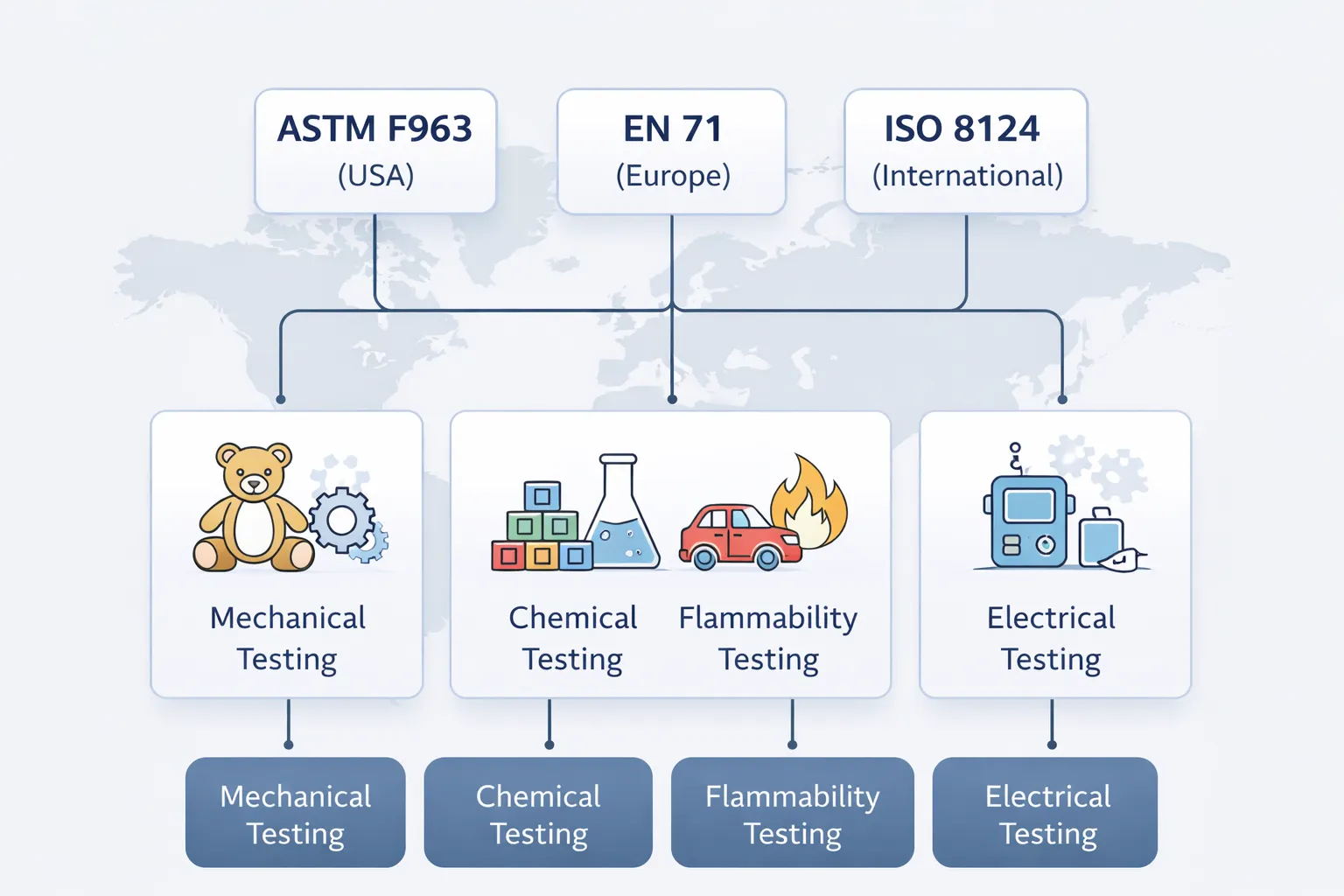
A toy is the only consumer product designed to be bitten, thrown, and slept with by the world’s most vulnerable users. Consequently, toy safety testing is the most highly regulated sector in consumer goods. A single design flaw-like a magnet that can be swallowed or a paint with 100ppm lead-can trigger a global recall, legal action, and the permanent destruction of a brand’s reputation.
For manufacturers and importers, the challenge is navigating a fragmented global landscape. A toy that is legal in New York (ASTM F963) might be illegal in Paris (EN 71) or Beijing (GB 6675). This guide provides a definitive technical and operational framework for ensuring your toys are safe, compliant, and ready for global shelves.
What Is Toy Safety Testing?
Toy safety testing is the rigorous evaluation of a toy’s mechanical, chemical, and flammability properties against mandatory government standards. It verifies that the product will not injure a child during normal play or foreseeable abuse (e.g., dropping it on concrete).
Scope and Context
It applies to any product designed for use in play by children under 14 years of age.
- Mechanical: Choking hazards, sharp edges.
- Chemical: Lead, phthalates, heavy metals.
- Flammability: Burn rate of fabrics and plastics.
- Electrical: Battery safety, overheating.
Why Toy Safety Standards Exist
1. Child Injury Risks
Children interact with products in unpredictable ways. They chew on wheels, pull on buttons, and put batteries in their mouths. Standards exist to engineer out hazards that a child cannot recognize.
2. The “Silent” Hazards
You can see a sharp edge, but you cannot see lead in paint or phthalates in plastic. Testing is the only way to detect these invisible chemical toxins that cause long-term developmental damage.
3. Regulatory Enforcement
Agencies like the CPSC (USA) and ECHA (EU) actively police the market. In 2024 alone, lead-contaminated toys accounted for 37% of recalls, proving that chemical non-compliance remains a massive risk.
Global Toy Safety Standards Overview
| Region | Standard | Regulatory Body | Key Characteristic |
|---|---|---|---|
| USA | ASTM F963 | CPSC (Consumer Product Safety Commission) | Mandatory federal law (CPSIA). strict lead/phthalate limits. |
| Europe | EN 71 | CEN (European Committee for Standardization) | Focuses on migration of elements (19 metals) and chemical safety. |
| International | ISO 8124 | ISO (International Org. for Standardization) | Used by Australia, New Zealand, and ASEAN nations. Aligns closely with EN/ASTM. |
| China | GB 6675 | SAMR (State Admin for Market Regulation) | Mandatory for domestic sale. Requires CCC (China Compulsory Certification). |
ASTM F963 Toy Safety Standard (USA)
Once voluntary, ASTM F963 became mandatory federal law under the CPSIA (Consumer Product Safety Improvement Act) of 2008.
Key Requirements
- Heavy Metals: Limits for 8 soluble metals (Lead, Antimony, Arsenic, Barium, Cadmium, Chromium, Mercury, Selenium).
- Lead Limit: Total lead content in substrate < 100 ppm; in paint < 90 ppm.
- Phthalates: Ban on 8 specific phthalates (DEHP, DBP, BBP, DINP, etc.) > 0.1%.
- Small Parts: Ban on small parts for children < 3 years.
EN 71 Toy Safety Standards (EU)
The EN 71 series is the bedrock of the EU Toy Safety Directive (2009/48/EC).
Core Parts
- EN 71-1: Mechanical & Physical Properties (choking, sharp points).
- EN 71-2: Flammability (fancy dress costumes, soft toys).
- EN 71-3: Migration of Certain Elements (The “Chemical” standard). It limits 19 heavy metals (vs. 8 in ASTM), including Aluminum, Boron, and Strontium.
ASTM vs EN 71 vs ISO Comparison
| Feature | ASTM F963 (USA) | EN 71 (EU) | ISO 8124 (Intl) |
|---|---|---|---|
| Heavy Metals | Tests for 8 elements. | Tests for 19 elements (strictest). | Tests for 8 elements (similar to ASTM). |
| Small Parts | Uses a 2.25-inch long cylinder. | Same cylinder dimensions. | Same cylinder dimensions. |
| Flammability | 0.1 inches/second burn rate limit. | 30 mm/second burn rate limit. | Similar to EN 71. |
| Chemistry | Total Lead + Soluble Metals. | Soluble Metals focus (Migration). | Soluble Metals focus. |
Mechanical & Physical Toy Testing
This ensures the toy doesn’t break into dangerous pieces.
Small Parts Test (Cylinder)
- The Tool: A cylinder with a diameter of 31.7mm (simulating a child’s throat).
- The Rule: If a toy (or a piece that breaks off) fits entirely inside, it is a banned Choking Hazard for children under 3.
Abuse Testing (Use & Abuse)
Simulates rough play.
- Drop Test: Dropping the toy 4 times from ~3 feet (0.93m) onto concrete.
- Torque/Tension Test: Pulling on eyes, buttons, or limbs with ~15 lbs of force.
- Compression: Crushing the toy to see if it shatters.
- Result: If any small parts or sharp edges are created after abuse, the toy fails.
Chemical Toy Safety Testing
Heavy Metals (EN 71-3 / ASTM F963)
- Method: The lab scrapes off paint or grinds up plastic, dissolves it in acid (simulating stomach acid), and analyzes it using ICP-MS.
- Migration vs. Total Content:
- Total Content (US Lead): How much lead is in the plastic? (Limit: 100 ppm).
- Migration (EU): How much lead dissolves out if swallowed? (Limit depends on element).
Phthalates (CPSIA / REACH)
- Target: Soft vinyl plastics (PVC).
- Regulation: REACH Annex XVII (EU) and CPSIA (USA) both limit key phthalates to 0.1%.
- Risk: These are hormone disruptors.
Flammability Testing for Toys
Toys shouldn’t become fireballs.
- Soft Toys (Plush): The lab sets the bear on fire. The flame must spread slowly (< 30mm/s) to allow a child to drop it.
- Costumes (Dress-up): Strictly regulated. Flash-burning capes or wigs are major recall risks.
Electrical Toy Safety Testing
IEC 62115 / ASTM F963
- Battery Safety: Batteries must not be accessible without a tool (screwdriver) for children < 3.
- Overheating: The toy is run until the batteries die. It must not get hot enough to burn skin.
- Button Batteries: Recent laws (Reese’s Law in USA) require strict locking compartments for button cells to prevent ingestion.
Age Grading & Toy Safety Requirements
Safety depends on the child’s age.
- Under 3 Years: Zero tolerance for small parts. No marbles, no small balls, no breakable parts.
- 3 to 6 Years: Small parts are allowed, but must carry a Warning Label (“Choking Hazard”).
- Age Determination Guidelines: Labs use ISO/TR 8124-8 or CPSC guidelines to determine the “appropriate” age. You cannot just slap “3+” on a rattle to avoid testing; if it looks like a baby toy, it is a baby toy legally.
Toy Certification & Compliance Process
The Workflow (USA Example)
- Design: Engineer out small parts for <3 toys.
- Sourcing: Collect Chemical Data Sheets from material suppliers.
- Production: Make a pilot run.
- Testing: Send samples to a CPSC-Accredited Lab (e.g., Intertek, SGS, BV).
- CPC: Issue a Children’s Product Certificate (CPC). This is a legal document where you (the importer) certify compliance based on the test results.
- Tracking Label: Permanently mark the toy with a Date Code and Batch Number for traceability.
Common Toy Safety Failures
- Small Parts (Choking): A glued eye pops off during the tension test. Fix: Use safety eyes with locking washers.
- Lead in Paint: A secondary supplier uses cheap, non-compliant paint. Fix: Test every batch of paint before application.
- Magnet Ingestion: High-powered magnets are swallowed and attract across intestines (fatal). Fix: Flux index limits apply.
- Button Batteries: Compartment opens too easily. Fix: Add a screw-lock mechanism.
Frequently Asked Questions
What is the Children’s Product Certificate (CPC)?
It is a mandatory document for US imports. It lists the product, the rules it passes (e.g., ASTM F963), the manufacturer, and the test lab. Amazon will block listings without it.
Can I test toys myself?
No. For legal certification (CPC/CE), tests must be performed by an ISO 17025 accredited laboratory. For the US, the lab must be on the CPSC’s approved list.
Do I need different tests for EU and USA?
Yes. While similar, the limits differ. US focuses on Total Lead; EU focuses on 19 Heavy Metals. You usually order a “Global Toy Bundle” test from the lab to cover both.
What is a “small part”?
Any object that fits entirely inside the test cylinder (31.7mm diameter). If it fits, it chokes.
Are wooden toys exempt?
No. While raw wood is safe, the paint, varnish, and glue must be tested for chemicals. The physical toy must still pass drop/sharp edge tests.