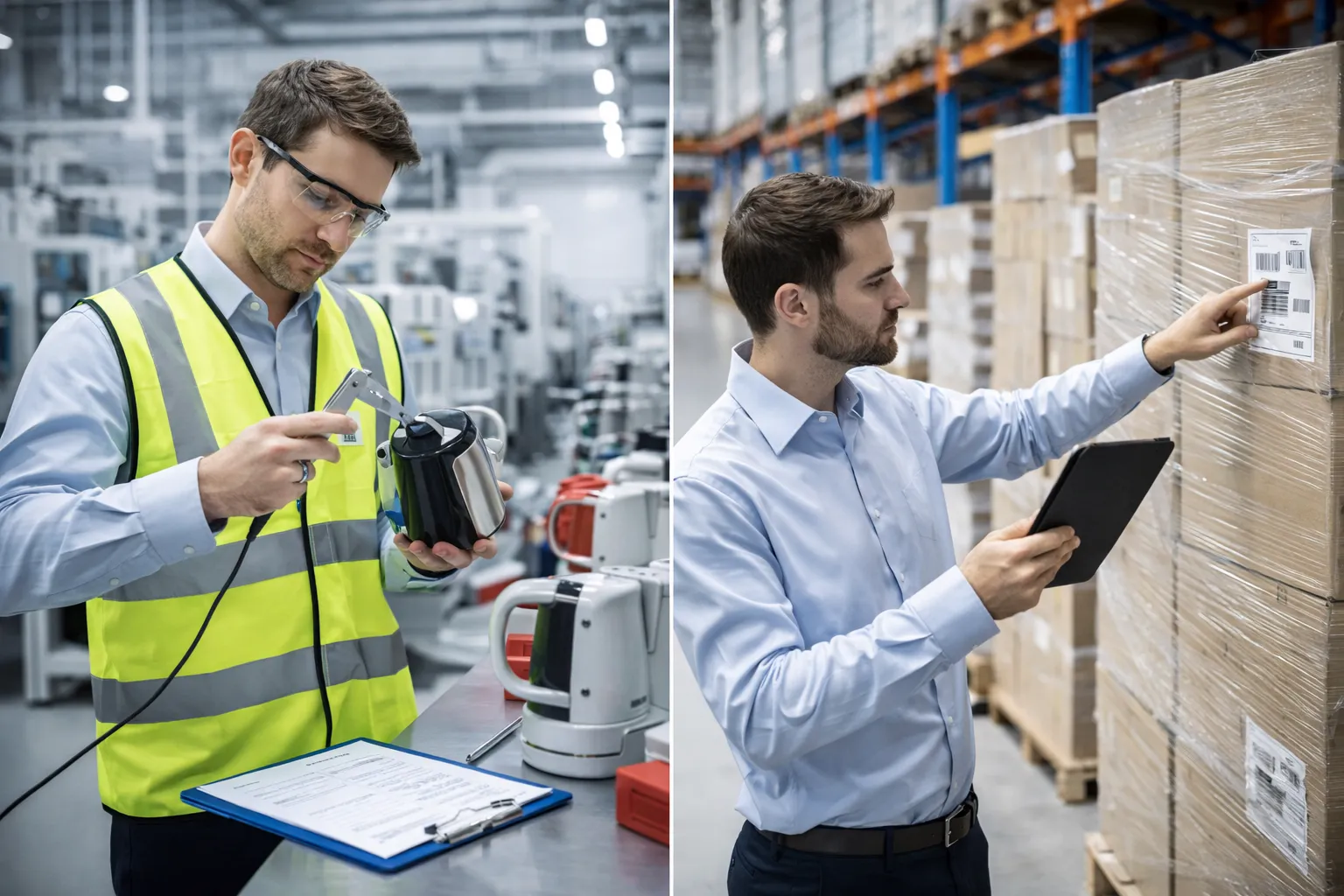
In global supply chains, trust is good, but verification is essential. Whether you are manufacturing electronics in Shenzhen or receiving apparel in a New Jersey warehouse, quality control (QC) is the only firewall between a profitable product and a brand-damaging return.
Most buyers confuse “inspection” with “guarantee.” They hire a third-party service, pay $300, and assume the goods will be perfect. This guide explains what inspection services actually do, the difference between factory and warehouse QC, and how to build an inspection program that filters out defects before they reach your customer.
What These Services Actually Cover
To buy the right service, you must understand the terminology.
Quality Control vs. Quality Assurance vs. Quality Management
- Quality Management (QM): The entire philosophy. The CEO says, “We will be a high-quality brand.” It includes culture, budget, and policy.
- Quality Assurance (QA): The process design. It happens before production. QA defines the SOPs, selects the right materials, and audits the factory’s ability to produce. QA prevents defects.
- Quality Control (QC): The product verification. It happens during or after production. QC inspects the physical goods to see if they match the QA plan. QC finds defects.
What Inspections Can (and Cannot) Do
| Inspections CAN… | Inspections CANNOT… |
|---|---|
| Verify if a specific batch meets your written specs. | Turn a bad factory into a good one. |
| Catch visible defects (scratches, wrong labels). | Check 100% of goods (unless you pay for 100%). |
| Pressure suppliers to fix issues before shipping. | Fix the root cause of the defect (that’s engineering). |
| Provide legal evidence for rejecting a shipment. | Guarantee 0% defect rate (sampling always has risk). |
The 2 Main Use Cases (Factory vs Warehouse)
Where should you inspect?
1. Factory Inspections (Source)
- Where: At the supplier’s facility (e.g., China, Vietnam).
- When: Before the goods leave the factory.
- Best For: avoiding shipping bad goods. If the inspection fails, the supplier must rework it there at their cost.
- Risk: You rely on a visiting inspector who sees a “snapshot” of the production.
2. Warehouse Inspections (Destination)
- Where: At your 3PL or distribution center (e.g., USA, UK).
- When: Upon arrival (Inbound QC) or before shipping to customer (Outbound QC).
- Best For: Verifying transit damage, managing returns, or checking goods from “trusted” suppliers who don’t need factory audits.
- Risk: If you find defects here, you’ve already paid for shipping and duties. Returning goods to the factory is usually impossible.
Types of Product Inspections (Explained)
First Article Inspection (FAI)
- Timing: Right after the first unit comes off the production line.
- Goal: Check if the machine calibration is correct.
- Best For: Custom tooling, plastic injection molding, new products.
Pre-Production Inspection (PPI)
- Timing: Before production starts.
- Goal: Check raw materials (e.g., is the fabric the right thickness? Is the chip the right model?).
- Best For: Preventing the use of cheap substitute materials.
During Production Inspection (DPI / DUPRO)
- Timing: When 20-50% of goods are produced.
- Goal: Catch systemic defects early. If the logo is printed crooked on the first 1,000 units, you stop the line before 10,000 are ruined.
- Best For: Large orders, new suppliers.
Pre-Shipment Inspection (PSI)
- Timing: When 100% produced and 80% packed.
- Goal: The standard “final exam.” Verifies the total order quality before you pay the balance.
- Best For: Almost every import order. This is the industry standard.
Container Loading Supervision (CLS)
- Timing: During loading onto the truck/container.
- Goal: Verify quantity and carton condition. Ensure they don’t swap good goods for bad ones after the inspection.
- Best For: Fragile goods, high-theft items, or untrusted suppliers.
How the Inspection Process Works (Step-by-Step)
- Define Specs: You send the inspector your “Golden Sample” photos and a defect list (e.g., “Scratch < 1mm is minor, > 1mm is major”).
- Sampling: The inspector arrives and pulls random cartons using AQL (Acceptable Quality Limit). They do not check every box.
- Visual Check: They look for cosmetic defects (stains, dents).
- Measurement & Function: They measure size (width, weight) and test function (does it turn on? does the zipper stick?).
- Packaging Check: They drop-test the carton and scan the barcode.
- Reporting: You receive a PDF with photos.
- Decision: You mark the report PASS (ship it) or FAIL (supplier must rework).
AQL Sampling & Defect Classification (Plain English)
Inspectors use ISO 2859-1 (AQL tables) to decide how many units to check.
- Lot Size: Total quantity (e.g., 5,000 widgets).
- Inspection Level II: Standard. For 5,000 units, sample size is 200 units.
Defect Types
- Critical (0 allowed): Dangerous (sharp edge, exposed wire) or illegal (wrong compliance label). Result: Instant Fail.
- Major (2.5% allowed): Product works but is unsellable (big scratch, wrong color).
- Minor (4.0% allowed): Saleable but not perfect (tiny thread loose, messy glue).
Example: In a sample of 200, if you find > 10 Major defects, the whole batch FAILS.
What’s Included in a Good Inspection Report
If your report lacks these, fire the provider.
- Executive Summary: Pass/Fail/Pending.
- Quantity Check: Count of finished vs. packed goods.
- Defect Summary: Table showing exactly how many Major/Minor defects were found.
- Photos: High-res photos of defects next to a ruler.
- On-Site Tests: Barcode scan screenshot, weight scale photo, drop test video.
- Inspector’s Remarks: “Factory manager refused to let me open Box #4.” (Red flag!).
Quality Control Checklists (Templates)
Don’t let the inspector guess. Give them these checklists.
Visual Inspection Checklist
- Color matches Pantone #XYZ?
- No scratches > 0.5mm on visible surfaces?
- Logo printing is centered (+/- 2mm)?
- Cleanliness: no oil, dust, or fingerprints?
Measurement Checklist
- Length / Width / Height (within tolerance)?
- Weight (grams)?
- Cable length?
Functional Checklist
- Unit powers on?
- All buttons click?
- Battery charges?
- Accessory fits into port?
Packaging & Labeling
- Barcode scans correct SKU?
- “Made in [Country]” label present?
- Warning labels (suffocation, battery) present?
- Carton drop test (10 drops from 30 inches)?
Pricing: What Drives Cost
- Man-Days: The standard unit. One inspector for one day = 1 Man-Day ($200 – $400 in China/India).
- Sample Size: Checking 500 units takes longer than 80.
- Travel: Remote factories require travel fees.
- Complexity: A t-shirt inspection is faster than a complex electronic device inspection.
How to Choose a Provider (Scorecard)
| Criteria | Good Provider | Bad Provider |
|---|---|---|
| Integrity | Has a strict anti-bribery policy and rotates inspectors. | Sends the same guy every time (he becomes “friends” with the factory). |
| Technology | Online booking dashboard, same-day PDF reports. | Email-based booking, reports take 48 hours. |
| Expertise | Has specialized inspectors for your category (e.g., Electronics). | Sends a “generalist” who inspects shoes today and tablets tomorrow. |
| Coverage | Has local staff in your region. | Subcontracts to random freelancers. |
Common Failures & How to Prevent Them
- Unclear Specs: “Make it look good” is not a spec. Fix: Use “No scratches visible at arm’s length (50cm).”
- No Golden Sample: Inspector doesn’t know what “correct” looks like. Fix: Mail a signed sample to the factory for the inspector to compare.
- Wrong AQL Level: Checking 200 units for a medical device is too risky. Fix: Use Level III or 100% inspection for high-risk goods.
- Inspection Too Late: Doing a PSI one day before the ship date leaves no time for rework. Fix: Schedule PSI at least 3-5 days before Ex-Factory date.
FAQ
What is the difference between inspection and testing?
Inspection is visual/functional (checking defects). Testing is lab-based (checking chemical composition, heavy metals, compliance). Inspectors usually cannot test for lead paint on-site.
When do I need a pre-shipment inspection?
For every order over $5,000, or anytime you work with a new supplier.
Can inspections replace lab testing?
No. An inspector can see a battery, but a lab confirms it won’t explode.
What is a “Golden Sample”?
A perfect version of the product, signed by you, kept at the factory. The inspector compares production units to this sample.
What happens if the inspection fails?
You refuse to pay the balance. You demand the factory “re-work” (fix) the defects and pay for a re-inspection.
Quick Action Plan (7 Steps)
- Create your Defect List: Write down every possible defect (scratch, dent, wrong color).
- Define AQL: Choose Level II (Standard) for most goods.
- Send Golden Sample: Mail a perfect unit to your factory.
- Book Inspection: Schedule a PSI for your next order (at least 5 days before shipping).
- Review Report: Don’t just look at “Pass/Fail.” Look at the photos.
- Approve/Reject: Officially tell the factory if they can ship.
- Track Data: Note the defect rate. If it increases, switch to DUPRO (During Production) inspections.
Need a template? Request our “QC Defect Classification Sheet” to start defining your standards.