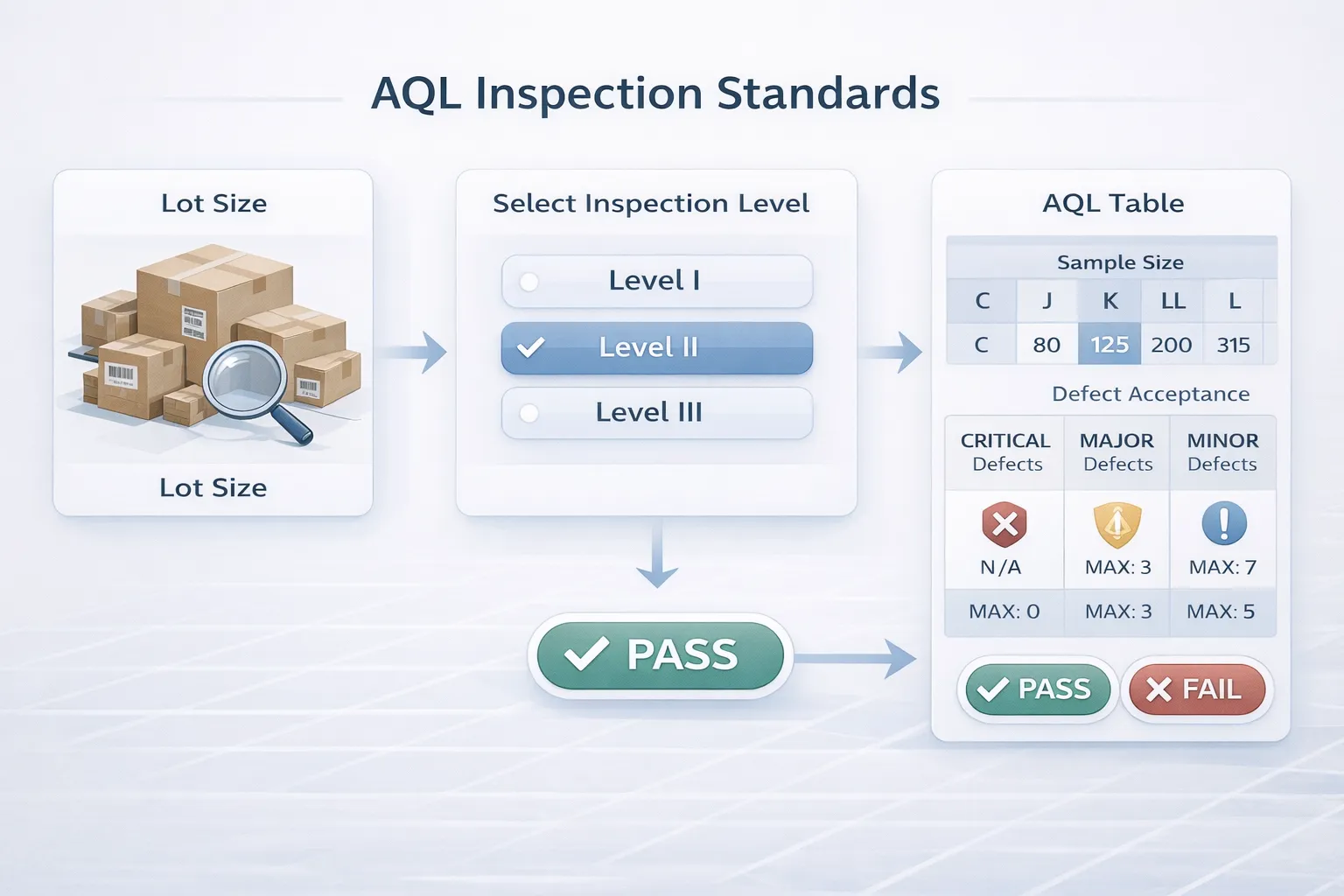
In manufacturing and supply chain management, checking every single unit of a 10,000-piece order is rarely feasible. It’s too expensive, too slow, and often destructive. Instead, the world runs on statistical sampling.
Acceptable Quality Limit (AQL) is the industry-standard statistical tool that answers the two most critical questions in quality control:
- How many samples should I inspect?
- How many defects are “too many”?
Most importers treat AQL tables like a confusing hieroglyphic chart. This guide demystifies the process, turning the ISO 2859-1 standard (also known as ANSI/ASQ Z1.4) into a practical operational tool.
Key Takeaways
- AQL is a Negotiation: It is the “worst quality level” you are willing to tolerate. It is not a target; it is a limit.
- AQL ≠ 100% Perfection: Using AQL means you accept that some defects will statistically exist in the shipment.
- Sample Size Matters: Inspecting 10% of the order is an amateur myth. The sample size is calculated based on risk, not a flat percentage.
- Inspection Levels Control Risk: Level II is standard. Level III checks more units (safer but costlier). Level I checks fewer (riskier but cheaper).
- The “Rejection Number” is Law: If the table says “Reject on 4 defects,” and you find 4, the entire batch fails.
- Defect Categories: Defects are not equal. You might accept 10 minor defects (loose threads) but 0 critical defects (needles).
- Code Letters: The “Code Letter” is the bridge between your lot size and your sample size.
- Tightened Inspection: If a supplier fails frequently, you must switch to “Tightened Inspection” to force improvement.
What AQL Is (and What It Is Not)
AQL (Acceptable Quality Limit) is the maximum percentage of defects that, for purposes of sampling inspection, can be considered satisfactory as a process average.
In plain English: It is the “line in the sand” that separates a pass from a fail.
Clarifying Common Misconceptions
- AQL ≠ “Allowed Defect % in Shipment”: AQL is a statistical tool for acceptance, not a permission slip for the factory to produce garbage.
- AQL ≠ SPC (Statistical Process Control): SPC monitors the process while it runs (machine temperature, speed). AQL checks the product after it is made.
- AQL ≠ 100% Inspection: AQL is based on probability. There is always a statistical risk (Producer’s Risk and Consumer’s Risk) that a bad batch passes or a good batch fails.
Core Terms You Must Know
Before opening the tables, you must speak the language.
- Lot Size (N): The total number of units in the specific order or batch being inspected (e.g., 5,000 widgets).
- Defect Categories:
- Critical: Dangerous or illegal (e.g., sharp edge, wrong warning label).
- Major: Product doesn’t work or looks unsellable (e.g., won’t turn on, large scratch).
- Minor: Saleable but imperfect (e.g., small smudge, loose thread).
- Inspection Level: Defines the relationship between lot size and sample size (Code Letter).
- AQL Value: The threshold percentage (e.g., 2.5, 4.0).
- Acceptance Number (Ac): The maximum number of defects allowed.
- Rejection Number (Re): The number of defects that triggers a failure.
- Normal / Tightened / Reduced:
- Normal: Standard starting point.
- Tightened: Used after a failure. Requires larger samples or stricter limits.
- Reduced: Used for trusted suppliers with a long history of passes.
Inspection Levels: How They Change Sample Size
The inspection level determines how many samples you pull. It balances cost (time) vs. confidence (accuracy).
General Inspection Levels (The Standard)
- Level I: “The Budget Check.” Used for trusted suppliers or low-risk goods. Checks ~40% fewer units than Level II.
- Level II: “The Industry Standard.” Default for 95% of consumer goods inspections. Use this if you are unsure.
- Level III: “The High Confidence Check.” Used for new suppliers or high-risk goods. Checks ~60% more units than Level II.
Special Inspection Levels (S-1, S-2, S-3, S-4)
Used for destructive testing or time-consuming checks (e.g., seam strength test, hi-pot test). You only check a handful of units (e.g., 5–13 pcs).
When to Use Which Level
| Scenario | Recommended Level | Why? |
|---|---|---|
| Standard Consumer Goods | Level II | Balance of risk vs. cost. |
| New / High-Risk Supplier | Level III | You need maximum visibility. |
| Proven / Trusted Supplier | Level I | Save money; they rarely fail. |
| Destructive Test (e.g., drop test) | S-3 | You can’t destroy 200 units. |
AQL Tables Explained (Step-by-Step Algorithm)
Follow this algorithm to derive your pass/fail criteria.
The 5-Step Algorithm
- Determine Lot Size: How many units are in the batch? (e.g., 3,200).
- Choose Inspection Level: Default is Level II.
- Find Code Letter: Look at Table 1. Find the row for 3,200 and the column for Level II. Get the Code Letter (e.g., “K”).
- Read Sample Size: Look at Table 2. Find Row “K”. It tells you the sample size (e.g., 125 units).
- Find Acceptance/Rejection Numbers: Scroll across Row “K” to your chosen AQL (e.g., 2.5). Read the numbers (e.g., Ac=7, Re=8).
Visual Walkthrough
- Input: 3,200 pcs, Level II, AQL 2.5.
- Table 1: 3,200 -> Letter K.
- Table 2: Letter K -> 125 Samples.
- Table 2 Column 2.5: Ac 7 / Re 8.
- Rule: If you find 7 defects, PASS. If you find 8 defects, FAIL.
How to Choose AQL Values (Critical / Major / Minor)
You must set different acceptable quality levels for different defect types. You cannot treat a safety hazard the same as a smudge.
The “Default” Standard (Consumer Goods)
For 90% of importers (Amazon, Retail, Promotional), these are the standard settings:
- Critical: AQL 0 (Not Allowed).
- Major: AQL 2.5.
- Minor: AQL 4.0.
When to Tighten?
- Luxury Goods: Tighten Major to 1.5 or 1.0.
- Medical / Auto: Requires strict limits (often 0.65 or 0.40).
- Low-Cost Giveaways: Loosen Major to 4.0.
AQL Sampling and Sampling Method
AQL sampling relies on randomness.
The Golden Rule of Sampling Method
The inspector must pull cartons from the top, middle, and bottom of the pallet stack.
- Bad Sampling: Picking the first 10 boxes on top (Factory puts good units there).
- Good Sampling: Picking square root of total cartons + 1, spread across the lot.
When Sampling Is Inappropriate
Do not use AQL for:
- Safety Critical Parts: Airbags or pacemaker batteries require 100% inspection.
- Small Batches: If the lot is 50 units, just inspect all 50.
Worked Examples
Example 1: Apparel Shipment (Standard)
- Product: T-Shirts
- Lot Size: 4,000 pcs
- Inspection Level: II (Standard)
- Code Letter: L (from Table 1)
- Sample Size: 200 pcs (from Table 2)
- AQL Values: 0 Critical / 2.5 Major / 4.0 Minor
- Limits (Table 2):
- Critical: Ac 0 / Re 1
- Major: Ac 10 / Re 11
- Minor: Ac 14 / Re 15
- Result: Inspector found 0 Critical, 8 Major, 12 Minor.
- Outcome: PASS. (8 < 11 and 12 < 15).
Example 2: Electronics (High Risk)
- Product: Bluetooth Headphones
- Lot Size: 1,000 pcs
- Inspection Level: III (High Confidence)
- Code Letter: K (Level III shifts it up from J to K)
- Sample Size: 125 pcs
- AQL Values: 0 Critical / 1.5 Major / 4.0 Minor
- Limits:
- Major (1.5): Ac 5 / Re 6
- Minor (4.0): Ac 10 / Re 11
- Result: Inspector found 6 Major defects (Audio jack loose).
- Outcome: FAIL. (6 = Rejection Number).
Example 3: Destructive Testing (Drop Test)
- Product: Ceramic Mugs
- Lot Size: 10,000 pcs
- Inspection Level: S-3 (Special Destructive)
- Code Letter: D
- Sample Size: 8 pcs
- AQL Value: 6.5 (Typical for destructive)
- Limits: Ac 1 / Re 2
- Result: 1 mug broke at standard height.
- Outcome: PASS. (1 is acceptable).
How to Write AQL Requirements in Your QC Spec / Purchase Order
Don’t let the factory guess. Put it in the contract.
Template 1: Short Clause
“Pre-shipment inspection shall be conducted per ISO 2859-1, Inspection Level II. AQL Limits: Critical 0, Major 2.5, Minor 4.0.”
Template 2: Detailed Clause
Quality Control & Acceptance:
- Standard: ANSI/ASQ Z1.4 (ISO 2859-1 equivalent)
- Sampling Plan: Single Sampling, Normal Severity
- Inspection Level: General Level II
- Defect Classifications:
- Critical (AQL 0): Safety hazards, sharp edges, regulatory failure.
- Major (AQL 2.5): Functional failure, visual defect > 5mm.
- Minor (AQL 4.0): Untrimmed thread, visual defect < 5mm.
- Rejection Rule: Shipment will be rejected if defects equal or exceed the Rejection Number in any category.
Common Mistakes (and How to Avoid Them)
- Ignoring the Rejection Number: “It was only 1 unit over the limit, let’s pass it.” Correction: AQL is statistical. Being “1 over” suggests the whole batch is significantly worse.
- Mixing Major/Minor: Adding Major and Minor defects together to get a total score. Correction: They are evaluated separately. You pass/fail each category independently.
- Using Level I to Save Money: Using Level I on a new supplier guarantees you will miss defects. Correction: Stick to Level II unless you have 2 years of data.
- No Critical Definition: Failing to define what “Critical” is. Correction: Always list “Safety Issue” as Critical.
- Wrong Code Letter: Reading the table wrong (e.g., using the Code Letter for 500 units when you have 5,000).
FAQ
What does 2.5 AQL mean in inspection?
It means the Acceptable Quality Limit for Major defects is 2.5%. In a sample of 200 units, you would accept up to 10 defects. If you find 11, the batch fails.
What are the standards for AQL inspection?
The global standard is ISO 2859-1. In the US, it is known as ANSI/ASQ Z1.4. They are effectively identical.
What is AQL for dummies?
It’s a chart that tells you: “If you have X products, check Y samples. If you find Z defects, reject the whole pile.”
How do I choose inspection level?
Use Level II for 90% of situations. Use Level III if you are paranoid (high value/risk). Use Level I if you trust the supplier completely.
Is AQL the same as acceptable defect rate?
Technically, no. AQL is a process average parameter. However, in practice, it functions as the maximum defect rate you are willing to tolerate in the sample.
Can I inspect 10% of the lot?
You can, but it is statistically inefficient. AQL sample sizes (e.g., 200 units for a lot of 10,000) are proven to be statistically significant without needing to check 1,000 units (10%).
What happens if the lot fails AQL?
The factory must rework (fix) the goods. You then perform a Re-Inspection (usually paid for by the factory) to verify the fix.
What is the difference between Ac and Re?
Ac (Acceptance Number) is the maximum defects allowed to pass. Re (Rejection Number) is the minimum defects that trigger a fail. Re is always Ac + 1.
Why are there S-1, S-2, S-3 levels?
These are Special Inspection Levels for tests that take a long time or destroy the product. They use very small sample sizes.
Does AQL guarantee zero defects?
No. AQL is a statistical tool. Passing AQL means the probability of the batch being bad is low, but not zero.
What is “Tightened Inspection”?
If a supplier fails 2 out of 5 consecutive inspections, you switch to “Tightened.” This moves you to the left on the AQL table (stricter acceptance numbers) to force improvement.
Can I set my own AQL limits?
Yes. If you sell budget items, you might use AQL 4.0 for Major defects. If you sell luxury watches, you might use AQL 0.65.