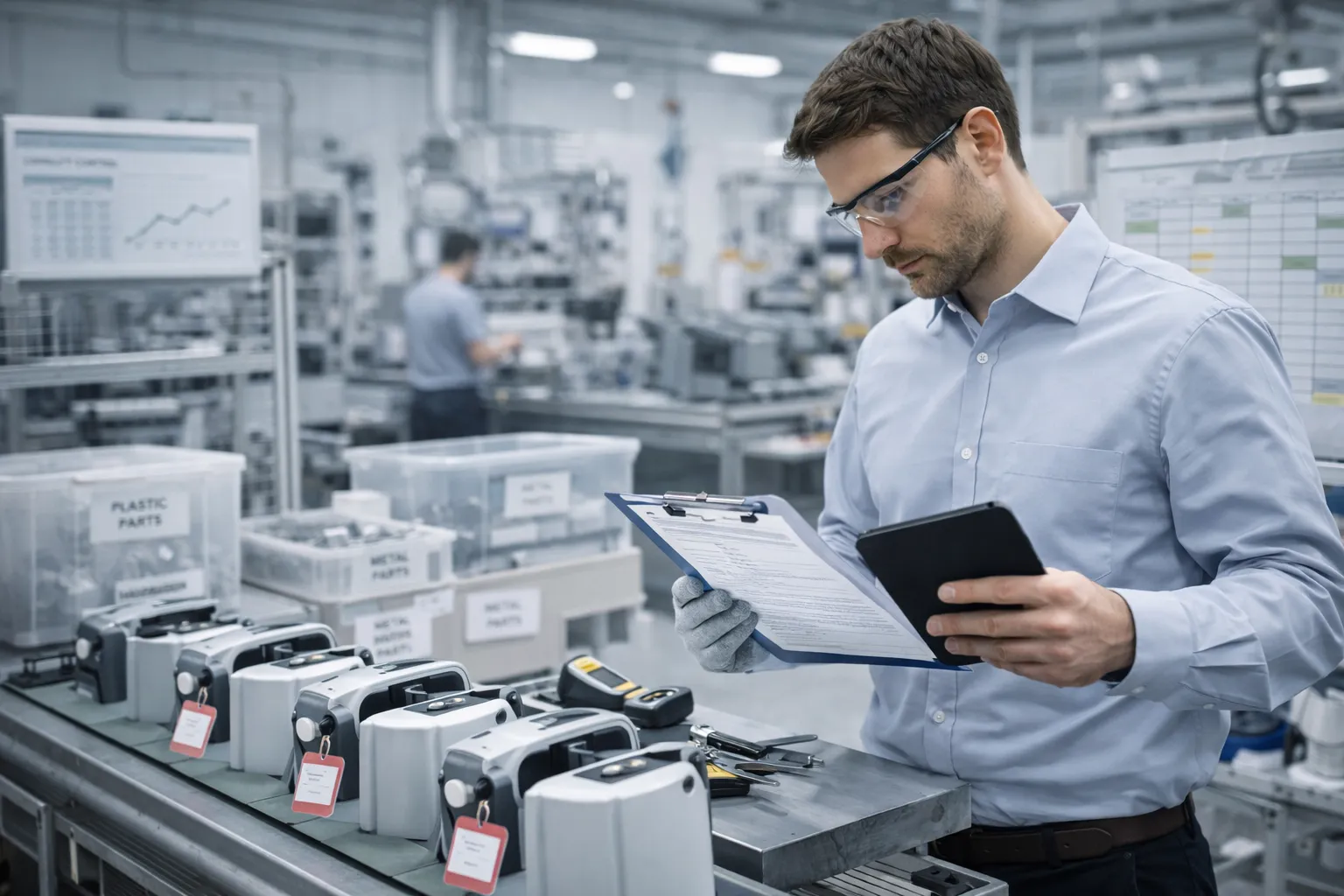
In global supply chain management, a purchase order is a promise, but a factory audit is the verification of the capability to keep that promise. While a product inspection tells you if a specific batch is good, a factory audit tells you if the supplier is a legitimate business capable of producing quality products consistently, ethically, and safely over the long term.
For buyers, sourcing managers, and quality engineers, the audit is the primary tool for risk mitigation. Whether you are vetting a new supplier in Vietnam or verifying a corrective action in Mexico, the audit process provides the objective evidence needed to make “Go/No-Go” decisions.
This guide details the end-to-end factory audit workflow, from defining the scope to closing the Corrective and Preventive Action (CAPA) plan.
Key Takeaways
Here are the key takeaways for implementing a successful supplier audit program:
- System vs. Product: Audits check the manufacturing system and process; inspections check the product.
- Risk-Based Approach: Do not audit every supplier with the same depth. Allocate resources based on spend volume and product risk.
- Evidence is King: An auditor’s opinion does not matter; only objective evidence (records, logs, photos, interviews) counts.
- Traceability is Non-Negotiable: If a factory cannot trace a finished product back to the raw material batch, they fail the audit.
- The “Golden Path”: Follow the production flow from Receiving to Shipping during the walkthrough.
- Triangulation: Verify facts by comparing three sources: Document (policy), Record (log), and Observation (reality).
- CAPA is Mandatory: An audit without a corrective action plan is just a snapshot in time. Improvement requires follow-up.
- Social Compliance: Ethical sourcing is now a baseline requirement; ignore labor practices at your own brand risk.
- Preparation: A surprise audit is rarely as effective as a prepared one for deep system analysis; send the document request list early.
- Scoring: Use a weighted scoring system to remove subjectivity from the final “Approved/Rejected” decision.
What Is a Factory Audit (and What It Is Not)
A factory audit is a systematic, independent, and documented process for obtaining objective evidence to determine the extent to which a supplier’s management systems meet specific criteria.
It answers the fundamental question: “Does this factory have the machinery, manpower, processes, and systems to make my product to my standards, legally and safely?”
Audit vs. Inspection vs. Testing
Buyers often confuse these three quality control pillars.
| Feature | Factory Audit | Product Inspection | Lab Testing |
|---|---|---|---|
| Focus | The System (Process & Management). | The Goods (Finished Product). | The Chemistry/Physics. |
| Timing | Before partnership (qualification) or annual. | Before shipment (PSI) or during production (DPI). | Early sample stage or random batch check. |
| Scope | Entire facility, records, HR, maintenance. | Random sample of one specific PO/Lot. | Specific material sample. |
| Outcome | Supplier Approval / Scorecard. | Shipment Release (Pass/Fail). | Compliance Certificate (Reach/CPSIA). |
| Example | Checking if the machine maintenance log is updated. | Checking if the t-shirt has a hole in it. | checking if the paint contains lead. |
Factory Audit in 60 Seconds
| Component | Description |
|---|---|
| Duration | Typically 1–2 days per site (depending on size). |
| Auditor | Certified Lead Auditor (ISO 9001/SA8000) or internal SQE. |
| Core Goal | Verify capability, capacity, and compliance. |
| Primary Output | Audit Report with Score (0–100%) and CAPA Plan. |
| Key Risk | “Desktop Auditing” (looking at papers but ignoring the factory floor). |
Types of Factory Audits (Choose by Risk & Objective)
You do not use a hammer to drive a screw. Similarly, you must choose the audit type that matches your business risk.
1. Quality System Audits (Technical / QMS)
- Focus: Can they make the product consistently? Based on ISO 9001 standards.
- Checks: Quality control (IQC, IPQC, OQC), machine maintenance, calibration, non-conforming material handling, and management review.
- Best For: New supplier qualification or when quality issues spike.
2. Social Compliance Audits
- Focus: Human rights and labor laws. Based on SA8000, SMETA (Sedex), or BSCI.
- Checks: Child labor, forced labor, working hours, wages, disciplinary practices, and dormitories.
- Best For: Protecting brand reputation and meeting ESG goals. Social compliance audits are mandatory for major retailers (Walmart, Target, Costco).
3. Environmental Audits
- Focus: Ecological impact. Based on ISO 14001.
- Checks: Wastewater treatment, hazardous waste disposal, air emissions, chemical storage.
- Best For: Textile dyeing mills, chemical plants, and heavy manufacturing.
4. Security Audits (C-TPAT / GSV)
- Focus: Supply chain security and anti-terrorism.
- Checks: Physical access controls, container sealing procedures, background checks, IT security.
- Best For: Suppliers shipping to the USA (Customs-Trade Partnership Against Terrorism).
5. Process / Manufacturing Audits
- Focus: Technical capability of a specific production line.
- Checks: Cycle times, line balance, equipment capability (Cpk), bottleneck analysis.
- Best For: Lean manufacturing projects and capacity verification.
Decision Matrix: Which Audit Do You Need?
| Business Goal | Recommended Audit Type | When to Schedule |
|---|---|---|
| Vetting a new vendor | Quality System (QMS) + Basic Social | Before placing the first PO. |
| Retailer Requirement | Social Compliance (SMETA/BSCI) | Annually or per retailer schedule. |
| Defect Rate Spikes | Process Audit | Immediately after Containment. |
| Sustainability Claim | Environmental Audit | Before marketing “Green” claims. |
| US Customs Fast Lane | C-TPAT Security Audit | Before first export to USA. |
Factory Audit Requirements (What You Need Before On-Site)
An unprepared auditor wastes time. Before booking travel, the lead auditor must issue a Pre-Audit Information Packet to the factory.
1. Scope Definition
Define exactly what is being audited.
- Site: Is it the main factory or the annex building down the street?
- Product: Are we auditing the electronics assembly line or the plastic injection molding line?
- Standard: Are we auditing against ISO 9001:2015 or your specific Brand Manual?
2. Documentation Request List
Request these 5–7 days in advance to review before arrival:
- Quality Manual and Org Chart.
- Business License and Export License.
- List of main machinery and maintenance status.
- Production Flow Chart (Process Map).
- Employee Handbook (for social audits).
3. Red Flags (Stop Before You Go)
If the factory refuses to provide the location, claims “trade secrets” for basic process maps, or cannot provide a business license, cancel the audit. These are signs of unauthorized subcontracting or a shell company.
The Audit Process (Step-by-Step)
A professional audit process follows a strict timeline to ensure impartiality and depth.
Step 1: Audit Planning (Risk-Based Approach)
The auditor reviews the pre-audit documents. Using an audit based approach, they identify high-risk areas. Example: If the factory makes medical devices, the sterilization process is high-risk and gets more time than the packaging line.
Step 2: Opening Meeting
- Attendees: Factory owner, QA Manager, Production Manager.
- Goal: Confirm the scope, timeline, and confidentiality. Ensure factory management understands that honesty is preferred over perfection.
Step 3: The Floor Walkthrough (The Core)
This is not a museum tour. The auditor walks the Golden Path of production:
- Warehouse: Incoming material tagging.
- Production: Operator discipline, machine settings.
- QC Labs: Testing equipment.
- Packing: Final checks.
- Tip: The auditor should stop randomly to talk to operators (without supervisors hovering) to verify training.
Step 4: Traceability Drill
The auditor picks a finished box from the warehouse and asks the factory to produce the records for the raw materials used in that specific box within 4 hours.
- Pass: Factory produces the “Traveler Card” -> Production Log -> Raw Material Batch # -> Supplier Invoice.
- Fail: “We lost the paper” or “We mix batches so we don’t know.”
Step 5: Document Review
Comparing the floor reality to the paperwork.
- Observation: Machine A temp was 200°C.
- Record: Does the daily log show 200°C?
- Procedure: Does the SOP say it should be 200°C?
Step 6: Closing Meeting
The auditor presents the draft findings. The factory management must sign the report acknowledgment. This is the time to clarify misunderstandings, not to negotiate the score.
Factory Audit Checklist (Master Checklist + Short Version)
A factory audit checklist guides the auditor so nothing is missed.
Master Checklist Sections
1. Zero Tolerance (Critical)
- No Child Labor / Forced Labor.
- No Immediate Life Safety Hazards (locked fire exits).
- Transparency (no bribery attempts, no fake records).
2. Quality Management System (QMS)
- Is there a dedicated QA Manager independent of Production?
- Is there a Document Control system for updating SOPs?
- Are Internal Audits conducted annually?
3. Incoming Quality Control (IQC)
- Are raw materials inspected upon arrival?
- Are “Approved Samples” available for comparison?
- Is non-conforming material segregated (Red Tag/Red Box)?
4. Production Process Control
- Are Work Instructions (WI) visible at every station?
- Are WIs in the local language of the workers?
- Do operators follow the steps exactly as written?
- Is First Article Inspection (FAI) performed at the start of every shift?
5. Equipment & Calibration
- Is there a Preventive Maintenance schedule?
- Are measurement tools (calipers, scales) calibrated?
- Is the calibration sticker valid and visible?
6. Final QC & Storage
- Is 100% inline check or sampling performed?
- Are finished goods stored off the floor and away from windows (sun damage)?
- Is the warehouse “First-In-First-Out” (FIFO) managed?
7. HR & Social Compliance
- Do time records match production records? (e.g., If production log shows output on Sunday, is there a timesheet for Sunday?)
- Are fire extinguishers charged and unblocked?
- Are bathrooms sanitary?
Printable Short Version (Quick Audit)
- Business License valid?
- QA Team exists?
- Raw Materials labeled?
- Work Instructions posted?
- Rework area defined?
- Tools calibrated?
- Final inspection records exists?
- Fire exits unlocked?
- Factory clean/organized (5S)?
- Traceability test passed?
Scoring, Audit Findings, and Decision Rules
An audit report without a score is just an opinion. Use a quantitative model.
Grading Findings
- Critical (0 points): Safety hazard, child labor, total system breakdown. Result: Automatic Fail.
- Major (5 points deducted): Systematic failure (e.g., no calibration program at all).
- Minor (2 points deducted): Isolated failure (e.g., one caliper missing a sticker, but the rest are fine).
Audit Score Calculation
Score=Total Possible PointsTotal Points Earned×100
Supplier Status Decision
| Score Range | Status | Action Required |
|---|---|---|
| 85% – 100% | Approved | Green light. Minor CAPA only. |
| 70% – 84% | Conditional | Yellow light. Approved for production, but CAPA must be verified within 30 days. |
| < 70% | Not Approved | Red light. Cannot place PO. Major system overhaul required. |
Audit findings must be written clearly: “Observed operator at Station 4 not using torque wrench as required by SOP-004, Rev B.”
CAPA & Follow-Up: What Happens After the Audit
The report is not the end; it is the beginning of improvement. The factory must submit a CAPA (Corrective and Preventive Action) plan within 7–14 days.
The CAPA Structure
- Containment: What did you do immediately? (e.g., “Retrained operator”).
- Root Cause Analysis: Why did it happen? (e.g., “Torque wrench was broken, and no spare was available”). Use the “5 Whys” method.
- Corrective Action: How to fix the root cause? (e.g., “Purchase backup tools and add daily tool check to supervisor log”).
- Verification: How do we know it worked? (e.g., “Next audit shows 100% compliance”).
Verification Types
- Desktop Verification: Factory sends photos/documents of the fix. (For minor issues).
- On-Site Follow-Up: Auditor returns to verify. (For major/critical issues).
Common Mistakes (and How to Avoid Them)
1. The “Clean Up” Show
Factories will clean up the day before you arrive.
- Avoidance: Look at the tops of cabinets or behind machines. Dust there proves the cleanliness is superficial. Check records from 3 months ago, not yesterday.
2. Desktop Auditing
Spending 8 hours in the conference room reading manuals.
- Avoidance: Spend 60% of the time on the factory floor. Procedures mean nothing if nobody follows them.
3. Ignoring Subcontractors
You approve Factory A, but they secretly outsource to the cheap Shed B next door.
- Avoidance: Check machine capacity. If they sell 1 million units but only have machines for 100k, they are outsourcing.
4. No Ownership of CAPA
The factory signs the report and ignores it.
- Avoidance: Link future orders to CAPA closure. “No new PO until Major findings are closed.”
FAQ
What is the factory audit process?
It is a structured evaluation involving planning, an opening meeting, a site walkthrough, document review, staff interviews, and a closing meeting to verify compliance with a standard.
What are the 5–7 steps in the audit process?
- Planning/Pre-audit prep.
- Opening Meeting.
- Factory Tour (Walkthrough).
- Document Review & Traceability.
- Employee Interviews.
- Scoring/Reporting.
- Closing Meeting & CAPA.
How long does a factory audit take?
Typically 1 to 2 man-days for a standard factory (up to 500 workers). Larger complexes may require a team of auditors for 3+ days.
Factory audit vs product inspection?
An audit checks the manufacturing system (QA process, maintenance, capacity) to ensure long-term capability. An inspection checks a specific shipment of goods to ensure they meet the quality specs.
What if you fail an audit?
If a factory fails, they are usually given a “Probationary” or “Rejected” status. They must implement a Corrective Action Plan (CAPA) and undergo a re-audit (usually at their expense) before they can receive orders.
How often should factory audits be repeated?
Annually is the standard for active suppliers. However, if quality issues arise, a “for cause” audit should be scheduled immediately.
Who pays for the factory audit?
Typically, the buyer pays for the initial audit. If the factory fails and requires a re-audit, it is common practice to charge the cost back to the factory.
What is a social compliance audit?
It is a specific type of audit (like SMETA or SA8000) that focuses entirely on labor conditions, wages, safety, and human rights rather than product quality.
Can I do a factory audit myself?
Yes, if you have the expertise. However, third-party auditors (like SGS, Intertek, QIMA) provide independence and local language skills that are often necessary for an objective result.
What is the “Golden Path” in an audit?
It refers to following the natural flow of production: from Receiving (raw materials) -> Warehousing -> Production Lines -> Packaging -> Finished Goods Warehousing -> Shipping.
What is a “process audit”?
A focused audit that looks at one specific production process (e.g., the painting line or welding station) to optimize efficiency and reduce defects, rather than auditing the whole company.
Why is traceability important in an audit?
It proves the factory is in control. If a safety defect is found later, traceability allows you to recall only the specific bad batch rather than all products ever made.