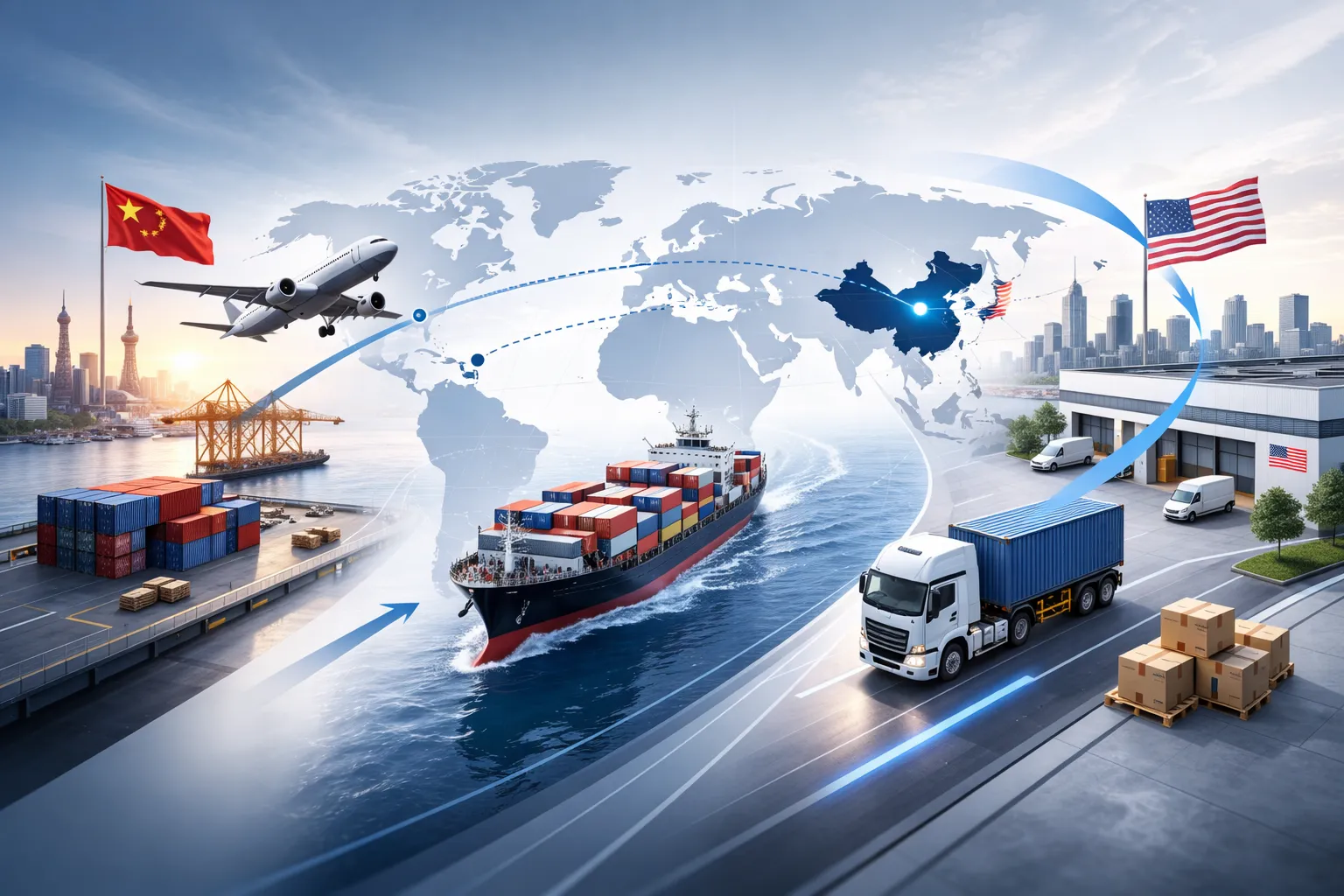
TL;DR: Quick Decision Guide
- Choose Sea Freight (FCL) if you have over 15 CBM of goods and can wait 30–40 days. It is the most economical per unit.
- Choose Air Freight for high-value cargo between 150 kg and 500 kg that needs to arrive in 5–10 days.
- Choose Express (DHL/FedEx) for samples or shipments under 150 kg. It is the fastest (3–5 days) but most expensive.
- Choose DDP Shipping if you want a “hands-off” experience where the forwarder handles duties and delivery to your door (Amazon FBA or warehouse).
Key 2026 Rules of Thumb:
- Volatility is the norm: Ocean freight rates fluctuate monthly. Always book 2 weeks in advance.
- Transit times are estimates: Add 7–10 days buffer for port congestion and customs delays.
- Weight breaks matter: Air freight gets significantly cheaper per kg once you hit 100kg+ and 500kg+ tiers.
Main Shipping Methods From China to USA
Ocean Freight / Sea Freight
The backbone of global trade, accounting for over 90% of shipments.
- FCL (Full Container Load): You rent the entire container (20 ft or 40 ft). It’s faster and safer than LCL because your goods aren’t mixed with others. Best for volume > 15 CBM.
- LCL (Less than Container Load): You pay only for the volume (CBM) you use. Your goods are consolidated with other shipments. Best for 1–15 CBM. Note: LCL often has higher “per unit” port fees at destination.
Air Freight / Air Cargo
Airport-to-airport service. Ideal for electronics, fashion, or urgent restocking.
- Standard Air Freight: Shipments move on passenger or cargo planes.
- Charter: Renting an entire cargo plane (rare, for massive urgent projects).
Express Shipping
Door-to-door courier service (DHL, FedEx, UPS).
- Pros: Customs is often cleared by the courier automatically (for low value).
- Cons: Extremely expensive for heavy/bulky items.
DDP Shipping (Delivered Duty Paid)
A popular “all-in” service for e-commerce and Amazon FBA sellers. The freight forwarder quotes one price that includes pickup, shipping, duties, taxes, and final delivery. You don’t need your own customs bond.
Transit Time: What “Delivery Time” Really Includes
“Transit time” often refers only to the port-to-port leg. Real door-to-door delivery includes:
- Factory Pickup & Export Customs: 3–7 days
- Main Leg (Sea/Air): Variable (see below)
- Port Discharge & Customs Clearance: 3–7 days
- Last Mile Delivery: 3–5 days
Estimated Door-to-Door Transit Times (2026)
| Method | Port-to-Port | Real Door-to-Door |
|---|---|---|
| Express (DHL/FedEx) | N/A | 3–5 Days |
| Air Freight | 1–3 Days | 5–10 Days |
| Fast Sea (Matson) | 11–12 Days | 15–22 Days (West Coast) |
| Standard Sea (West Coast) | 15–25 Days | 25–35 Days |
| Standard Sea (East Coast) | 30–40 Days | 40–55 Days |
Note: Deliveries to inland US destinations (e.g., Chicago, Dallas) via rail add 10–15 days to ocean freight transit times.
Shipping Cost Breakdown
Understanding the full structure helps you avoid “hidden fees” from your forwarder.
| Cost Component | Who Charges | Depends On | How to Optimize |
|---|---|---|---|
| Factory Pickup | Trucking Co. | Distance to port | Use EXW only if you have a cheap local trucker; otherwise FOB. |
| Origin Charges | Port/Terminal | Volume/Container | Standardized; hard to negotiate. |
| Base Freight Rate | Carrier (Airline/Line) | Weight (Air) or Volume (Sea) | Book FCL during “slack season” (Mar-June). |
| Fuel & Peak Surcharges | Carrier | Monthly Oil Prices | Inevitable; check validity date of quote. |
| Destination Charges | US Port/Warehouse | DTHC (Handling Charges) | Avoid LCL for large shipments (fees are high). |
| Customs & Duties | US Gov | HS Code & Product Value | Check Section 301 tariffs carefully. |
| Last Mile Delivery | Trucker/UPS | Distance & Weight | Ship to a warehouse near the arrival port. |
Warning: In LCL shipping, destination fees can sometimes exceed the cost of the ocean freight itself.
Cost Comparison: Air vs Sea vs Express vs DDP
| Feature | Express | Air Freight | Sea Freight (LCL) | Sea Freight (FCL) |
|---|---|---|---|---|
| Cost | $$$$ (Highest) | $$$ (High) | $$ (Medium) | $ (Lowest) |
| Speed | Fastest | Fast | Slow | Medium |
| Ideal Weight | < 150 kg | 150 – 500 kg | 1 – 15 CBM | > 15 CBM |
| Complexity | Low (Paperless) | Medium | High | Medium |
| Best For | Samples, Documents | Urgent Stock | Small Pallets | Bulk Inventory |
2026 Rate Benchmarks (Estimates):
- Express: $6–$9 per kg
- Air Freight: $4–$8 per kg (drops as weight increases)
- Sea Freight (LCL): $40–$80 per CBM (plus hefty destination fees)
- Sea Freight (FCL): $1,800–$4,000 per container (highly volatile)
How to Choose the Right Shipping Option
Follow this decision logic to find the cheapest shipping method that meets your deadline:
- Is it under 150 kg?
- Yes: Use Express Shipping (DHL/FedEx). It’s simpler and often cheaper than air cargo after minimum fees.
- No: Go to step 2.
- Is it urgent (needs to arrive in < 10 days)?
- Yes: Use Air Freight.
- No: Go to step 3.
- Is volume between 1 and 15 CBM?
- Yes: Use LCL Ocean Freight or DDP Sea Shipping.
- No (Volume > 15 CBM): Use FCL Ocean Freight. Even if you don’t fill the container, FCL is often cheaper and safer than large LCL shipments.
- Do you have a US Customs Bond?
- No: Use DDP Shipping so the forwarder acts as the importer of record.
Freight Forwarder: What They Do & How to Pick One
A freight forwarder is your travel agent for cargo. They don’t own the ships, but they coordinate the entire chain.
Questions to Ask Before Booking
- Does this rate include all destination surcharges?
- Is this a direct sail or strictly a transshipment (slower)?
- Do you have your own house trucker in the US for delivery?
- Can you handle customs clearance if I don’t have a bond?
- What is the validity date of this quote? (Rates expire every 2 weeks).
- Are there any “General Rate Increases” (GRI) expected?
Data You Must Provide for an Accurate Quote
- Commodity: What is the product? (Battery/Liquid requires SDS).
- Dimensions & Weight: Total CBM and KG.
- Incoterms: FOB (you pay freight) or EXW (you pay pickup + freight).
- Origin & Destination: Pickup address (or port) and delivery zip code.
Customs Clearance Basics
Delays in freight transit time often happen here, not on the ship.
- Commercial Invoice: Must clearly list the HS Code, value, and description.
- Packing List: Must match the physical count exactly.
- ISF (Importer Security Filing): Must be filed 24 hours before the ship leaves China. Late filing = $5,000 fine.
- Bond: You need a “Single Entry Bond” or “Continuous Bond” to clear sea freight in the US.
Common Mistake: Undervaluing goods to save taxes. US Customs (CBP) can flag this, leading to inspections that cost thousands in detention fees.
Practical Tips to Reduce Cost and Delays
- Consolidate Samples: Ask suppliers to send samples to one forwarder, who combines them into one box.
- Optimize Packaging: Ocean freight is sold by volume. Reduce empty space in your packaging to save CBM.
- Ship FOB, Not CIF: Under CIF, the supplier controls the shipping, often using cheap agents who charge you massive hidden fees at the US port.
- Book Early: In peak season (Aug-Oct), book space 14–21 days in advance.
- Use “Fast Boats” for Cash Flow: Services like Matson (China to Long Beach) cost more but arrive in ~12 days, letting you sell faster than standard 30-day transit.
FAQ
What is the cheapest way to ship from China to the USA?
For small items (<100kg), standard mail or slow air carriers are cheapest. For bulk (>2 CBM), Standard FCL Ocean Freight is the cheapest per unit cost.
What is the average shipping time from China to the US?
Door-to-door: Air freight takes 5–10 days. Standard sea freight takes 25–40 days depending on the coast (West vs. East).
Is DHL or FedEx faster from China?
They are comparable. Typically DHL has slightly stronger coverage in Asia, but FedEx IP (International Priority) is extremely fast to the US (often 2–3 days).
How much does it cost to ship a 20 ft container from China to the USA?
In early 2026, rates typically range from $1,800 to $2,800 for West Coast delivery, but this changes weekly based on supply and demand.
When should I use LCL vs FCL?
Switch to FCL once you have enough cargo to fill roughly half a 20ft container (approx 15 CBM). Below that, LCL is usually more cost-effective.
What does DDP include?
DDP (Delivered Duty Paid) includes export, shipping, import duties, taxes, and final delivery. The price you see is the final price you pay.
What are the main shipping ports in China?
Shanghai, Ningbo, Shenzhen (Yantian), Qingdao, and Xiamen.
Get a Quote for Your Shipment
Stop guessing. Rates change weekly.
Get a precise calculation based on your cargo details: